Medical Marketing Agency
The Future of Healthcare Discovery

AI Search Optimization for Healthcare

Healthcare search is undergoing a structural transformation. Traditional search engines once presented patients with a list of links. Today, artificial intelligence systems increasingly generate direct answers to medical and healthcare questions before users ever click a website.

Platforms such as Google AI Overviews, ChatGPT, Perplexity, and Bing Copilot now synthesize information from multiple sources to deliver conversational answers. These answers often cite only a handful of authoritative sources.

For healthcare organizations, this shift changes how patient discovery works.

The question is no longer simply “How do we rank on Google?”

It is now:

How do we become the trusted source AI systems choose when generating answers?


That discipline is called AI Search Optimization (AISO) sometimes also referred to as Answer Engine Optimization (AEO) or Generative Engine Optimization (GEO).


At Best Edge Medical Marketing, we help healthcare organizations structure their digital presence so that AI systems recognize, extract, and cite their expertise when generating healthcare answers.
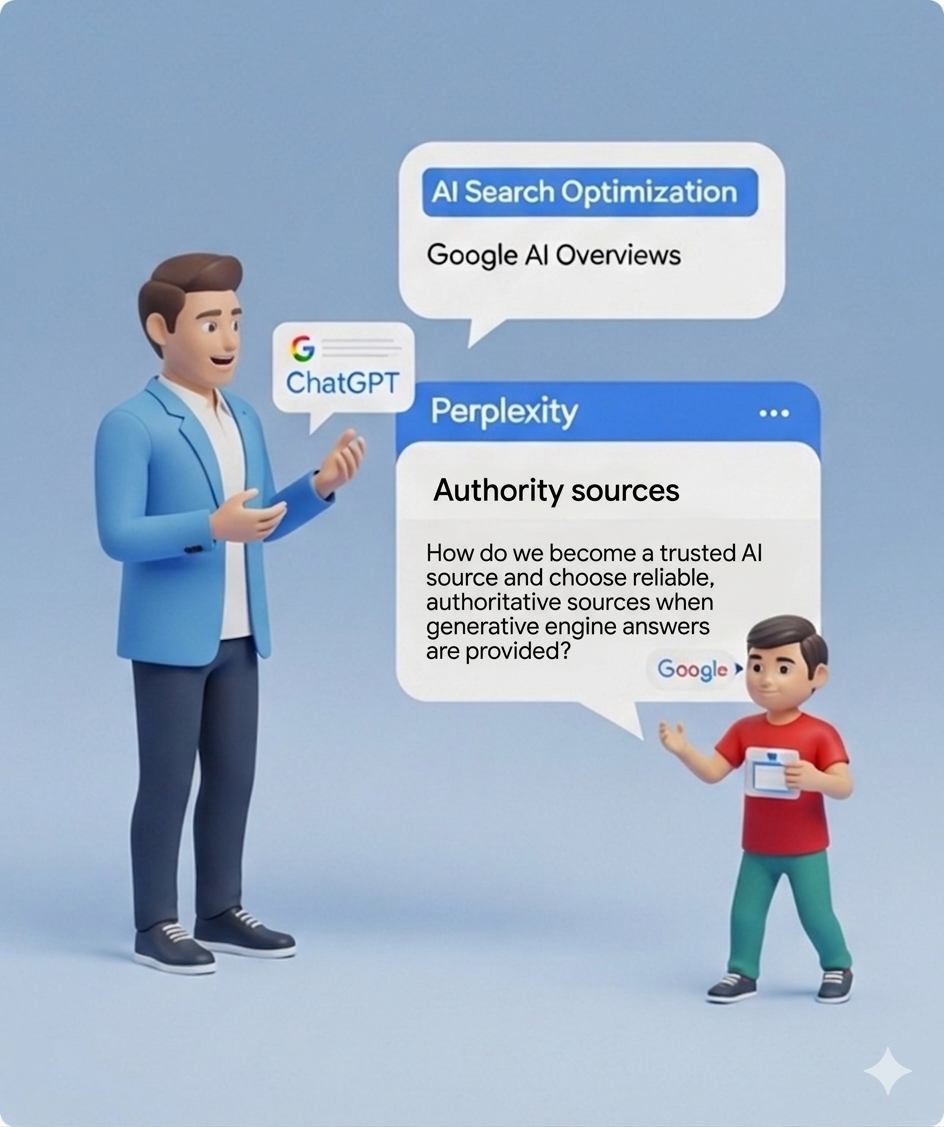

ai-search-optimization-healthcare-marketing-scaled
At Best Edge Medical Marketing, we help healthcare organizations structure their digital presence so that AI systems recognize, extract, and cite their expertise when generating healthcare answers.

What Is AI Search Optimization for Healthcare?

AI Search Optimization for Healthcare is the process of structuring medical websites and digital content so artificial intelligence search systems can identify, interpret, and cite them as authoritative sources in AI-generated answers.
AI systems evaluate healthcare information differently than traditional algorithms. They prioritize sources that demonstrate high medical credibility, structured explanations, and consistent topical expertise.
Healthcare websites that are optimized correctly can become primary reference sources for AI-generated responses.
Statistics, quotes, and research claims should be verified before publication.

Unlike traditional SEO, which focuses on ranking individual pages, AI search optimization focuses on:

A circular emblem icon representing entity authority and digital presence in AI search.
Entity authority
A line-art document icon representing clear, readable medical content.
Content clarity
A stacked database cylinder icon representing structured data and knowledge graphs.
Structured knowledge
A secure shield icon representing expert medical credibility, trust, and safety.
Expert credibility
A laptop icon displaying a medical pulse line on the screen, representing healthcare data formatted for AI engines.
Answer-ready formatting

Healthcare organizations that appear in those AI answers gain three powerful advantages:

A shield icon with a checkmark, representing increased trust, safety, and brand authority.

Increased Authority

Being cited by AI systems positions your practice as a trusted expert source.
An upward trending graph icon, representing early patient discovery and growth.

Earlier Patient Discovery

AI answers often appear before traditional search results, allowing practices to influence decisions earlier in the patient journey.
A verified badge icon with a checkmark, representing high patient conversion rates and readiness.

Higher Conversion Potential

Patients who discover practices through educational answers often arrive already informed and ready to book consultations.
Why AI Search Matters

Why AI Search Matters for Healthcare Marketing

Patient behavior is evolving rapidly.
Patients increasingly ask AI-powered systems questions such as:
Search

“What is the best treatment for melasma?”

Search

“How much does Invisalign cost?”

Search

“When should you see a dermatologist for acne?”

Search

“What are signs of skin cancer?”

AI systems analyze trusted sources and produce summarized answers that guide patients toward care decisions.
Healthcare marketing strategies that ignore AI search risk losing visibility as search behavior evolves.

How AI Search Engines Work

To understand optimization, it is important to understand how AI answer engine’s function.
Modern AI search platforms use a combination of technologies:
A stylized neural network icon representing large language models and AI analysis.

Large Language Models (LLMs)

AI systems like GPT-based models analyze massive datasets to understand language patterns, medical terminology, and relationships between concepts.
An AI microchip icon representing artificial intelligence processing

Retrieval-Augmented Generation (RAG)

Instead of relying only on training data, AI systems retrieve live web content from trusted sources before generating answers.
A data graph icon with connected nodes representing entity mapping.

Entity Graph Analysis

AI systems map relationships between entities such as:
  • Medical conditions
  • Treatments
  • Procedures
  • Healthcare specialties
  • Physicians
  • Locations
A shield icon with a central star representing authority, trust, and credibility.

Authority Scoring

Sources are evaluated based on credibility signals including:
  • Expertise
  • Citations
  • Domain authority
  • Healthcare specialties
  • Physicians
  • Locations
Healthcare websites that align with these signals are more likely to be used in AI-generated answers.

AI Search Optimization vs Traditional Healthcare SEO

While AI search builds on traditional SEO principles, it introduces new optimization priorities.
Factor Traditional SEO AI Search Optimization
Goal Rank pages Become answer sources
Focus Keywords Entities & expertise
Content Long-form pages Extractable answers
Authority Backlinks Trust + topical depth
Structure HTML ranking signals Structured knowledge
Discovery Click-through results AI-generated citations
Practices that adapt their content strategies can gain competitive advantages in both traditional and AI-driven search environments.

How Healthcare Websites Appear in AI Search Results

AI systems typically extract answers from websites that meet several criteria:
  1. Clear topic authority
  2. Structured medical explanations
  3. High trust signals
  4. Entity-based topical coverage
  5. Answer-ready formatting
Content that clearly explains medical questions, treatments, risks, and patient considerations becomes highly extractable by AI.
Healthcare organizations that publish comprehensive topic clusters often become preferred sources.
A doctor in a white lab coat typing on a laptop displaying a medical history form, with a blood pressure cuff and medical supplies on the desk.

The AI Search Authority Framework for Healthcare

At Best Edge Medical Marketing, we implement a multi-layer framework designed to align healthcare websites with AI search systems.

01

Medical Entity Authority

AI systems evaluate expertise around specific medical entities such as:

  • Acne treatment
  • Melasma therapy
  • Invisalign
  • Mohs surgery
  • Botox injections


Practices must demonstrate deep topical expertise across these entities.

This is achieved through:
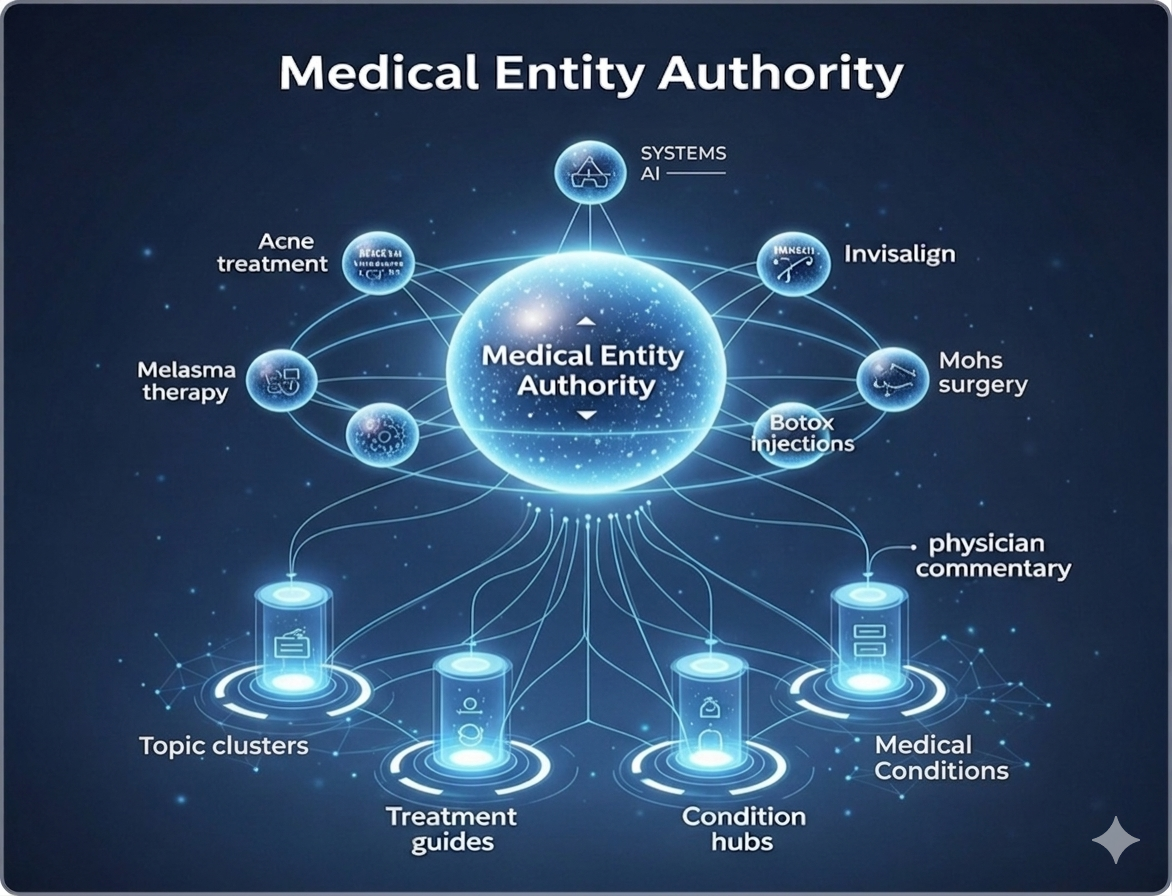
  • Topic clusters
  • Treatment guides
  • Condition hubs
  • Physician commentary
A digital data map illustrating 'Medical Entity Authority', showing a central glowing sphere connected to nodes like 'Acne treatment', 'Invisalign', and 'Botox injections', supported by pillars labeled 'topic clusters' and 'treatment guides'.
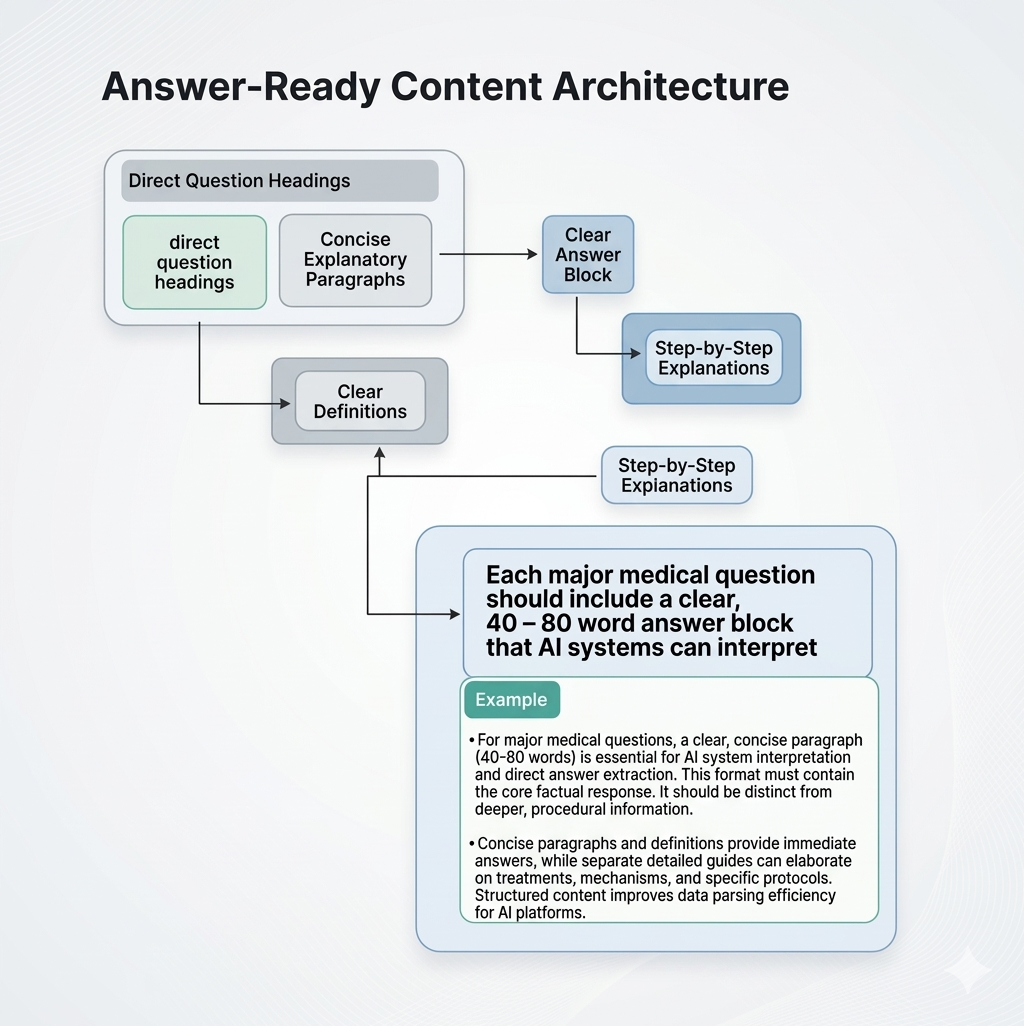
A flowchart diagram titled 'Answer-Ready Content Architecture' illustrating how direct question headings connect to clear definitions, concise paragraphs, and a specific 40-80 word answer block for AI extraction.

02

Answer-Ready Content Architecture

AI systems extract answers most easily when content is structured with:

  • Direct question headings
  • Concise explanatory paragraphs
  • Clear definitions
  • Step-by-step explanations


Each major medical question should include a clear, 40–80 word answer block that AI systems can interpret.

Example AI-Extractable Answer Block

What is AI search optimization for healthcare?

AI search optimization for healthcare is the process of structuring medical website content so artificial intelligence search systems can identify, interpret, and cite the information when generating answers. It involves entity authority, structured explanations, expert credibility signals, and content designed for AI extraction.

03

Expert Credibility Signals

Healthcare information is classified as “Your Money or Your Life (YMYL) “ content by Google.


AI systems prioritize sources that demonstrate:

  • Physician expertise
  • Medical credentials
  • Professional authorship
  • Editorial review
  • Evidence-based explanations


Healthcare websites should prominently display:

  • Doctor biographies
  • Credentials
  • Clinical experience
  • Professional memberships
  • Medical citations


These signals increase trustworthiness for both users and AI systems.
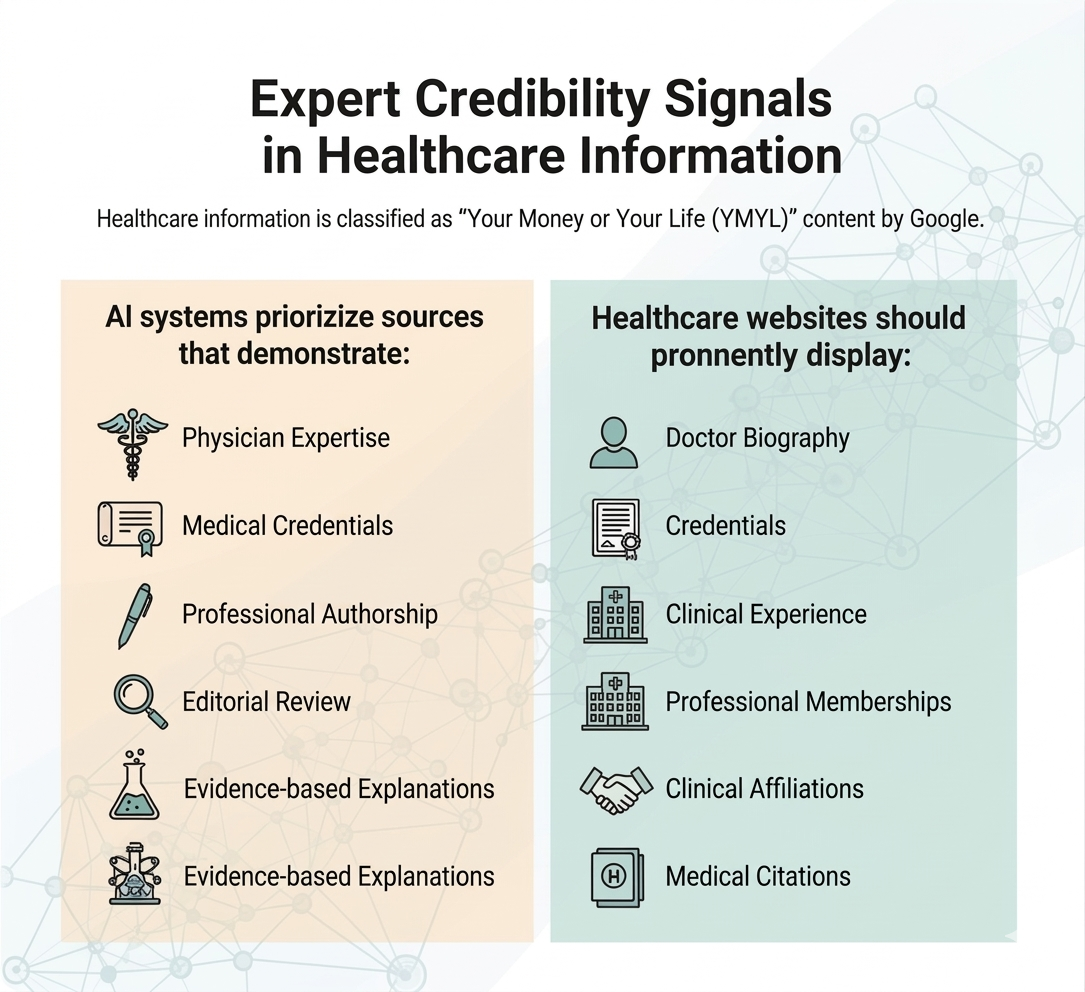
An infographic detailing expert credibility signals for YMYL healthcare content, listing physician expertise, medical credentials, and editorial reviews.
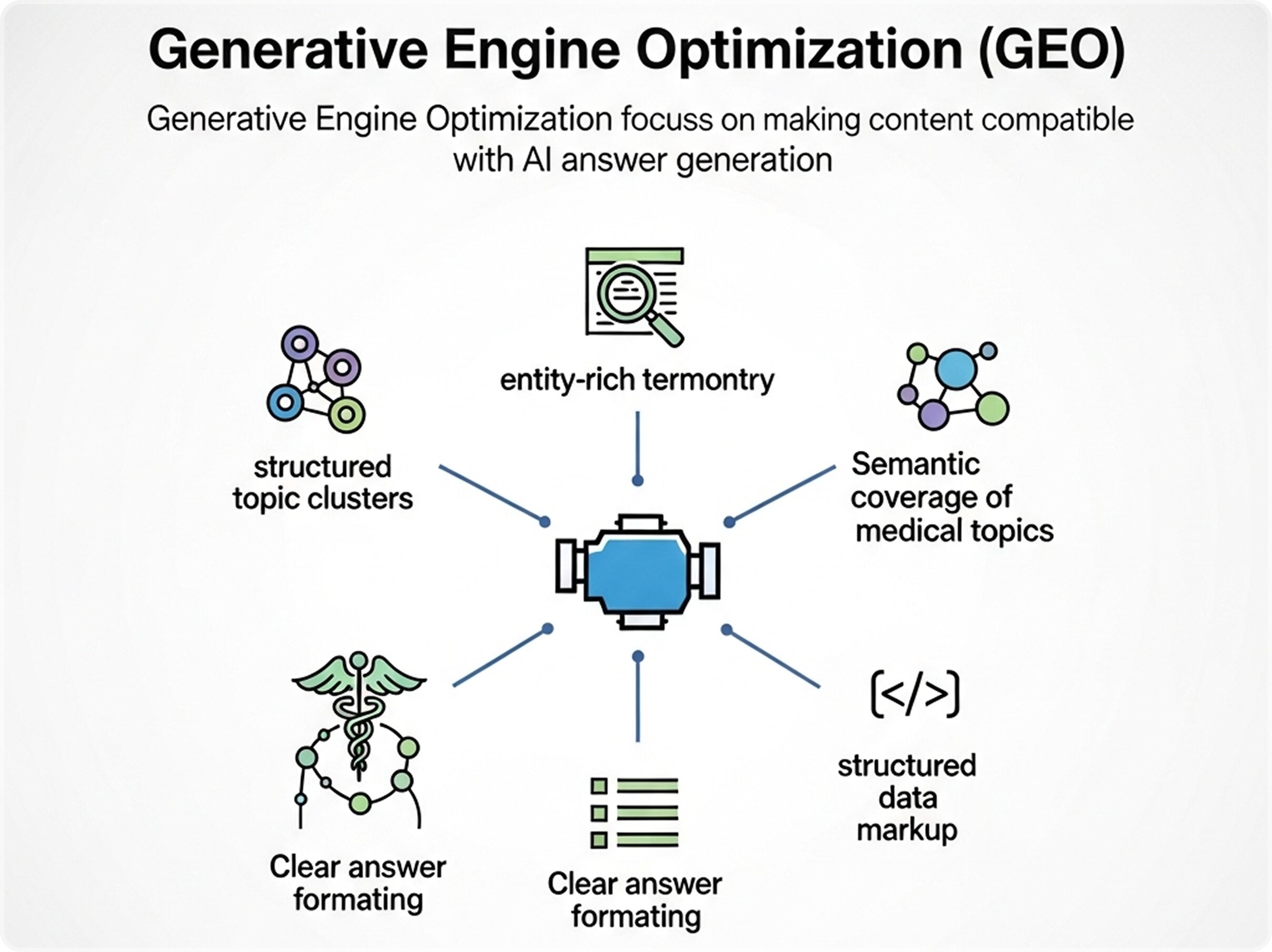
An infographic illustrating Generative Engine Optimization strategies, showing how structured topic clusters, entity-rich terminology, semantic coverage, structured data markup, and clear answer formatting feed into an AI engine.

04

Generative Engine Optimization (GEO)

Generative Engine Optimization focuses on making content compatible with AI answer generation.


Key GEO strategies include:

  • Structured topic clusters
  • Entity-rich terminology
  • Semantic coverage of medical topics
  • Clear answer formatting
  • Structured data markup


This ensures AI systems can easily understand relationships between conditions, treatments, and patient concerns.

05

Healthcare Knowledge Graph Development

AI systems rely heavily on knowledge graphs that map relationships between entities.


Healthcare websites that consistently publish authoritative content about specific treatments help reinforce those entity connections.
For example:


Dermatology practice → Acne treatment → Isotretinoin → Side effects → Patient safety considerations.


This structure strengthens the likelihood that AI systems view the practice as an authoritative source.
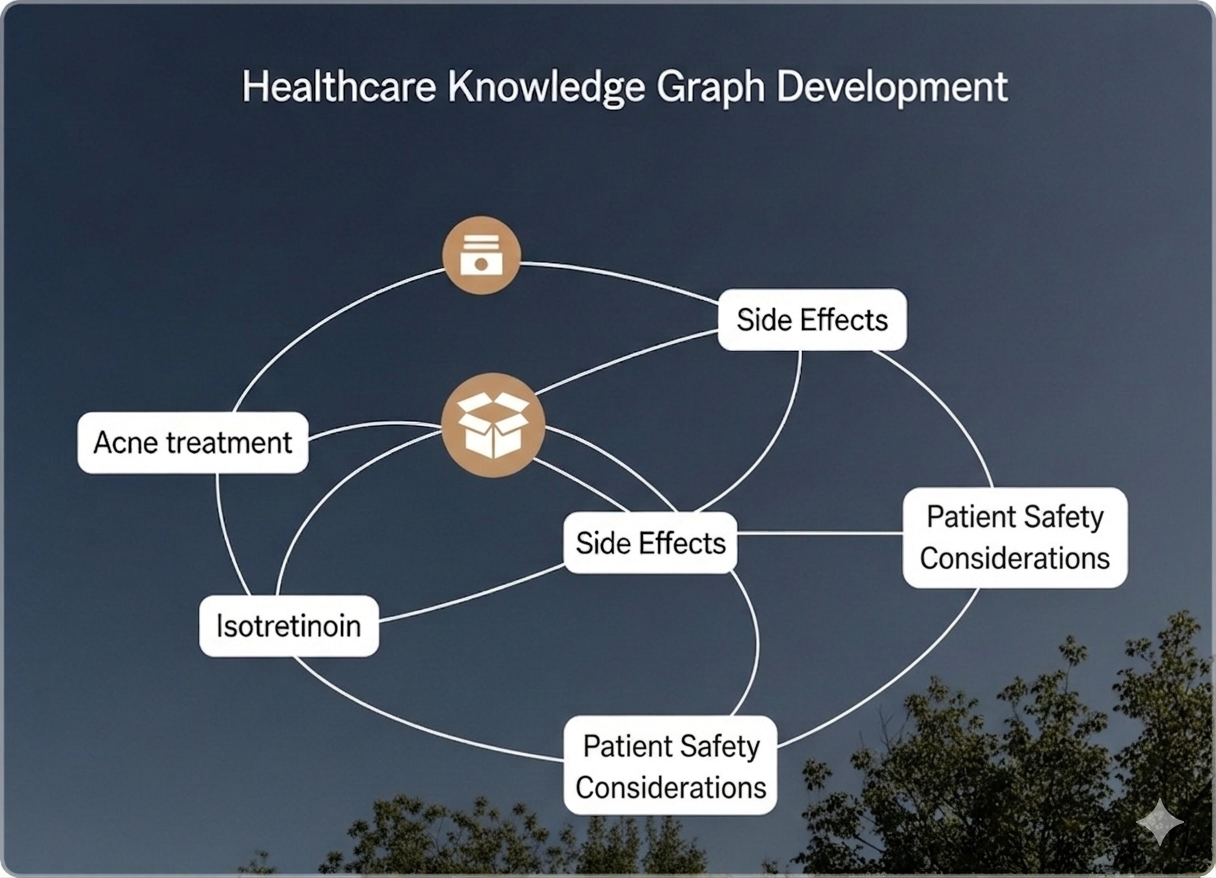
A knowledge graph diagram showing the connected relationships between medical entities, linking acne treatment to isotretinoin, side effects, and patient safety.

Our AI Search Optimization Process

Best Edge Medical Marketing applies a structured implementation process designed specifically for healthcare organizations.

1

AI Visibility Audit

We evaluate how your healthcare organization currently appears across AI search platforms including:

  • Google AI Overviews
  • ChatGPT browsing results
  • Perplexity answers
  • Bing Copilot responses


This identifies opportunities to increase authority and visibility.

2

Entity Authority Mapping

We identify the core medical entities your practice should dominate, such as:

  • dermatology treatments
  • cosmetic procedures
  • dental services
  • aesthetic medicine treatments

Then we develop a topical authority map covering:

  • patient questions
  • treatments
  • risks
  • costs
  • outcomes
  • comparisons

3

Content Architecture Development

We restructure website content into AI-compatible knowledge hubs, including:

  • pillar pages
  • treatment clusters
  • condition guides
  • patient education resources


Each page is optimized for AI extraction and semantic coverage.

4

Structured Data Implementation

Schema markup helps AI systems understand healthcare content more clearly.


Common structured data implementations include:

  • MedicalWebPage schema
  • Physician schema
  • FAQ schema
  • MedicalCondition schema
  • MedicalProcedure schema


This structured information improves machine interpretation.

5

Authority Expansion

We strengthen trust signals through:

  • expert commentary
  • authoritative citations
  • professional credentials
  • clinical insights


These elements reinforce credibility for both search engines and AI systems.
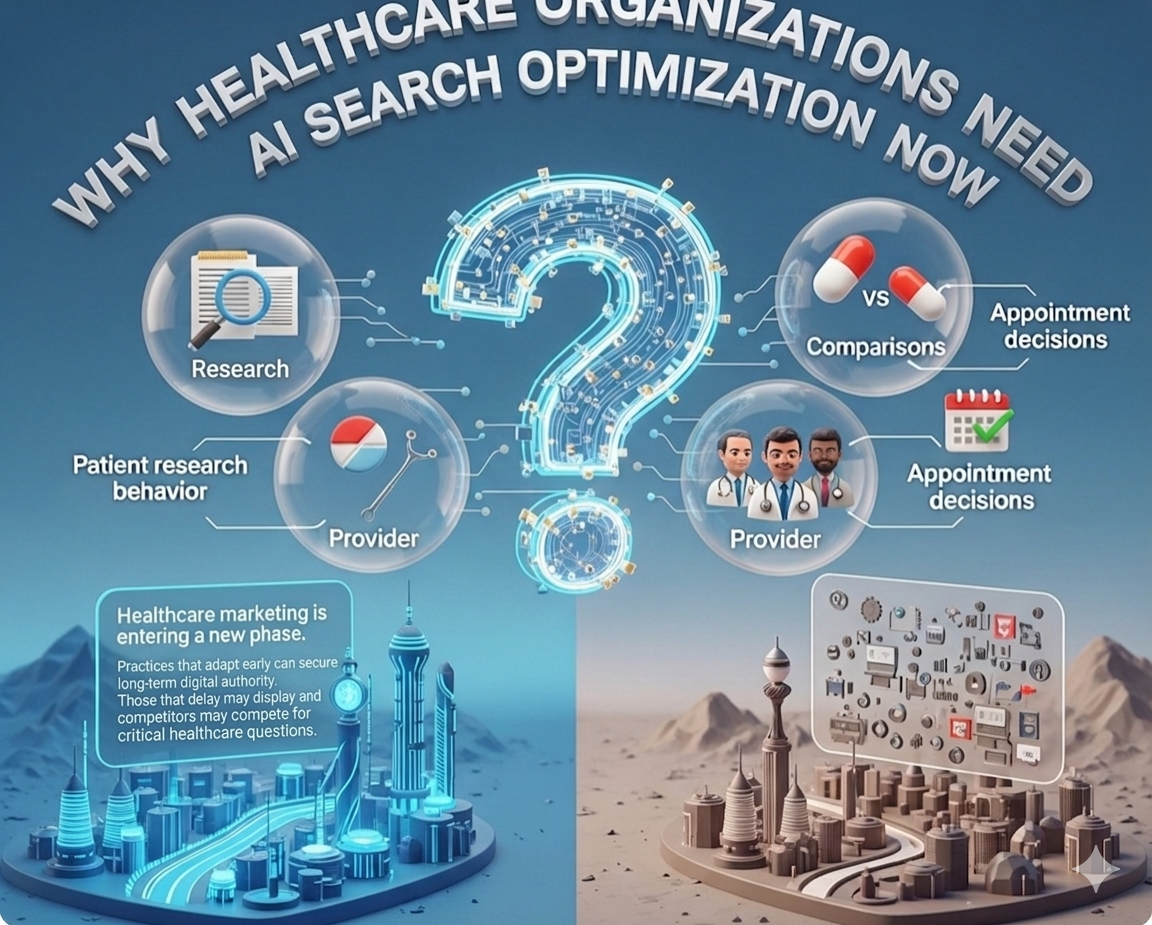
A 3D conceptual illustration showing a glowing question mark connected to data nodes for patient research, provider selection, and appointment decisions, hovering above two contrasting futuristic cityscapes.

Why Healthcare Organizations Need AI Search Optimization Now

Healthcare marketing is entering a new phase.
AI-generated answers increasingly influence:
  • patient research behavior
  • treatment comparisons
  • provider selection
  • appointment decisions
Practices that adapt early can secure long-term digital authority.
Those that delay may find competitors dominating AI answers for critical healthcare questions.

The Future of Patient Discovery

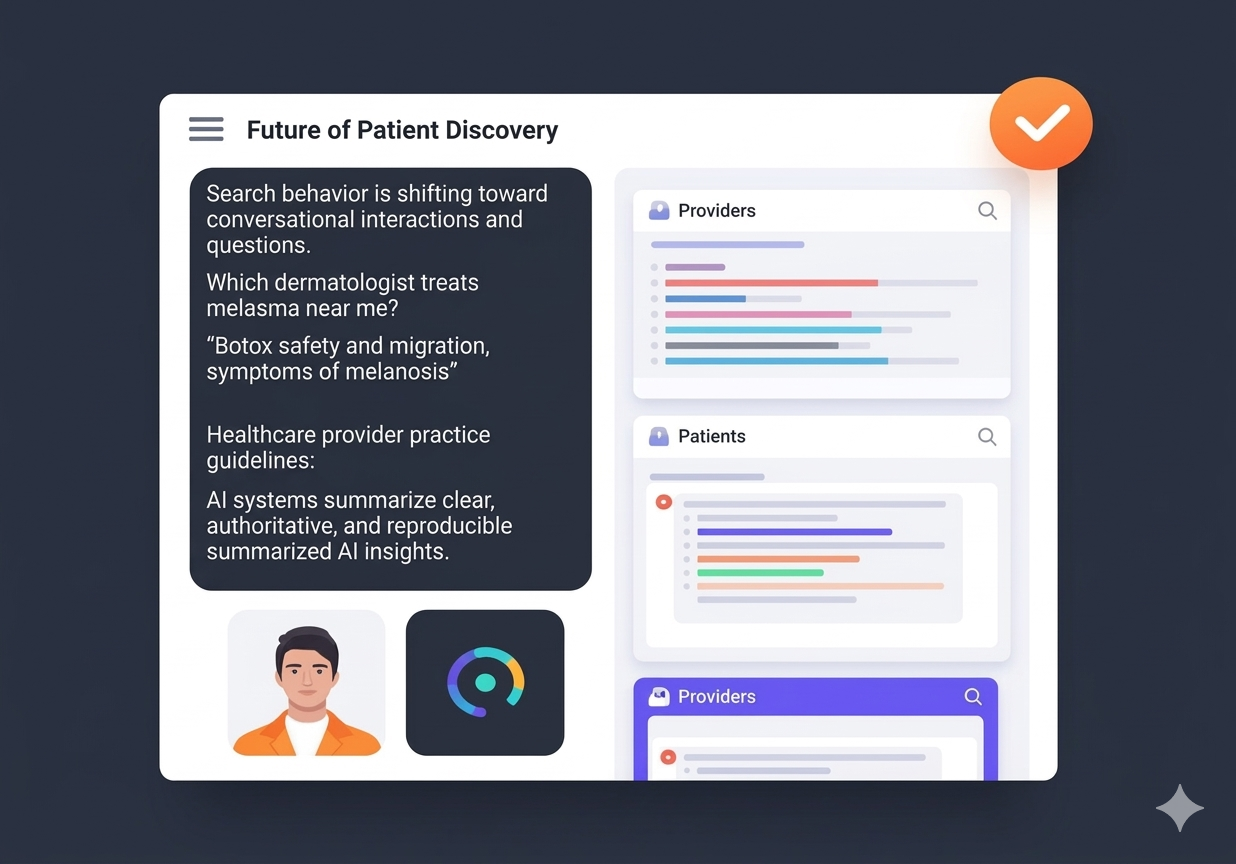
Search behavior is shifting toward conversational interactions.
Patients are increasingly asking AI systems complex healthcare questions such as:
  • “What dermatologist treats melasma near me?”
  • “Is Botox safe for migraines?”
  • “What are the early symptoms of melanoma?”
AI systems analyze multiple sources and produce summarized responses.
Healthcare practices that provide clear, authoritative explanations become the sources AI relies upon.
A digital interface mockup showing a conversational AI search dashboard answering complex healthcare questions with summarized data results.
A 3D illustration of a glowing digital question mark hovering over a metallic pedestal featuring the Best Edge Medical Marketing logo, surrounded by four floating analytics and technology icons.

Why Choose Best Edge Medical Marketing

Healthcare marketing requires specialized expertise.
At Best Edge Medical Marketing, our strategies combine:
  • advanced SEO methodology
  • healthcare marketing compliance
  • AI search optimization frameworks
  • authority-driven content strategies
We help healthcare organizations position themselves as trusted sources within AI-powered search ecosystems.

Mastering the AI Search Landscape

AI search optimization is the process of structuring website content so artificial intelligence search systems can identify, interpret, and cite it when generating answers to user questions.
Traditional SEO focuses on ranking webpages in search results, while AI search optimization focuses on becoming a trusted source that AI systems reference when generating answers.
Doctors appear in AI search results when their websites demonstrate strong expertise signals, structured medical explanations, and authoritative coverage of healthcare topics that AI systems use as reference sources.
Answer Engine Optimization is the practice of structuring content so it can be directly extracted and displayed as answers by search engines and AI platforms.
Generative Engine Optimization refers to optimizing content so AI systems can interpret it correctly and include it in AI-generated responses.
Healthcare organizations cannot directly control AI-generated answers, but they can significantly increase the likelihood of being cited by publishing authoritative, well-structured, expert-driven content.
AI search is not replacing SEO but expanding it. Successful healthcare marketing strategies now integrate both traditional SEO and AI search optimization.
Most healthcare organizations begin seeing measurable improvements in AI search visibility within 3–6 months, depending on website authority, competition, and implementation strategy.

Start Optimizing for AI Search

Artificial intelligence is reshaping how patients find healthcare providers.
Practices that invest in AI search optimization today position themselves to become trusted sources in tomorrow’s healthcare discovery ecosystem.
Best Edge Medical Marketing helps healthcare organizations implement the strategies needed to earn visibility, authority, and patient trust in AI-powered search environments.
Get Your AI Visibility Audit

About Us

Best Edge Medical Marketing is a medical marketing agency that provides marketing, SEO, design, and development services to businesses in the medical industry.

Make an Appointment

Locations in USA, Costa Rica, Dominican Republic, and India

Call Us Today

(252) 303-0074

menu-circlecross-circle linkedin facebook pinterest youtube rss twitter instagram facebook-blank rss-blank linkedin-blank pinterest youtube twitter instagram