
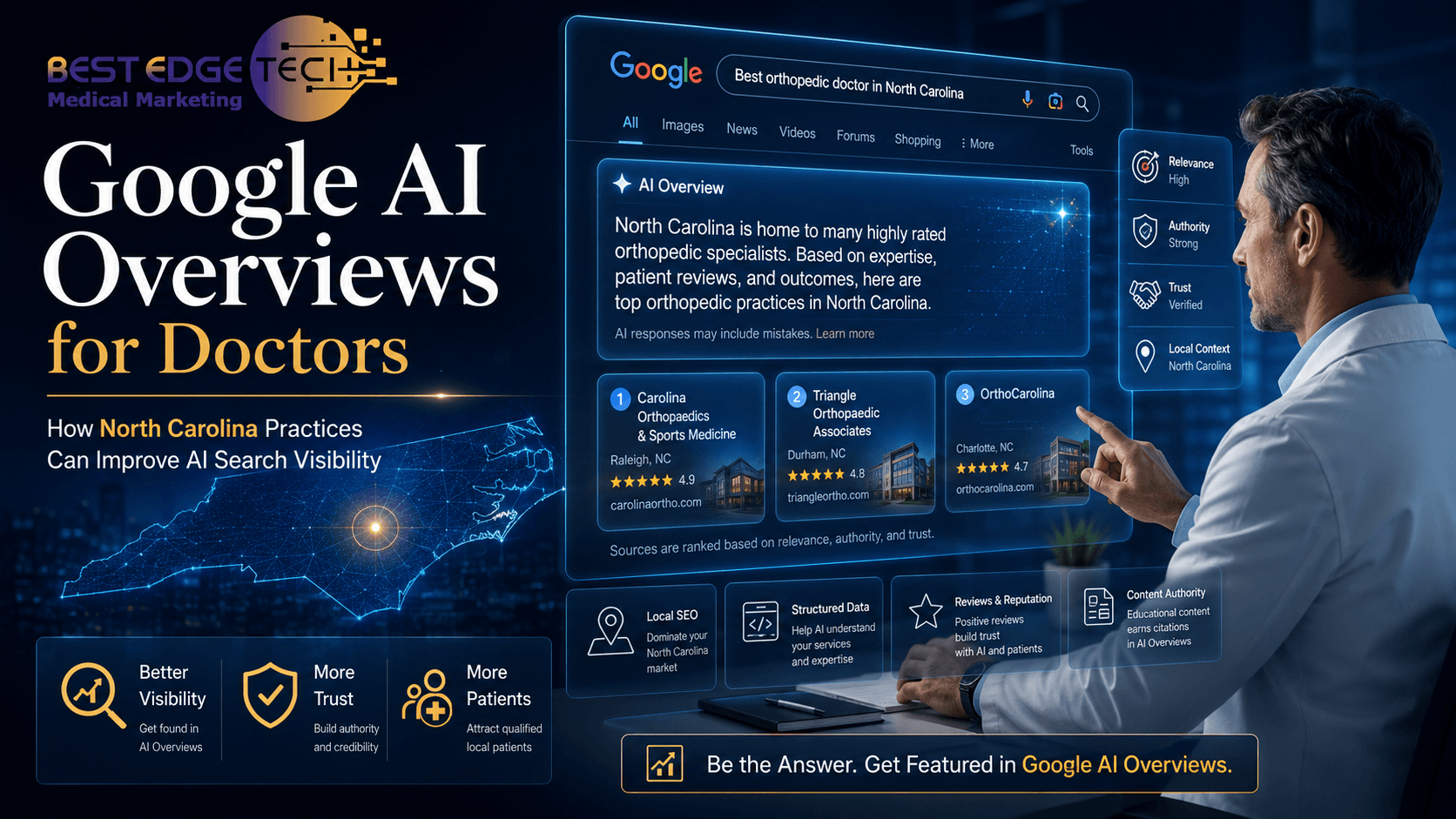
Google AI Overviews for doctors are changing how North Carolina patients find, compare, and choose medical practices online. Instead of relying only on traditional search results, patients may now see AI-generated summaries that explain conditions, compare care options, and reference trusted sources before they ever visit a practice website. For North Carolina medical practices, earning visibility in Google AI Overviews requires a stronger SEO foundation, clearer patient-focused content, local authority signals, structured data, and trustworthy medical expertise that search engines can understand and cite.
North Carolina medical practices can improve their chances of being mentioned in Google AI Overviews by building authoritative, patient-focused content that is technically indexable, locally optimized, medically trustworthy, and structured around the exact questions patients ask before booking care.
For doctors, dentists, med spas, plastic surgeons, chiropractors, mental health providers, and specialty practices across Raleigh, Charlotte, Durham, Greensboro, Wilmington, Greenville, Cary, and surrounding North Carolina markets, AI search visibility is becoming a serious competitive advantage. The practices that prepare now will be better positioned to earn visibility when patients search for answers such as “best doctor near me,” “how to choose a dermatologist in Raleigh,” “what type of specialist treats chronic knee pain,” or “best medical practice marketing agency in NC.”
Google AI Overviews are AI-generated summaries that appear in some Google Search results to help users understand a topic faster. Instead of showing only a list of blue links, Google may generate a synthesized answer and include supporting sources. For medical practices, this means patients may form an opinion before they ever click a website.
AI Overviews matter because they change the traditional search experience. A patient searching for a medical service may see a summarized explanation, recommended considerations, local intent cues, and cited websites before reviewing organic rankings. That creates a new visibility layer above traditional search results.
For North Carolina doctors, the opportunity is not simply to “rank number one.” The larger goal is to become a trusted source that Google and other AI systems can understand, extract from, and cite.
AI Overviews are especially important for healthcare-related searches because patients often ask complex, question-based queries before choosing a provider. These queries may include:
When a practice website provides clear, accurate, locally relevant answers to these questions, it becomes more useful for both patients and search systems.
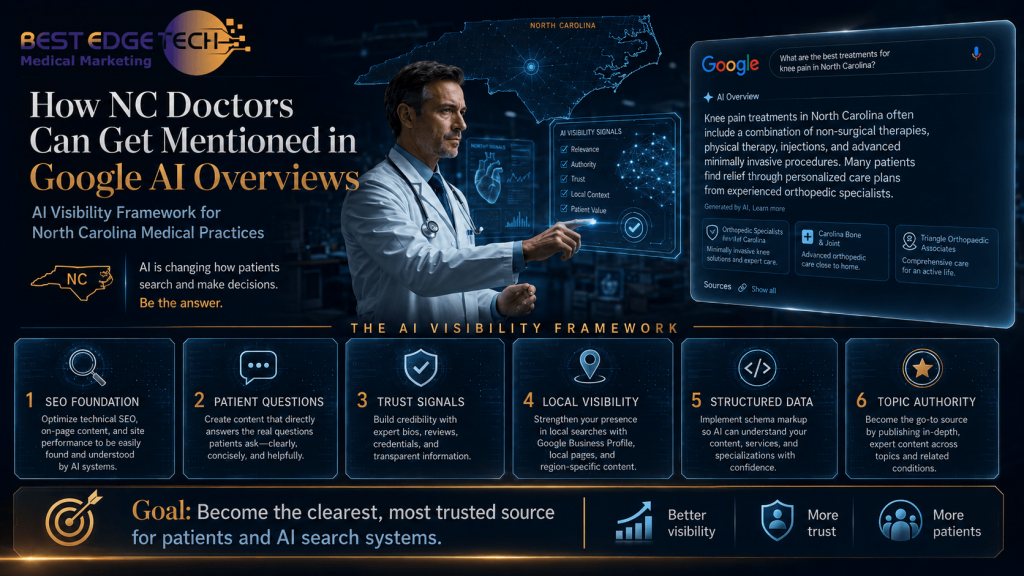
AI Overviews matter because they influence patient discovery before the click. A medical practice that appears in AI-generated search results may gain authority, visibility, and trust earlier in the patient decision journey. Practices that ignore AI search may lose visibility even if they previously performed well in traditional organic rankings.
For years, medical SEO focused heavily on ranking in organic results, Google Maps, and local service searches. Those areas still matter. However, AI search adds another layer of competition. Your website now needs to be understandable not only to patients and crawlers but also to generative systems that synthesize information from multiple sources.
For North Carolina healthcare providers, AI search visibility can affect:
Medical marketing is moving from “Can patients find us?” to “Do search engines and AI systems understand why we are a trusted answer?”
That shift is especially important in healthcare, where trust, accuracy, provider credentials, reviews, location signals, and patient education all influence decision-making.
Doctors cannot directly pay to be organically mentioned in Google AI Overviews. Paid ads may appear near AI-powered search experiences, but organic mentions depend on whether Google’s systems find a page useful, eligible, relevant, and trustworthy for the query. The practical strategy is to improve the website’s authority, structure, usefulness, and technical accessibility.
This is an important distinction. AI Overview visibility should not be treated as a placement that can be purchased like an ad. It is closer to advanced organic visibility. A medical practice must earn eligibility by creating content that search systems can crawl, understand, and confidently use.
That means AI Overview optimization usually includes:
A medical practice should still use paid search strategically when appropriate, especially for competitive services. However, paid ads and AI Overview visibility are not the same thing. The strongest medical marketing strategies combine both short-term lead generation and long-term organic authority building.
Google’s AI systems are more likely to use content that is accessible, clearly structured, helpful, original, and aligned with search intent. For medical websites, usefulness also depends on trust signals such as provider expertise, accurate service information, local relevance, transparent business details, and content that helps patients make informed decisions.
In practical terms, Google needs to understand four things about a medical practice website:
A vague medical website with thin service pages, generic blog posts, weak provider bios, outdated location information, and no structured content will struggle in AI search. A detailed, locally optimized website with clear service explanations, medical review processes, FAQs, provider credentials, location pages, and patient-focused education has a much stronger foundation.
For example, a generic page that says “We offer dermatology services in North Carolina” does not provide much value. A stronger page would explain what conditions are treated, when patients should seek care, what to expect during a visit, insurance or appointment considerations where appropriate, provider qualifications, service areas, and frequently asked patient questions.
AI search rewards clarity. Medical websites should not force search systems to infer meaning. They should make expertise, relevance, and local context obvious.
Traditional SEO is still the foundation of AI Overview visibility. A page must be crawlable, indexable, technically sound, and eligible to appear in Google Search before it can realistically compete for AI search visibility. AI SEO does not replace technical SEO, content quality, internal linking, or local optimization. It expands them.
For North Carolina doctors, this means the first step is not chasing AI tricks. The first step is making sure the practice website has a strong SEO foundation.
That includes:
Many medical practices want to appear in AI search but still have incomplete service pages, slow websites, duplicate location pages, missing provider bios, no FAQ content, weak internal linking, or inconsistent practice information across directories.
Those issues must be fixed first.
AI Overview optimization is not a shortcut around SEO. It is a higher standard for SEO.
Medical practices improve AI visibility by answering real patient questions in clear, complete, and medically responsible language. AI systems often respond to question-based searches, so content should directly address what patients want to know before choosing care. The best pages answer what, why, when, who, cost, safety, and next-step questions.
Traditional keyword targeting still matters, but AI search is heavily shaped by natural language questions. Patients do not always search like marketers. They search in full questions, concerns, symptoms, comparisons, and decision-making phrases.
For example, a North Carolina orthopedic practice should not only target “orthopedic doctor Raleigh.” It should also answer questions like:
A dental practice might target:
A med spa might target:
These question-based sections help patients and AI systems understand the page. They also increase the likelihood that a page can be extracted into snippets, voice answers, AI Overviews, and answer engines.
AI-extractable answer blocks are concise, self-contained explanations placed near the beginning of major sections. They typically answer a specific question in 40 to 80 words before the page expands into deeper explanation. This format helps users, featured snippets, voice search systems, and AI engines understand the main answer quickly.
A strong answer block should be:
For example, a weak answer block says:
“SEO helps doctors get found online.”
A stronger answer block says:
“Medical SEO helps doctors appear when patients search for healthcare services, symptoms, providers, and local treatment options. For North Carolina practices, effective SEO combines technical website optimization, local search visibility, patient-focused content, provider authority, reviews, and structured data so search engines can understand the practice and recommend it for relevant searches.”
This type of writing is more useful because it defines the topic, adds context, and includes entity-rich language.
Every major medical service page and blog should include sections that directly answer patient questions in this format.
Healthcare content must demonstrate experience, expertise, authority, and trust. For medical practices, this means content should identify who provides the service, how the practice evaluates patients, what credentials support the care, and when patients should seek professional guidance. AI systems need trust signals, and patients need confidence before booking.
E-E-A-T is especially important for medical topics because healthcare decisions can affect a person’s wellbeing. A medical practice website should not look like generic marketing copy. It should reflect real-world clinical experience, provider knowledge, safety considerations, and patient care standards.
To strengthen E-E-A-T, medical practices should include:
A medical blog should ideally show that content has been reviewed by a qualified professional when the topic involves clinical guidance. Service pages should clearly explain the practice’s process without making exaggerated claims.
For example, instead of saying “We provide the best treatment for back pain,” a stronger, more trustworthy statement would be:
“Our providers evaluate back pain based on symptoms, medical history, mobility, prior injuries, and diagnostic needs before recommending a treatment plan.”
This is more credible, specific, and aligned with patient-first healthcare communication.
Local entity signals help Google understand that a practice is a real healthcare provider serving a specific geographic market. For North Carolina doctors, this includes consistent name, address, phone number, provider details, service areas, Google Business Profile data, local reviews, location pages, and references to nearby cities or communities.
AI search is not only about content. It is also about entity understanding. Google needs to know the relationship between your practice, your providers, your specialties, your locations, and your service areas.
A North Carolina medical practice should make local relevance clear through:
For example, a Raleigh dermatology practice may serve patients from Raleigh, Cary, Wake Forest, Garner, Knightdale, Apex, and Durham. The website should communicate this naturally, not through spammy city stuffing.
Strong local entity optimization helps a practice compete for searches like:
The key is to build genuine location relevance, not doorway content.
Structured data helps search engines understand page content in a standardized format. For medical practices, schema can clarify the organization, location, services, FAQs, reviews, breadcrumbs, articles, and provider information. While schema does not guarantee AI Overview inclusion, it supports machine understanding and improves eligibility for enhanced search features.
Recommended schema types for North Carolina medical practices may include:
| Schema Type | Best Use |
|---|---|
| Organization | Defines the parent brand or medical group |
| LocalBusiness | Supports local practice visibility |
| MedicalBusiness | Helps identify healthcare-related business context |
| Physician | Useful for individual doctor profile pages |
| Dentist | Useful for dental practice pages |
| MedicalClinic | Useful for clinic or multi-provider practices |
| Service | Clarifies specific services offered |
| FAQPage | Marks up frequently asked questions where eligible |
| Article | Supports blog and educational content |
| BreadcrumbList | Helps clarify site structure |
Structured data should match visible page content. It should not be used to make claims that are not present on the page. It should also be implemented carefully, tested, and updated when practice details change.
For example, a service page about medical SEO for doctors may use Service schema. A blog post about AI Overviews may use Article schema and FAQPage schema. A location page may use LocalBusiness or MedicalBusiness schema, depending on the practice type.
Schema is not a magic ranking factor, but it is valuable because it removes ambiguity.
A content cluster helps a medical practice or medical marketing agency demonstrate depth around a subject. To appear in AI search, one article is rarely enough. Practices need connected pages that answer related questions, support semantic relevance, and establish topical authority around services, locations, providers, and patient concerns.
For Best Edge Medical Marketing, the recommended cluster should focus on AI visibility for healthcare providers.
A strong cluster could include:
This cluster should internally link between related pages using descriptive anchor text such as medical SEO services, AI search optimization, GEO services in North Carolina, healthcare content marketing, and medical website design.
Internal linking helps search engines understand relationships between services and topics. It also helps patients move from education to action.
Blogs can support AI visibility, but service pages often convert patients or leads. North Carolina medical practices should ensure core service pages are fully optimized before relying on blog content. A strong AI search strategy connects educational blogs to high-converting service pages with clear next steps.
For a medical practice, priority service pages may include:
For Best Edge Medical Marketing, priority service pages may include:
Each page should include:
Blogs should not exist in isolation. They should support commercial pages, reinforce topical authority, and guide users toward consultation.
Google Business Profile and reviews help confirm that a medical practice is real, local, active, and trusted. For AI search visibility, local reputation signals can reinforce the practice’s authority, especially when users search for nearby providers, top-rated practices, or city-specific healthcare services.
For North Carolina doctors, Google Business Profile should be treated as a core visibility asset. It should be accurate, complete, and aligned with the website.
Important optimization areas include:
Reviews are especially important because patients use them as trust signals. AI systems may also interpret reputation patterns, sentiment, and local prominence as part of broader entity understanding.
Medical practices should not incentivize fake reviews or violate platform policies. The goal is to build an ethical, consistent review process that encourages real patients to share honest experiences.
A strong review strategy includes:
Reputation management is not separate from SEO. For healthcare, it is part of the trust ecosystem.
Provider bios are one of the most underused assets on medical websites. A strong provider bio helps patients evaluate expertise and helps search systems understand the relationship between the provider, specialty, location, and services. Weak bios reduce trust and make it harder for AI systems to identify authority.
A strong doctor bio should include:
For example, a weak bio says:
“Dr. Smith is passionate about helping patients and provides excellent care.”
A stronger bio says:
“Dr. Smith is a board-certified dermatologist in Raleigh, North Carolina, who treats acne, eczema, psoriasis, skin cancer concerns, and cosmetic dermatology needs. Her approach emphasizes accurate diagnosis, patient education, and treatment plans tailored to each patient’s skin type, medical history, and goals.”
The second version gives patients and search engines clearer information. It includes specialty, location, conditions, approach, and relevance.
If a doctor wants to appear in AI search, their website must make their expertise explicit.
Thin medical content is unlikely to earn trust from patients or AI systems. Generic pages that repeat basic definitions, use vague claims, or fail to explain real clinical or local context do not create citation value. AI visibility requires original, specific, useful content that reflects real expertise and patient needs.
Medical practices should avoid content that sounds like it could appear on any healthcare website in any city.
Common problems include:
AI systems are designed to summarize helpful information. If a page does not provide helpful information, there is little reason for it to be cited.
A high-quality medical article should include:
Medical marketing content should be written like a useful resource, not a sales brochure.
Comparison tables help AI systems and users quickly understand differences between options. For medical practices, tables can clarify services, provider types, treatment considerations, marketing strategies, or patient decision factors. Well-structured tables are useful because they organize information in a format that is easy to scan, summarize, and cite.
For example, a medical practice marketing article might include:
| Visibility Area | Traditional SEO Focus | AI Search Focus |
|---|---|---|
| Keywords | Ranking for target search terms | Answering natural-language questions |
| Content | Service pages and blogs | Extractable answers and topic clusters |
| Local SEO | Maps rankings and citations | Local entity clarity and trusted business data |
| Schema | Rich result eligibility | Machine-readable context |
| Reviews | Conversion and local ranking | Trust and reputation signals |
| Authority | Backlinks and content quality | Expertise, citations, and entity strength |
Tables are especially useful for topics like:
When used correctly, tables improve user experience and AI readability.
AI search visibility is harder to measure than traditional rankings, but it can still be monitored. Medical practices should track organic traffic, branded searches, query growth, AI referral patterns, rankings, Google Business Profile actions, conversions, and manual AI search appearances across priority questions.
Traditional SEO reporting often focuses on keyword rankings, traffic, impressions, and conversions. Those metrics still matter, but AI visibility requires additional monitoring.
A practical AI search tracking process includes:
For Best Edge Medical Marketing clients, reporting should connect AI visibility to business outcomes. Visibility alone is not enough. The goal is more qualified patients, more booked consultations, and stronger long-term authority.
North Carolina doctors can improve AI Overview readiness by optimizing technical SEO, service pages, local entity signals, provider authority, structured data, FAQs, reviews, and patient education content. The goal is to create a website that is easy to crawl, easy to understand, medically trustworthy, and genuinely useful for local patients.
Use this checklist as a working framework:
| Optimization Area | Action Item |
|---|---|
| Technical SEO | Make sure important pages are indexable and mobile-friendly |
| Site Structure | Organize pages by service, location, provider, and topic |
| Service Pages | Build comprehensive pages for each major service |
| Provider Bios | Add credentials, specialties, locations, and care philosophy |
| Local SEO | Keep NAP details consistent across the web |
| Google Business Profile | Complete categories, services, photos, hours, and appointment links |
| Reviews | Build an ethical review generation and response process |
| FAQs | Add patient questions to service pages and blogs |
| Structured Data | Add Organization, LocalBusiness, Service, Article, FAQ, and Breadcrumb schema where appropriate |
| Internal Links | Connect blogs, services, locations, and contact pages |
| Content Quality | Use expert-reviewed, patient-focused explanations |
| AI Readability | Use direct answer blocks, tables, lists, and clear headings |
| Conversion | Add clear calls to book, call, or request a consultation |
| Measurement | Track rankings, AI appearances, traffic, calls, forms, and bookings |
This checklist should be revisited regularly because AI search is changing quickly.
North Carolina doctors should act now because AI search is still early enough for proactive practices to build authority before competitors catch up. Practices that create structured, helpful, locally relevant content today are more likely to benefit as AI-powered search becomes a larger part of patient discovery.
Healthcare competition in North Carolina is already intense. Patients have more provider options, more review platforms, more insurance considerations, and more search tools than ever before. AI search adds another layer of complexity.
The practices that win will not necessarily be the ones publishing the most content. They will be the ones publishing the most useful, trustworthy, and well-structured content.
That means:
AI search is not about tricking algorithms. It is about becoming the clearest and most trustworthy answer.
Best Edge Medical Marketing helps healthcare providers improve visibility across Google Search, Google AI Overviews, local search, and emerging AI answer engines through medical SEO, AI search optimization, GEO strategy, website design, healthcare content, structured data, and reputation-focused local marketing.
For North Carolina medical practices, the agency’s role is to connect technical SEO with real patient acquisition. That means building a search ecosystem where each page has a purpose, each service is clearly explained, each provider is positioned as credible, and each local signal supports trust.
A strong AI search strategy may include:
Medical practices do not need more generic marketing activity. They need a system that helps search engines, AI platforms, and patients understand why the practice is a trusted choice.
Practices looking to improve visibility can start with AI search optimization, GEO services in North Carolina, or medical SEO services.
A doctor can improve AI Overview visibility by publishing helpful, medically responsible, well-structured content that answers patient questions clearly. The website should also have strong technical SEO, provider bios, local business information, reviews, schema markup, internal links, and service pages that explain expertise, location, and patient care.
AI SEO builds on medical SEO. Traditional medical SEO focuses on rankings, local search visibility, technical optimization, and patient acquisition. AI SEO adds answer-focused content, entity optimization, structured data, topic clusters, and formatting designed to help generative search systems understand, summarize, and cite the website.
No. AI Overviews do not replace regular SEO. A page still needs to be crawlable, indexable, useful, and eligible to appear in Google Search. Traditional SEO remains the foundation, while AI-focused optimization improves how clearly the content can be understood, extracted, and trusted.
Medical content that clearly answers patient questions, explains services, includes expert context, uses structured headings, provides local relevance, and avoids vague claims is more likely to be useful for AI search. Strong FAQs, comparison tables, service explanations, and provider-reviewed educational content can all support AI visibility.
Most medical service pages should include FAQs because patients often search in question form before booking care. FAQs help explain symptoms, treatment options, appointment expectations, safety considerations, cost factors, and next steps. They also create structured content that can support featured snippets, voice search, and AI extraction.
Reviews are important because they support local trust, reputation, and patient decision-making. While reviews alone do not guarantee AI Overview inclusion, they help reinforce the credibility and prominence of a medical practice. Doctors should use an ethical review strategy and respond professionally without disclosing protected health information.
Yes. A new practice can compete by building a technically strong website, publishing helpful service pages, optimizing Google Business Profile, earning legitimate reviews, creating provider bios, adding structured data, and developing patient-focused content around local search intent. Early investment can help build authority before competitors adapt.
AI Overview visibility varies by market, competition, content quality, technical strength, and query type. Some improvements may appear as pages are indexed and optimized, while broader authority usually takes months of consistent SEO, content, local optimization, and reputation work. No agency should guarantee AI Overview placement.
Doctors should avoid thin content, keyword stuffing, copied medical articles, unsupported claims, fake reviews, doorway location pages, inaccurate business information, and overly promotional language. AI search visibility depends on clarity, trust, usefulness, and accuracy, not shortcuts.
The best first step is an AI visibility and SEO audit. The audit should review technical SEO, indexability, service pages, local signals, provider bios, content quality, structured data, reviews, Google Business Profile, internal linking, and conversion tracking. This identifies the highest-impact improvements before publishing more content.
Google Search Central: AI Features and Your Website
Google Search Central: Google’s Guide to Optimizing for Generative AI Features on Google Search
Google Search Central: Local Business Structured Data
Google Search Central: FAQPage Structured Data
Google Blog: New Opportunities, Control and Insights for Website Owners
Measuring Google AI Overviews: Activation, Source Quality, Claim Fidelity, and Publisher Impact
How Generative AI Disrupts Search: An Empirical Study of Google Search, Gemini, and AI Overviews
Impact of AI Search Summaries on Website Traffic: Evidence from Google AI Overviews and Wikipedia

Strategically Reviewed By
Founder and CEO of Best Edge Medical Marketing | Medical Marketing, SEO and AI Search Strategist
Christopher A. Whitfield strategically reviews Best Edge Medical Marketing content for patient search intent, source credibility, SEO quality, responsible marketing claims, semantic coverage, and AI search visibility. Read Christopher’s professional biography .
Strategic marketing review does not replace medical review by a qualified healthcare professional when clinical verification is required.
Best Edge Medical Marketing is a medical marketing agency that provides marketing, SEO, design, and development services to businesses in the medical industry.
Call Us Today
(252) 303-0074