
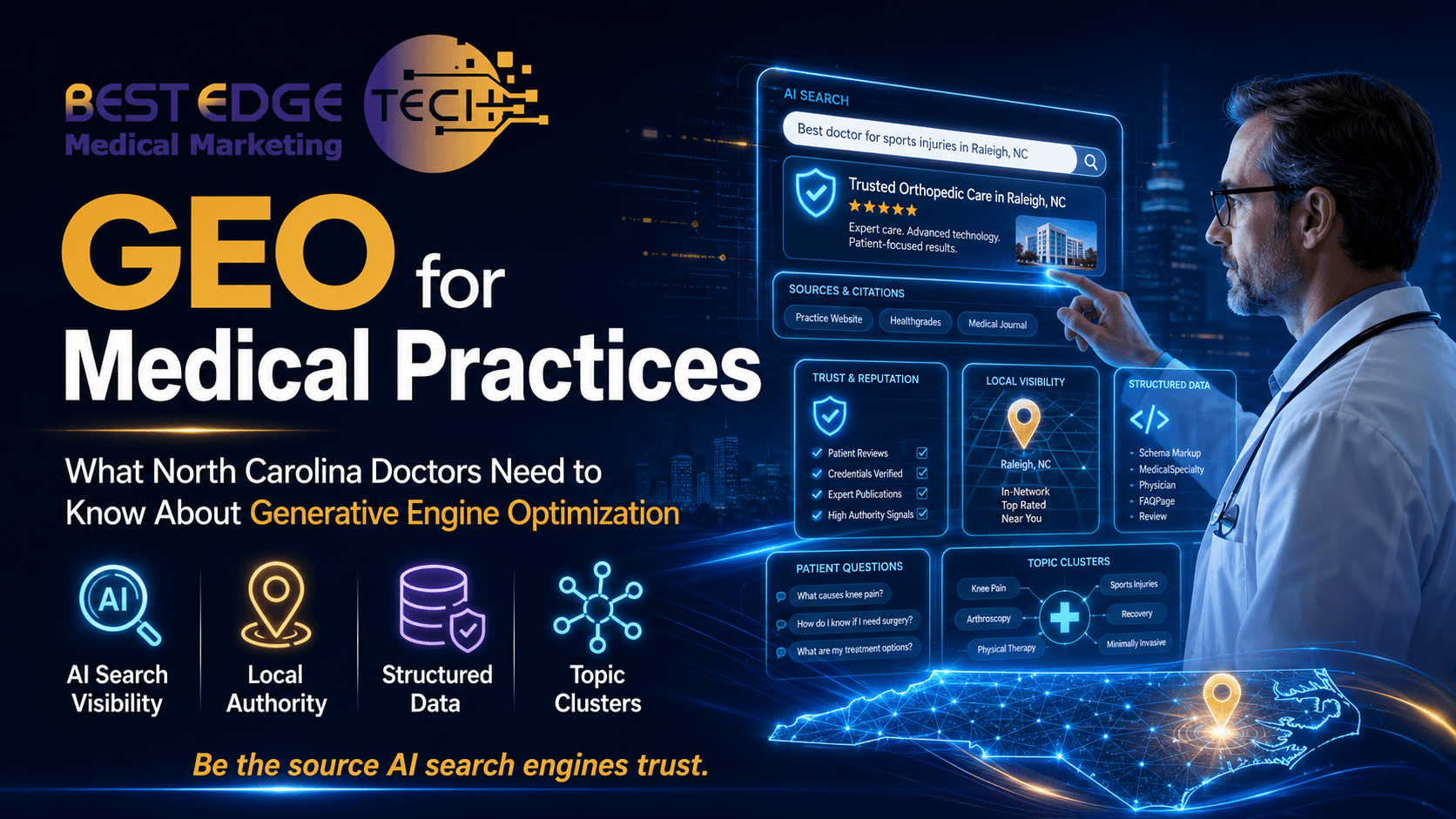
GEO for medical practices is the process of optimizing a healthcare brand so it can be discovered, understood, referenced, and trusted by generative AI search systems. For North Carolina doctors, GEO helps bridge the gap between traditional SEO and AI-powered discovery across Google AI Overviews, ChatGPT, Perplexity, Gemini, Bing Copilot, and other answer engines patients may use before choosing a provider.
Patients are no longer searching only through traditional blue-link results. They are asking longer, more specific questions and receiving AI-generated summaries that explain conditions, compare treatment considerations, surface local context, and cite supporting sources. That shift changes how medical practices need to think about online visibility.
For years, medical SEO focused on ranking service pages, optimizing Google Business Profile, building local citations, earning reviews, and publishing helpful content. Those fundamentals still matter. However, generative search adds a new layer: your website must be structured and authoritative enough for AI systems to understand what your practice does, who you help, where you serve patients, and why your content should be trusted.
For North Carolina medical practices in Raleigh, Charlotte, Durham, Greensboro, Wilmington, Greenville, Cary, Asheville, Fayetteville, and surrounding communities, GEO is quickly becoming a competitive advantage. The practices that build clear, medically responsible, locally relevant content now will be better positioned as AI search becomes a larger part of patient discovery.
GEO for medical practices means optimizing a healthcare organization’s website, content, local signals, structured data, and digital authority so generative search engines can understand and reference the practice. It focuses on making medical content clear, credible, extractable, and useful for AI-generated answers, not just traditional search rankings.
GEO stands for Generative Engine Optimization. It is closely related to SEO, but it is not exactly the same. Traditional SEO helps a page rank in search results. GEO helps a practice become a reliable source for AI-generated answers.
For medical practices, GEO includes:
A patient may ask an AI-powered search system:
GEO helps your content become part of the answer ecosystem for these types of searches.
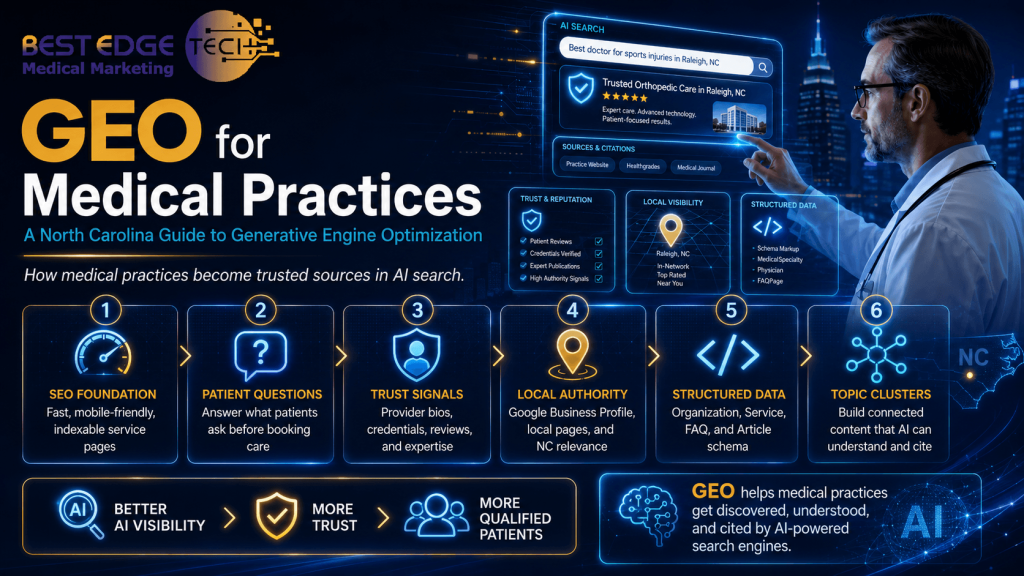
GEO matters because AI search is changing how patients discover healthcare providers before they ever visit a website. A medical practice that appears as a trusted source in AI-generated answers can gain visibility, authority, and patient confidence earlier in the decision process.
North Carolina is a competitive healthcare market. Patients compare providers across major metro areas, growing suburbs, and specialty-driven medical markets. A practice may be competing with hospital systems, private practices, dental groups, med spas, urgent care centers, specialty clinics, and large healthcare directories.
That competition is no longer limited to Google Maps or organic rankings. Patients may now receive AI-generated summaries that influence:
For doctors, this means the goal is not only to rank. The goal is to be understood, trusted, and referenced.
A strong GEO strategy can support:
The practices that invest in GEO early are more likely to build authority before competitors treat AI visibility as a priority.
SEO helps medical practices rank in traditional search results, while GEO helps them become trusted sources for AI-generated answers. The two strategies overlap, but GEO places greater emphasis on answer clarity, source credibility, entity optimization, structured content, and citation-worthy expertise.
SEO and GEO should work together. GEO does not replace medical SEO. It builds on it.
| Area | Traditional Medical SEO | GEO for Medical Practices |
|---|---|---|
| Primary Goal | Rank in search results | Be referenced in AI-generated answers |
| Content Focus | Keywords and service intent | Patient questions and answer extraction |
| Local Focus | Maps, reviews, citations | Local entity clarity and trust signals |
| Technical Focus | Crawlability, speed, indexing | Machine understanding and structured context |
| Authority Focus | Backlinks and rankings | Expertise, source quality, and citation readiness |
| Measurement | Rankings, traffic, leads | AI visibility, source mentions, branded search, qualified leads |
| Content Format | Pages and blogs | Answer blocks, FAQs, tables, topic clusters, schema |
A traditional SEO page may target “dermatologist Raleigh NC.” A GEO-optimized page goes further by answering:
That added depth makes the page more useful for patients and easier for AI systems to summarize.
Generative search changes patient behavior by giving people summarized answers before they click a website. Patients may compare providers, learn treatment basics, evaluate credibility, and form early trust signals from AI-generated results. This means medical websites must provide clearer answers and stronger proof of expertise.
Patients are using search differently. Instead of typing only short terms like “doctor near me,” they may ask:
These searches are longer, more conversational, and more decision-focused. AI systems are built to respond to that behavior by summarizing information from sources they can interpret.
That is why generic medical content is becoming less effective. A thin service page that only says “we provide quality care” does not answer the patient’s real question. A stronger page explains the service, decision factors, provider qualifications, patient expectations, local relevance, and next steps.
In healthcare, the decision journey often includes multiple stages:
| Patient Stage | Example Search Behavior | GEO Opportunity |
|---|---|---|
| Symptom Awareness | “Why does my knee hurt when climbing stairs?” | Educational condition content |
| Provider Research | “What kind of doctor treats knee pain?” | Specialty explanation pages |
| Local Comparison | “Best orthopedic doctor near Raleigh” | Local SEO and trust signals |
| Appointment Readiness | “What happens at an orthopedic consultation?” | Service page FAQs and process details |
| Trust Evaluation | “How do I choose the right doctor?” | Provider bios, reviews, credentials, content authority |
GEO helps the practice show up across more stages of that journey.
GEO for medical practices includes technical SEO, patient-focused content, local optimization, provider authority, structured data, reviews, topic clusters, and content designed for AI extraction. The objective is to create a digital presence that is clear enough for search engines, credible enough for AI systems, and useful enough for patients.
A complete GEO strategy should include the following components.
A medical website must be crawlable, indexable, fast, secure, and mobile-friendly before it can compete in AI search. Generative search systems still rely on accessible web content, so technical SEO remains the foundation of GEO.
Important technical requirements include:
A practice cannot build AI visibility on a weak technical foundation. If important pages are slow, buried, duplicated, or not indexed, they are unlikely to perform well in traditional search or AI search.
Patient-focused content answers the questions real people ask before choosing care. It avoids vague claims and explains what a service is, who it is for, when to seek help, what to expect, and how the provider approaches care.
Strong patient-focused content should cover:
For example, a med spa service page should not only describe a treatment. It should explain how patients should evaluate providers, what credentials matter, how consultations work, what realistic expectations look like, and what questions to ask.
This creates useful content for patients and clearer context for AI systems.
Entity optimization helps search systems understand the relationship between a practice, its providers, services, locations, specialties, and reputation. For medical practices, entity clarity is essential because healthcare searches often involve provider type, specialty, geography, and trust.
A strong entity profile includes:
Search engines should not have to guess what your practice is known for. Your digital footprint should make it obvious.
For example, a Raleigh dental implant practice should consistently reinforce:
That consistency improves both local SEO and GEO.
Structured data helps search engines classify page content. For medical practices, schema can clarify the organization, location, provider, service, article, FAQ, image, and breadcrumb relationships. It does not guarantee AI visibility, but it improves machine readability.
Recommended schema types may include:
| Schema Type | Best Use |
|---|---|
| Organization | Brand-level identity |
| LocalBusiness | Local practice visibility |
| MedicalBusiness | Healthcare business context |
| MedicalClinic | Clinic-level practice pages |
| Physician | Individual doctor profile pages |
| Dentist | Dental practice and dentist profile pages |
| Service | Specific medical or marketing services |
| Article | Educational blog posts |
| FAQPage | Frequently asked questions |
| BreadcrumbList | Site hierarchy |
| ImageObject | Featured image context |
Schema should match visible page content. Do not add schema that makes unsupported claims or lists services not shown on the page.
Reviews help patients evaluate trust and help reinforce local authority. While reviews alone do not create GEO success, they support the credibility of a medical entity and can influence whether patients feel comfortable booking an appointment.
Healthcare review strategy should be ethical, compliant, and consistent. Practices should:
AI systems may not rely on reviews the same way humans do, but reputation signals contribute to the broader trust environment around a practice.
A topic cluster is a group of related pages that build depth around a subject. For medical practices, clusters can support services, conditions, treatments, locations, and patient decision questions. For GEO, topic clusters help demonstrate that a practice is a comprehensive source on a subject.
An orthopedic practice might build a cluster around knee pain:
A medical marketing agency might build a cluster around AI search:
Clusters help AI systems understand topical depth and improve internal linking between related resources.
Medical practices can optimize for GEO by building a technically strong website, creating content around patient questions, strengthening provider authority, adding structured data, improving local SEO, earning reviews, and organizing content into clear topical clusters. The strongest GEO strategies combine search visibility with patient trust.
Here is a practical framework.
Before publishing new content, evaluate whether the site is ready to compete.
A GEO audit should review:
This gives the practice a realistic view of what needs to improve first.
Service pages are the foundation of medical SEO and GEO. Each major service should have a dedicated page that explains the service clearly and supports patient decision-making.
A strong service page should include:
A service page should not be a short paragraph and a contact form. It should be a useful resource.
Answer blocks are concise explanations placed near the top of a section. They help readers quickly understand the answer and help AI systems extract the main point.
Example:
“GEO helps medical practices become easier for AI search systems to understand and reference. It improves visibility by combining technical SEO, patient education, structured data, provider authority, local SEO, and content that answers real patient questions clearly.”
This format is ideal for sections such as:
Provider bios are essential for medical trust. A generic bio is a missed opportunity. A strong provider profile helps patients and search systems understand expertise.
Include:
Provider bios should be written for patients, not just as resumes.
Local SEO remains a major part of GEO because patients often search with location intent. A practice should make its local relevance unmistakable.
Important local signals include:
For North Carolina practices, local pages should feel authentic. Avoid doorway pages that swap city names without adding local value.
Source-worthy content is content that another writer, journalist, AI system, or patient would want to reference. It explains a topic clearly, includes original insight, and avoids generic filler.
Strong medical content may include:
For Best Edge Medical Marketing, source-worthy topics include:
The goal is to build content that is genuinely helpful enough to earn references.
GEO applies to nearly every type of medical practice because patients use AI search to understand symptoms, compare providers, evaluate trust, and find local care. The exact strategy should be tailored to the specialty, patient journey, service model, and competition level.
| Practice Type | GEO Priority |
|---|---|
| Primary Care | Local visibility, provider trust, appointment access |
| Dentistry | Service pages, procedure FAQs, before-and-after trust signals |
| Orthopedics | Condition clusters, treatment explainers, local specialist visibility |
| Dermatology | Symptom content, cosmetic/service pages, provider expertise |
| Plastic Surgery | Consultation guides, credentials, procedure education |
| Med Spas | Safety, provider qualifications, treatment expectations |
| Chiropractic | Condition-based content and local service visibility |
| Mental Health | Trust-building, specialty pages, appointment process clarity |
| Pediatrics | Parent questions, provider bios, local trust signals |
| Urgent Care | Local search, hours, services, insurance and visit expectations |
Each specialty has different patient concerns. GEO should reflect those differences instead of using one generic healthcare marketing template.
Medical practices should avoid treating GEO as a shortcut or a buzzword. The most common mistakes include publishing thin AI-generated content, ignoring provider expertise, skipping local optimization, using unsupported claims, neglecting structured data, and failing to connect content to patient conversion paths.
The biggest GEO mistakes include:
Healthcare content should be accurate, specific, and useful. If the content could apply to any practice in any state, it is probably not strong enough.
GEO success should be measured through a combination of traditional SEO metrics, AI visibility checks, branded search growth, content performance, local actions, and patient lead quality. Because AI search visibility is still evolving, practices should track multiple indicators instead of relying on one metric.
Useful GEO metrics include:
A medical practice should not measure GEO by visibility alone. The goal is qualified patient growth.
GEO is not a one-time optimization task. It requires a long-term strategy because AI search systems evaluate content quality, authority, trust, entity clarity, topical depth, freshness, and source usefulness over time. Medical practices need consistent optimization to remain visible as search behavior changes.
A strong long-term GEO strategy includes:
The practices that treat GEO as an ongoing visibility system will outperform practices that treat it as a one-time blog campaign.
Best Edge Medical Marketing helps North Carolina healthcare providers build AI-ready visibility through medical SEO, GEO strategy, healthcare content marketing, structured data, local SEO, Google Business Profile optimization, and website improvements designed to support patient acquisition.
The goal is not just more traffic. The goal is clearer authority, stronger visibility, and more qualified patient inquiries.
A GEO strategy from Best Edge Medical Marketing may include:
Medical practices can learn more about medical SEO services, Google AI Overviews for doctors, healthcare content marketing, and medical website design.
GEO means Generative Engine Optimization. For medical practices, it is the process of optimizing website content, local signals, provider authority, structured data, and patient education so AI-powered search systems can understand and reference the practice in generated answers.
No. GEO and SEO are related, but they are not identical. SEO focuses on rankings in traditional search results. GEO focuses on visibility in AI-generated answers, answer engines, and generative search experiences. Medical practices need both because AI search still depends on strong SEO foundations.
Doctors should care about GEO because patients increasingly use AI-powered search to research symptoms, treatments, provider types, and local healthcare options. A practice that is easier for AI systems to understand and trust may earn stronger visibility during the patient decision journey.
GEO can improve a medical practice’s readiness for Google AI Overviews by strengthening content clarity, structured data, provider authority, local relevance, and topic depth. However, no agency can guarantee inclusion because AI Overview selection depends on Google’s systems and the specific query.
The best GEO content answers real patient questions clearly. Strong examples include service pages, condition guides, consultation checklists, provider bios, FAQs, comparison articles, treatment explainers, and local healthcare resources. Content should be medically responsible, specific, and useful.
Structured data supports GEO by helping search engines classify page content in a machine-readable format. It can clarify organization details, services, locations, articles, FAQs, breadcrumbs, and images. Schema does not guarantee AI visibility, but it improves understanding and eligibility for enhanced search features.
GEO timelines vary based on competition, website quality, authority, content depth, and local market strength. Some improvements may support visibility within weeks after indexing, while broader authority and AI search visibility often require months of consistent SEO, content, and reputation work.
The first step is a GEO and SEO audit. The audit should review technical SEO, content quality, service pages, local signals, provider bios, structured data, internal links, reviews, Google Business Profile, and current visibility in AI search results.
Yes. Small medical practices can compete by publishing better local content, strengthening provider expertise, answering patient questions, optimizing service pages, earning reviews, and building topical authority in a focused specialty or service area. GEO rewards clarity and usefulness, not just brand size.
AI can help with research, structure, and drafting, but healthcare content should be reviewed for accuracy, specificity, compliance, and patient usefulness. Medical practices should avoid publishing generic AI-generated pages without expert insight, local relevance, and verification.
Google Search Central: Google’s Guide to Optimizing for Generative AI Features on Google Search
Google Search Central: AI Features and Your Website
Google Search Central: Local Business Structured Data
Google Search Central: Creating Helpful, Reliable, People-First Content
Google Search Central: Google Search’s Guidance on Generative AI Content
How Generative AI Disrupts Search: An Empirical Study of Google Search, Gemini, and AI Overviews
Measuring Google AI Overviews: Activation, Source Quality, Claim Fidelity, and Publisher Impact
Generative Engine Optimization: How to Dominate AI Search

Strategically Reviewed By
Founder and CEO of Best Edge Medical Marketing | Medical Marketing, SEO and AI Search Strategist
Christopher A. Whitfield strategically reviews Best Edge Medical Marketing content for patient search intent, source credibility, SEO quality, responsible marketing claims, semantic coverage and AI search visibility. Read Christopher’s professional biography .
Strategic marketing review does not replace medical review by a qualified healthcare professional when clinical verification is required.
Best Edge Medical Marketing is a medical marketing agency that provides marketing, SEO, design, and development services to businesses in the medical industry.
Call Us Today
(252) 303-0074