
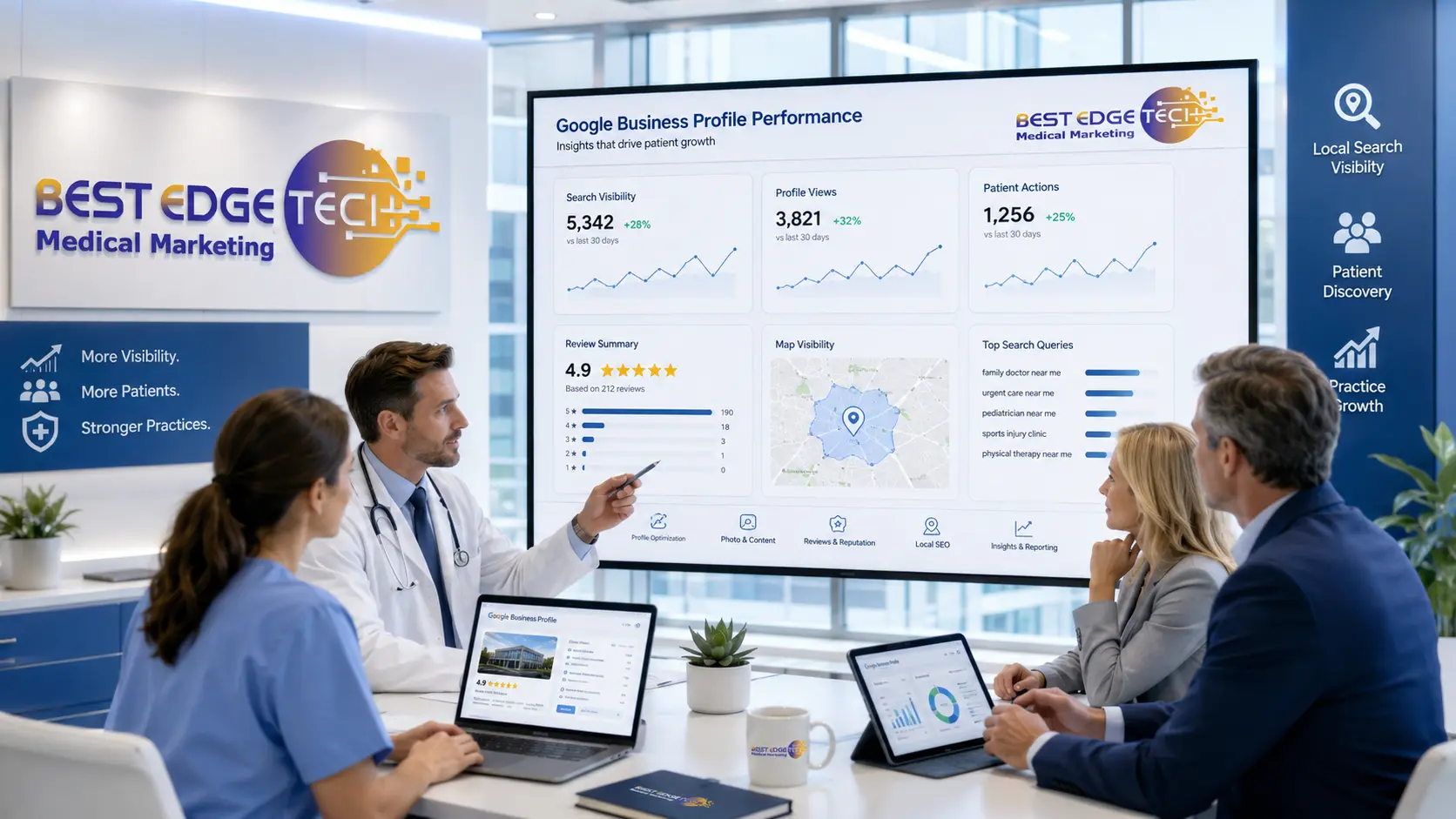
For doctors, surgeons, dentists, and medical practice owners, Google Business Profile optimization for medical practices is no longer optional—it is a strategic necessity. As patient discovery shifts toward AI-driven search and local answer engines, your Google Business Profile (GBP) becomes the digital front door to your practice. A fully optimized GBP not only supports your visibility in local search but also strengthens trust, compliance, and patient engagement in a highly competitive healthcare landscape.
Google Business Profile optimization for medical practices is the foundation of modern local SEO, AI search visibility, and compliant reputation management. An accurate, complete, and strategically enhanced GBP ensures your practice is discoverable by patients searching for care, supports clearer interpretation by AI-driven systems, and strengthens trust and credibility signals for your brand. For medical practices, this means supporting clearer inquiry paths, better patient experiences, and a stronger digital reputation.
In 2026, Google Business Profile optimization for medical practices is essential because patients increasingly use Google Search, Maps, and AI Overviews to find healthcare providers. Your GBP is the primary data source for these systems, directly impacting your local visibility, patient trust, and digital reputation. Practices that fail to optimize risk being overlooked by both traditional searchers and AI-driven answer engines.
For medical practices, GBP is the anchor of local SEO. It verifies your entity, displays your specialties, and provides actionable information—such as directions, phone numbers, and booking links—directly to patients. Accurate NAP (Name, Address, Phone) details and medical categories help your practice appear in “doctor near me” searches and local map packs.
Google’s AI Overviews and answer engines extract practice details from GBP to answer patient queries instantly. If your GBP is incomplete or outdated, your practice may be excluded from these AI-powered summaries, reducing your digital visibility and authority in the eyes of both patients and search systems. Statistics, quotes, and research claims should be verified before publication.
Summary: Optimizing your GBP is a direct investment in your practice’s visibility and patient trust. Review your profile regularly and update it as your services or staff change.
Claiming and verifying your GBP is the first step to controlling your digital presence. For medical practices, this process ensures that only authorized staff can manage sensitive information and respond to reviews, supporting both security and compliance.
For practices with multiple locations or specialty clinics, create a separate GBP for each location. Use unique phone numbers and precise addresses to avoid confusion and support accurate local search results. Assign location managers to oversee each profile and maintain consistency across all entries.
Action Plan: Assign a dedicated team member to oversee GBP verification and access controls for each location to maintain compliance and security.
Choosing the correct categories and attributes is crucial for helping Google and patients understand your services. Medical practices should select the most specific primary category (e.g., “Cardiologist,” “Pediatric Dentist”) and add relevant secondary categories and attributes to reflect all offered services.
Always use the most accurate medical specialty as your primary category. Secondary categories can include related services (e.g., “Medical Clinic,” “Dermatologist,” “Cosmetic Dentist”). This helps your practice appear in a wider range of relevant searches while maintaining clarity for AI-driven systems.
Attributes such as “Accepts Insurance,” “Wheelchair Accessible,” and “Women-led” provide valuable information to patients and support entity authority. Enable all relevant attributes in your GBP dashboard, and review them regularly to ensure accuracy.
Next Steps: Review your categories and attributes quarterly to ensure they reflect your current services and support AI-influenced search.
Your GBP business description should clearly explain your services, philosophy, and unique value—without making medical claims or violating advertising rules. For medical practices, this section is an opportunity to build trust and encourage patient inquiries.
Use patient-friendly language that highlights your specialties, experience, and commitment to care. Incorporate keywords naturally, but focus on clarity and helpfulness. This supports both patient understanding and AI-driven content extraction.
Never include patient names, specific treatment details, or medical advice in your description. Avoid superlative claims (“Best doctor in North Carolina”) and ensure all statements are truthful and compliant with state and federal advertising guidelines.
Summary: Review your business description with a compliance checklist before publishing to ensure it meets all legal and ethical standards.
Reviews are a cornerstone of digital trust for medical practices. Managing them compliantly means responding professionally, protecting patient privacy, and encouraging authentic feedback without violating HIPAA or advertising standards.
Thank reviewers in general terms and avoid referencing specific treatments or visits. For example, say “Thank you for your feedback” rather than “Thank you for coming in for your surgery.” This approach protects patient privacy and aligns with HIPAA guidance.
Encourage patients to leave reviews by providing clear instructions at checkout or via follow-up emails. Never offer incentives for reviews, and remind staff to avoid discussing reviews in a way that could identify patients. Monitor reviews regularly and flag any that violate platform policies or advertising standards.
Action Plan: Train your front desk and clinical staff on compliant review request scripts and monitor your GBP weekly for new reviews.
High-quality visual content builds trust and supports AI-driven systems in verifying your practice’s legitimacy. For medical practices, photos of the facility, team, and equipment (never patients) help patients feel comfortable and support stronger digital visibility signals.
Upload professional photos of your waiting area, exam rooms, and staff (with their consent). Avoid before-and-after images unless they are compliant with advertising rules and do not reveal patient identities. Visual content should reflect the cleanliness, professionalism, and accessibility of your practice.
Rich media strengthens your profile’s authority for Generative Engine Optimization (GEO). AI-driven systems often use visual cues to confirm a practice’s legitimacy and location, making consistent, high-quality imagery a key part of your GBP strategy. Statistics, quotes, and research claims should be verified before publication.
Summary: Maintain a library of approved, compliant images and update your GBP visuals at least twice per year.
Google Business Profile offers features designed to convert searchers into patients. For medical practices, leveraging booking links, call-to-action buttons, and the Q&A section can streamline the path from search to appointment.
Integrate online booking systems and enable “Call Now” or “Request Appointment” buttons. These features reduce friction for patients and support clearer inquiry paths. Ensure all links are secure and lead to HIPAA-compliant scheduling platforms.
Monitor and answer questions in the GBP Q&A section proactively. Provide general information about services, insurance, and office hours—never medical advice. This supports both patient education and AI-driven answer engines.
Action Plan: Assign a staff member to monitor GBP Q&A and booking features weekly to ensure prompt responses and a seamless patient experience.
GBP optimization should be integrated with your broader digital marketing strategy. For medical practices, this means aligning GBP details with your website, service pages, and provider bios to support NAP consistency and entity authority.
Maintain identical Name, Address, and Phone details across your GBP, website, and all online directories. Inconsistencies can confuse both patients and search engines, weakening your local visibility and trust signals. Review your listings regularly and update them as needed.
Link your GBP to your main website and ensure your site features clear service pages, provider bios, and contact information. Structured data and schema markup on your website further support Google’s understanding of your practice as a unique entity. For more on this, see our comprehensive medical SEO guide.
Next Steps: Audit your website and GBP quarterly for NAP consistency and update schema markup as your services or staff change.
Ongoing monitoring and updates are essential for maintaining visibility in both traditional and AI-driven search. Medical practices should track key metrics and adapt to changes in Google’s AI and generative search features.
Monitor profile views, direction requests, phone calls, and booking clicks in your GBP dashboard. Track review volume and sentiment to gauge patient satisfaction and reputation trends. Use these insights to identify areas for improvement.
Stay informed about updates to Google’s AI Overviews and generative search features. Regularly review your GBP for new fields, attributes, or features that can enhance your profile’s authority and support clearer interpretation by AI-driven systems. For advanced strategies, explore our AI search optimization and Generative Engine Optimization (GEO) services.
Action Plan: Set a monthly reminder to review GBP analytics and Google Search Console for changes in AI-influenced visibility and branded search trends.
Many medical practices miss critical opportunities by making avoidable mistakes. The most common include incomplete profiles, inconsistent NAP details, generic or non-compliant descriptions, lack of visual content, and unmonitored reviews. Each of these can weaken your local authority and reduce your digital visibility in both traditional and AI-driven search environments.
Summary: Avoid these pitfalls by following a structured, compliance-aware optimization process and reviewing your GBP regularly.
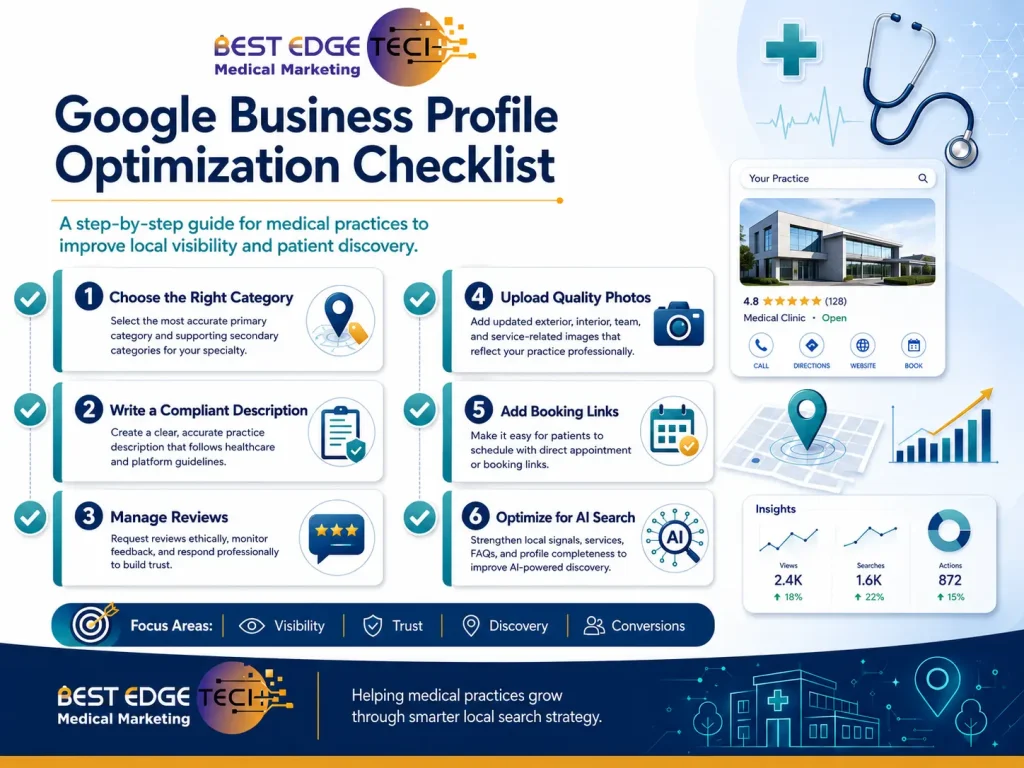
Medical practices should follow a comprehensive checklist to ensure their GBP is optimized for both AI search and compliance. This checklist addresses the unique needs of healthcare providers, supporting digital visibility, patient trust, and regulatory requirements.
For a visual reference, see our infographic: Medical Practice Google Business Profile Optimization Checklist.
Next Steps: Print or save this checklist and review it with your team each quarter to maintain a high-performing, compliant GBP.
Medical content architecture for AI search involves structuring your GBP and website content so that both patients and AI-driven systems can easily interpret your practice details. This means using clear headings, structured data, and entity-focused content, while ensuring every element meets compliance standards. Proper architecture supports digital visibility, patient trust, and regulatory requirements.
| Field Name | General Business Best Practice | Medical Practice Best Practice | Compliance Note (NC-specific where possible) |
|---|---|---|---|
| Categories | Restaurant, Retail, etc. | Cardiologist, Dentist, Dermatologist | Use precise medical specialties; ensure categories match NC licensing and advertising rules |
| Description | “We sell food” | “We provide compassionate cardiac care” | No medical advice, guarantees, or superlative claims; comply with NC Medical Board advertising guidelines |
| Reviews | “Thanks for the meal” | “We appreciate your feedback” | No confirming patient status; responses must not disclose PHI per HIPAA and NC law |
| Photos | Food, Products | Facility, Team, Equipment | No patient faces or PHI; obtain staff consent for images; follow NC privacy standards |
| Attributes | Open 24h, Free Wi-Fi | Accepts Insurance, Wheelchair Accessible | Enable all relevant medical attributes; verify accuracy for NC insurance and accessibility laws |
Implementation Checklist for Medical Content Architecture:
Summary: A well-structured, compliance-aware content architecture helps both patients and AI-driven systems understand your practice, supporting digital visibility and trust.
Provider bios, service pages, and schema markup are essential components of medical content architecture, especially for AI search. Structuring these elements properly ensures that both patients and AI-driven systems can accurately interpret your expertise, services, and compliance standards.
| Content Element | Best Practice for AI Search | Compliance Note (NC-specific where possible) |
|---|---|---|
| Provider Bios | Include credentials, specialties, and experience; use Physician schema markup | No patient testimonials; avoid superlative claims; comply with NC Medical Board rules |
| Service Pages | Dedicated page for each service with clear headings and LocalBusiness schema | No medical advice; descriptions must be factual and compliant with NC advertising laws |
| Schema Markup | Apply LocalBusiness, Physician, and MedicalOrganization schema to the website and GBP | Ensure schema data matches public information; review for HIPAA and NC compliance |
Checklist for Implementation:
Summary: Structuring provider bios and service pages with proper schema markup supports AI-influenced discovery and ensures compliance, helping patients and search systems understand your expertise.
Healthcare AI search requires a different SEO strategy because AI-driven systems interpret and present information differently than traditional search engines. Medical practices must structure their content and GBP data to support AI-influenced answers, digital trust, and compliance, rather than relying solely on keyword rankings.
AI search engines prioritize structured, entity-based information, clear service descriptions, and digital trust signals such as reviews and accurate provider bios. Unlike traditional SEO, which focuses on keyword density and backlinks, AI search optimization emphasizes data clarity, schema markup, and compliance-aware content. This shift is especially important for healthcare, where accuracy and privacy are paramount.
Implementation Guidance: Review your SEO strategy to ensure it addresses AI search requirements, including structured data, compliance, and digital trust signals. For expert support, explore our AI search optimization services.
Summary: Adapting your SEO approach for healthcare AI search is essential for supporting digital visibility, compliance, and patient trust in 2026 and beyond.
Understanding the differences between traditional SEO and AI search optimization helps medical practices prioritize strategies that support both patient discovery and compliance. The table below highlights key distinctions and actionable steps.
| Aspect | Traditional SEO | AI Search Optimization |
|---|---|---|
| Primary Focus | Keyword rankings, backlinks, meta tags | Structured data, entity clarity, AI trust signals, compliance |
| Content Structure | Long-form content, keyword density | Clear headings, schema markup, concise service descriptions |
| Measurement | Organic rankings, traffic, conversions | Visibility signals, AI interpretation, engagement, and inquiries (measured via Google Search Console and branded search trends) |
| Compliance | General best practices | Strict adherence to HIPAA, state advertising, and privacy laws |
| Trust Signals | Reviews, testimonials | AI trust signals: compliant reviews, accurate provider bios, verified attributes |
Summary: Medical practices should blend traditional SEO with AI search optimization, focusing on structured data, compliance, and digital trust to support both patient and AI-driven discovery.
Consider a North Carolina dermatology clinic. By claiming and fully optimizing their GBP—selecting “Dermatologist” as the primary category, enabling “Accepts Insurance,” uploading professional facility photos, and maintaining NAP consistency—the clinic appears in both traditional “dermatologist near me” searches and Google AI Overviews. Patients searching for “best dermatologist for acne in Raleigh” see the clinic’s profile, reviews, and booking link, supporting both trust signals and direct patient inquiries.
The clinic also implemented structured data on their website, created detailed provider bios with credentials, and ensured all content met North Carolina advertising and HIPAA requirements. As a result, the clinic saw measurable improvements in branded search traffic, increased patient inquiries through their website, and more positive reviews. Statistics, quotes, and research claims should be verified before publication.
Action Plan: Follow this example by auditing your GBP, updating your website with schema markup, and training staff on compliance-aware review management.
Reputation management for medical practices is not just about collecting reviews—it’s about building digital trust with both patients and AI-driven systems. AI trust signals are the digital cues that AI search engines use to assess your practice’s reliability, such as a steady flow of compliant reviews, accurate provider bios, and verified attributes. Prompt, professional responses to reviews and consistent information across platforms help support stronger digital visibility signals and patient trust.
Summary: Strengthen your reputation by focusing on AI trust signals and compliance, which support both patient confidence and AI-influenced discovery.
Compliance-aware marketing is essential for medical practices to avoid legal risks and build patient trust. Every aspect of your GBP and digital presence must adhere to HIPAA, North Carolina advertising rules, and privacy standards. Use the checklist below to guide your compliance efforts.
Summary: Make compliance a core part of your marketing workflow to protect your practice and support digital trust.
Optimizing your GBP is only the first step—guiding patients from discovery to inquiry is where practices see real results. A seamless patient inquiry path ensures that patients who find you via GBP can easily contact your office, schedule appointments, and receive timely responses, all while maintaining compliance and supporting AI-influenced discovery.
Here’s a practical example of a patient journey from GBP to inquiry:
Checklist for Guiding Patients from GBP to Inquiry:
Summary: Review your patient inquiry path quarterly to ensure a seamless, compliant experience from GBP to appointment.
Optimizing your Google Business Profile is a critical step, but true digital authority requires ongoing strategy and expertise. Best Edge Medical Marketing specializes in healthcare marketing services designed for doctors, surgeons, dentists, and specialty clinics. To strengthen your local visibility, support AI-influenced discovery, and build a compliant, patient-focused digital presence, contact us today for a personalized consultation.
Next Steps: Schedule a strategy session with our team to audit your GBP, website, and digital marketing for AI search readiness and compliance.
Ready to take your medical practice’s digital presence to the next level? Explore our AI search optimization services and medical SEO solutions to support stronger digital visibility and patient trust.
The most important category is the one that most accurately reflects your medical specialty, such as “Cardiologist,” “Pediatric Dentist,” or “Dermatologist.” Using the correct primary category ensures your practice appears in relevant searches and supports clearer interpretation by AI-driven systems. Secondary categories can be added for related services, but the primary category should always match your core specialty for optimal visibility. Review your categories quarterly to maintain accuracy.
Always respond to reviews in a general, professional manner. Thank the reviewer for their feedback without referencing specific treatments, appointments, or confirming their patient status. For example, say “Thank you for your feedback” rather than “Thank you for coming in for your procedure.” This approach protects patient privacy and aligns with HIPAA and advertising guidelines. When in doubt, keep responses brief and non-identifying. Train your staff on compliant response templates.
Before-and-after photos should be used with extreme caution. Only post images that are fully compliant with advertising standards, do not reveal patient identities, and have proper patient consent. Many states have strict rules regarding the use of testimonials and treatment images. When in doubt, focus on facility, team, and equipment photos to build trust without risking compliance. Review all images with a compliance officer before posting.
If your practice is missing from Google AI Overviews, it may be due to an incomplete or unverified GBP, inconsistent NAP details, missing categories, or lack of recent updates. AI-driven systems rely on accurate, detailed GBP data to include practices in answer summaries. Regularly review and update your profile, and ensure all information is consistent across your digital presence. Use Google Search Console to monitor branded search trends.
Update your GBP at least quarterly, or whenever there are changes to your services, staff, hours, or contact information. Regular updates signal to Google and AI-driven systems that your practice is active and trustworthy. Monitor reviews, add new photos, and check for new GBP features or attributes that may enhance your profile’s authority and visibility. Set calendar reminders for regular audits.
Key attributes for medical practices include “Accepts Insurance,” “Wheelchair Accessible,” “Women-led,” and any specialty-specific options available in the GBP dashboard. These attributes provide valuable information to patients and support entity authority for AI-driven systems. Review available attributes regularly and enable all that accurately describe your practice. Document attribute changes for compliance records.
An optimized GBP supports your practice’s visibility in local search results, map packs, and AI Overviews. Accurate categories, attributes, NAP consistency, and high-quality photos all contribute to stronger digital visibility signals. This helps patients find accurate information about your practice and supports your authority as a trusted local provider. Track performance using Google Search Console and GBP analytics.
Yes, you can integrate online booking links and enable “Call Now” or “Request Appointment” buttons in your GBP. These features make it easier for patients to schedule appointments directly from your profile, streamlining the inquiry process and supporting clearer inquiry paths. Ensure all booking systems are secure and HIPAA-compliant. Test booking links regularly for functionality.
Create a separate GBP for each location, using unique phone numbers and precise addresses. Assign location managers to oversee each profile and maintain consistency across all entries. This approach supports accurate local search results and helps patients find the correct location for their needs. Review all profiles quarterly for accuracy and compliance.
A complete GBP provides structured data that generative engines use to verify your practice as a trusted source. Rich media, detailed services, and verified attributes all contribute to stronger digital visibility signals, supporting your inclusion in AI-influenced answer environments and enhancing your reputation as a credible healthcare provider. Update your GBP and website schema regularly to support GEO.
Creating Helpful, Reliable, People-First Content – Google Search Central
Introduction to Structured Data – Google Search Central
Google Business Profile Help Center
AI Features and Your Website – Google Search Central
Optimizing Your Website for Generative AI Features on Google Search – Google Search Central
Statistics, quotes, and research claims should be verified before publication.
Best Edge Medical Marketing is a medical marketing agency that provides marketing, SEO, design, and development services to businesses in the medical industry.
Call Us Today
(252) 303-0074