
To measure ai search leads for a medical practice, treat Google’s AI visibility data as an upper-funnel signal, then connect it to your own inquiry tracking. Google Search Console can show how often your site appears in generative AI features, but it does not prove that a specific form fill, phone call, or consult request came from an AI answer. The practical goal is to build a careful reporting model that links AI visibility, service-page engagement, location-page engagement, and downstream lead signals without overstating attribution.
Use Google Search Console’s generative AI reporting to monitor impressions and page-level visibility, then compare that exposure with website analytics, call tracking, form submissions, and appointment-request data. Separate branded from non-branded visibility, map impressions to service and location pages, and label AI-driven leads as “influenced” unless your own tracking can support a stronger attribution claim. No one can promise AI citations, patient inquiries, rankings, or revenue from AI search visibility.
As of 2026, Google’s own documentation is the safest place to start. The Google Search Console generative AI performance report is designed to show how a site performs in generative AI features on Google Search. Google describes this reporting around visibility signals such as impressions, including how often links to your site were shown in generative AI features.
For medical practices, this matters because the report is not a patient-acquisition dashboard. It can help you see whether pages are appearing in AI features, but it does not replace lead tracking, call tracking, CRM notes, intake-source fields, or appointment-request analysis.
Google’s AI search surfaces also continue to evolve. Google’s Search Central documentation explains that AI features in Search can show links and supporting sources in different ways depending on the search experience. For a healthcare marketer, that means reporting should be built with caution: measure what the platform provides, connect it to what your practice controls, and avoid claiming certainty where the data does not support it.
Generative AI impressions are the starting point, not the finish line. In plain terms, they help you understand whether Google’s AI features displayed links to your site. If a plastic surgery, dental, med spa, primary care, or longevity practice sees rising generative AI impressions for key pages, that can suggest improving visibility in AI-enhanced search experiences.
But generative AI impressions do not automatically mean patients clicked, called, submitted a form, booked a consultation, or became new patients. A page can earn visibility without producing a measurable inquiry. Another page can receive fewer generative AI impressions but produce stronger downstream engagement because it targets a more specific service or location intent.
When you review generative AI impressions, focus on three questions:
That last question is where many practices make a reporting mistake. They see AI visibility and immediately call it lead generation. A more accurate statement is that generative AI impressions may be an awareness or consideration signal. Your own analytics must determine whether that visibility aligns with qualified patient inquiries.
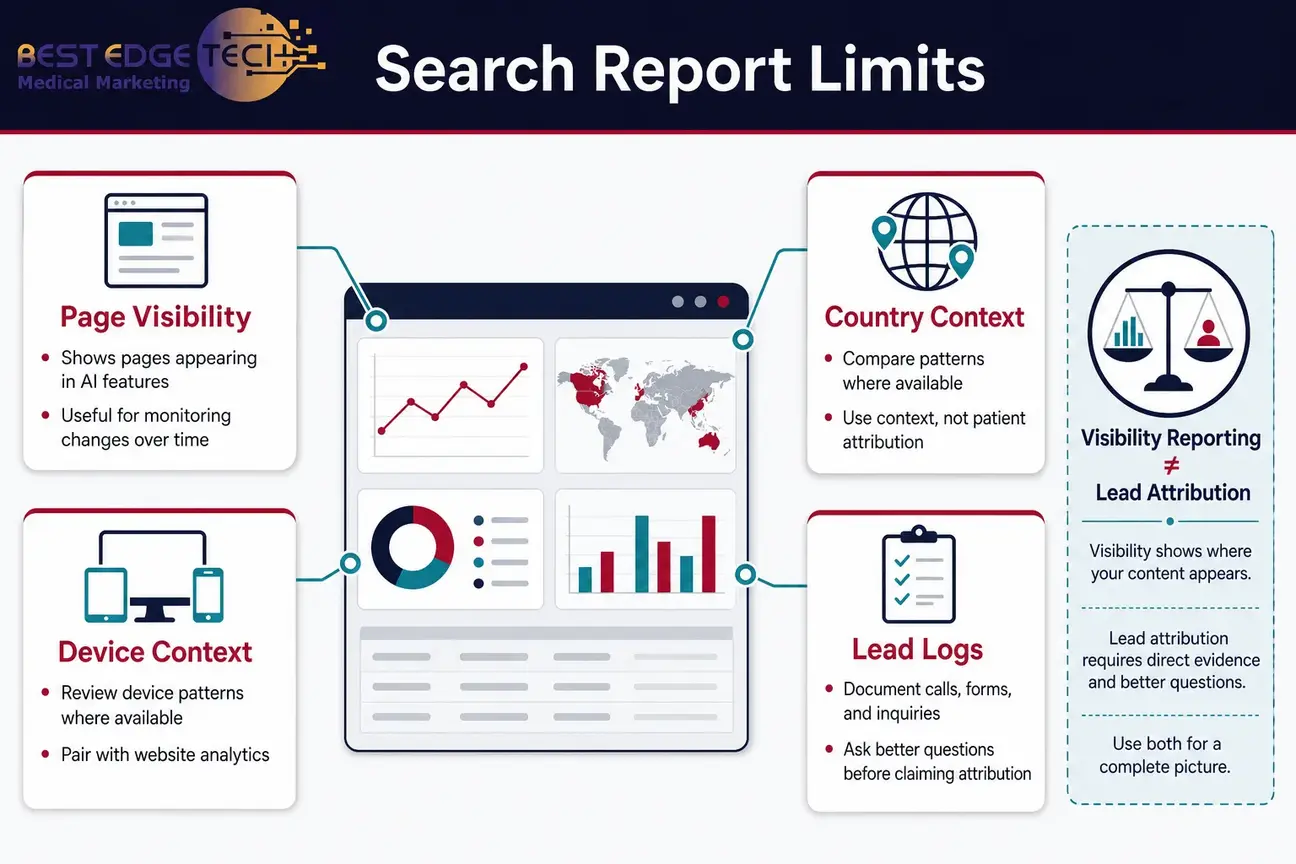
A Search Console report can show important search visibility patterns, but it is not a complete attribution system. In a medical marketing context, attribution means answering: “Which search exposure, page visit, phone call, form submission, or offline conversation contributed to a real inquiry?” Search Console helps with the first part of that chain, not the entire chain.
Use the Search Console report to identify pages that appear in generative AI features, monitor changes over time, and compare performance by page, country, and device where available. Then export or document those patterns alongside website analytics and lead logs. This lets the practice ask better questions instead of forcing the data to say more than it can.
For example, a dermatology practice may see that a service page earns new generative AI impressions. That is useful. But the practice still needs to check whether organic sessions to that page changed, whether tracked calls increased, whether forms were submitted, and whether intake notes mention online research. The Search Console report informs the investigation; it does not close the attribution loop by itself.
If your team works on AI search optimization for healthcare, the reporting discipline is just as important as the optimization work. Visibility is valuable only when the practice can interpret it honestly and connect it to patient inquiry behavior without promising outcomes the data cannot prove.
An AI visibility report should translate Search Console data into decisions a practice owner, administrator, or marketing director can understand. It should not be a long export of impressions without context. The report should answer: what appeared, where it appeared, which pages matter, what changed, and what follow-up actions are reasonable.
A useful AI visibility report for a medical practice usually has five sections:
This approach keeps the AI visibility report useful without making it look more precise than it is. A practice owner does not need inflated claims. They need to know whether visibility is moving in the right direction, which pages deserve improvement, and where lead tracking needs cleanup.
A strong AI visibility report should also flag data gaps. If the practice has no call tracking, no form-event tracking, no service-line categorization, and no consistent intake-source question, the report should say so. Otherwise, the practice may mistake incomplete tracking for weak performance.
The safest way to measure ai search is to build a framework that respects the difference between visibility, engagement, inquiry, and conversion. The following seven-part model is designed for healthcare marketing teams that need practical reporting without overstated attribution.
Start with a page inventory. For most practices, the key pages include high-value service pages, location pages, provider pages, condition or concern pages written for education, and conversion pages such as contact or appointment request pages. Do not treat every impression equally.
A generic blog post with many generative AI impressions may be helpful for awareness, but a service page with lower impressions may be more commercially relevant. A location page may matter more for a multi-location practice than a broad informational article. If the site structure is weak, consider whether medical website design improvements are needed before the data can be interpreted clearly.
Use practical intent buckets: branded, non-branded service, local service, provider, informational, and conversion. This keeps the AI visibility report from blending very different kinds of search behavior.
For example, a branded query suggests someone already knows the practice. A non-branded service query suggests the person may be comparing providers. A local service query suggests location relevance. A provider query may reflect reputation or referral behavior. Each category can produce patient inquiries, but they should not be judged the same way.
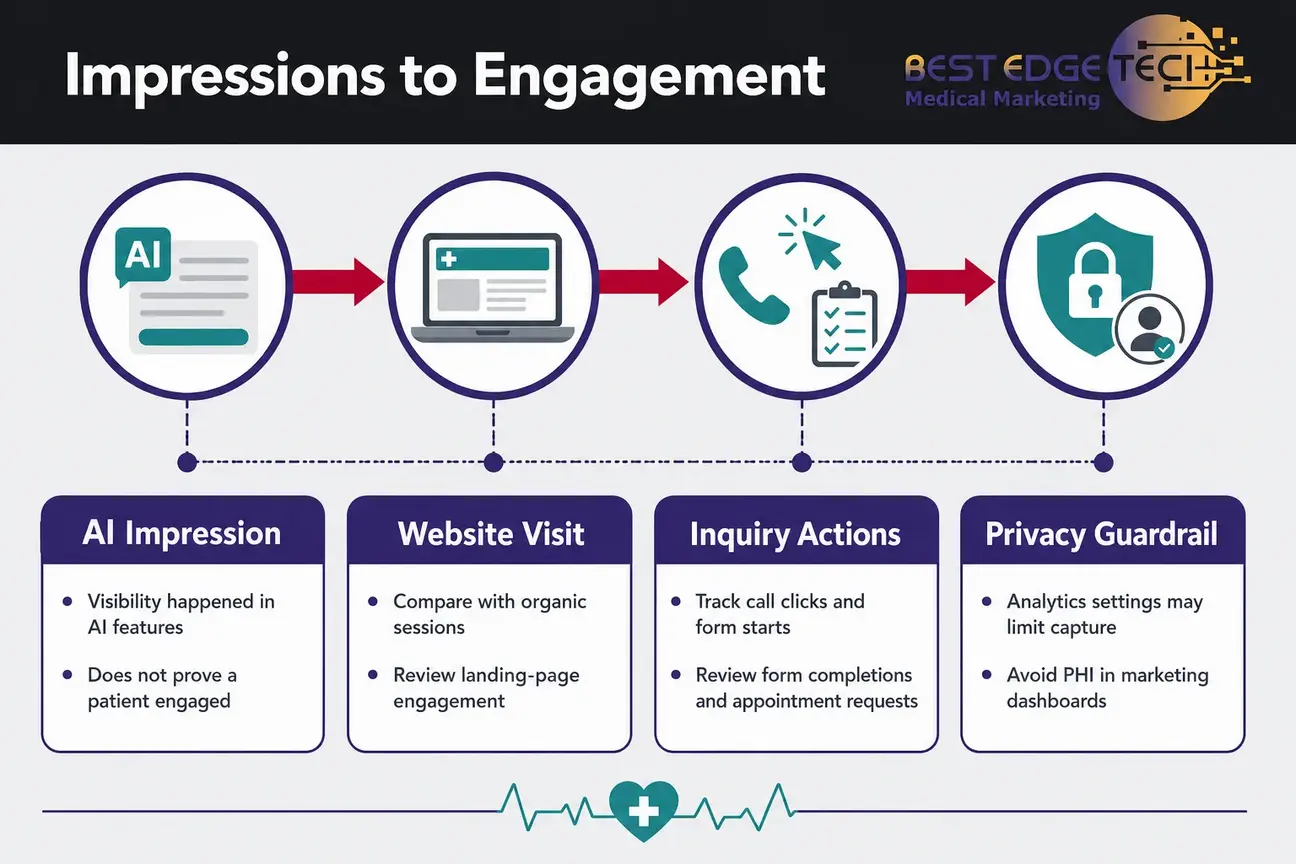
Generative AI impressions tell you that visibility happened. They do not show whether a person engaged meaningfully with the practice. Your next layer should compare page visibility with organic sessions, landing-page engagement, call clicks, form starts, form completions, and appointment-request events.
Healthcare marketers should be careful with engagement data because privacy and analytics settings can limit what is captured. Avoid using protected health information in analytics tools, call notes, or marketing dashboards. The HHS Office for Civil Rights HIPAA Privacy Rule page is an appropriate starting point for understanding privacy obligations, but practices should confirm advertising and privacy requirements with their own counsel or compliance team.
For marketing reporting, a lead usually begins with an inquiry action: a phone call, website form, appointment request, chat request if the practice uses one, or click to a scheduling workflow. These are not the same as revenue, completed treatment, or patient outcomes, and they should not be reported that way.
A medical practice can use source fields and internal intake procedures to connect online visibility to inquiry patterns. Keep the categories simple: organic search, Google Business Profile, referral, direct, paid media if used, and unknown. If “AI search” is added as a category, define it carefully as an internal marketing label, not as a native Google metric.
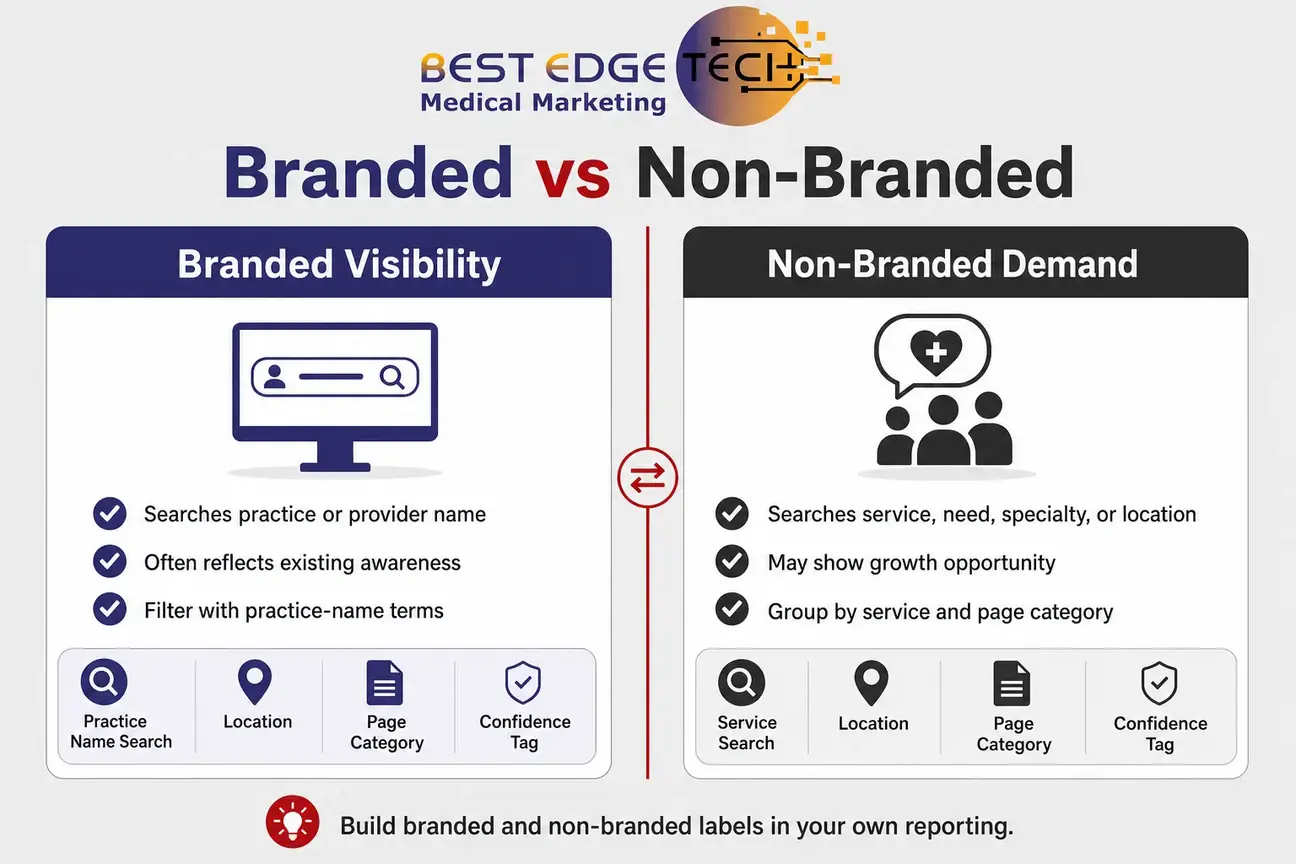
A branded AI visibility increase can be useful, but it often reflects existing awareness. Non-branded visibility may be more important for growth because it can indicate exposure to people who are searching by service, need, specialty, or location rather than by practice name.
Because Google’s generative AI reporting does not provide a simple branded-versus-non-branded lead attribution model, your team should build one in your own reporting. Use query analysis where available in broader Search Console data, practice-name filters, service-name filters, and page-level categorization. Then label the confidence level of your conclusions.
Service and location pages are often where medical marketing becomes measurable. A broad educational article may introduce the practice, but service and location pages usually carry stronger commercial intent. They also make it easier to connect generative AI impressions with specific inquiry types.
If a location page earns visibility but produces no calls, forms, or direction-related engagement, check the page before assuming AI search is underperforming. Is the page clear about services offered at that location? Does it have a visible phone number? Are calls to action easy to use on mobile? Does it load reliably? Is the content helpful and specific enough for both patients and search systems?
Every AI-related lead report should include an attribution confidence label. Use “high confidence” only when tracking clearly connects an inquiry to a page visit or campaign path. Use “moderate confidence” when timing, page engagement, and inquiry type align but the chain is incomplete. Use “limited confidence” when you only have visibility data and no downstream inquiry support.
This discipline protects the practice from overstating results. It also makes reporting more useful. A limited-confidence signal can still guide content improvements, technical SEO priorities, internal linking, and conversion work. It simply should not be described as a proven AI-generated lead.
Branded visibility answers a different business question than non-branded visibility. If a person searches the practice name, a provider name, or a unique branded service line, they may already know the practice. That can be valuable for reputation and navigation, but it is not the same as being discovered by a new patient comparing options.
Non-branded visibility includes searches around specialties, procedures, symptoms or concerns in a marketing context, service categories, and location modifiers. For healthcare practices, non-branded reporting should be handled carefully because clinical claims and patient privacy are sensitive. The goal is not to write medical advice; it is to understand how people search when comparing providers.
In your AI visibility report, keep these rows separate:
| Visibility bucket | What it suggests | What to measure next |
|---|---|---|
| Practice-name visibility | Existing awareness, referral follow-up, reputation checking | Profile visits, branded organic sessions, calls, contact-page visits |
| Provider-name visibility | Referral research or reputation comparison | Provider-page engagement, call clicks, appointment-request starts |
| Service visibility | Comparison shopping by specialty or procedure category | Service-page sessions, form completions, call tracking by page |
| Location visibility | Local provider discovery | Location-page engagement, phone calls, maps-related actions where tracked |
| Educational visibility | Early-stage research | Assisted engagement, internal clicks to service pages, return visits |
This branded versus non-branded split also helps administrators ask better budget questions. If most AI visibility is branded, the priority may be reputation, provider bios, and conversion clarity. If non-branded service pages are earning visibility but not inquiries, the priority may be page quality, call-to-action placement, internal linking, and mobile usability.
Medical practices should not report AI search visibility as one blended number. A dental practice, med spa, orthopedic group, plastic surgery practice, or anti-aging clinic may have very different service lines with different patient intent. A single total for generative AI impressions can hide which pages are actually gaining visibility.
Start with a page map. Group URLs by service line, provider, location, and funnel stage. Then compare each group against inquiry signals. This is where medical SEO services and healthcare SEO overlap with AI reporting: the same page architecture that helps traditional organic search also helps you interpret AI visibility.
For each important page group, ask:
Google’s guidance on creating helpful, reliable, people-first content is especially important for healthcare pages because medical topics can affect trust and decision-making. For practice websites, that means clear provider information, accurate service descriptions maintained by the practice, transparent authorship where appropriate, and no unsupported claims about clinical outcomes.
If your team is working on generative engine optimization, or GEO, you can also connect this page map to generative engine optimization services. The same caution applies: GEO reporting should focus on documented visibility and measurable inquiry signals, not promises of AI citations or patient volume.
Once generative AI impressions are mapped to pages, look for downstream signals. These signals are not all equal, and not every practice will track all of them. The point is to build a measurement stack that reflects real inquiry behavior without collecting unnecessary sensitive information.
The most useful lead signals for healthcare marketing teams include:
Do not report clinical outcomes, treatment acceptance, or patient value as AI search metrics unless the practice has a lawful, approved, privacy-aware way to analyze that information. Even then, marketing reports should avoid exposing unnecessary details. For most practices, inquiry-level reporting is the appropriate marketing layer.
AI attribution usually goes wrong in one of three ways. First, the report treats impressions as leads. Second, it assumes every inquiry after an AI visibility increase came from AI search. Third, it blends branded, non-branded, service, and location visibility into one number and calls it performance.
These mistakes can mislead practice owners. They also create pressure to optimize for dashboards instead of patient inquiry quality. A better approach is to state attribution limits clearly. For example: “This service page gained generative AI impressions during the same period that organic calls increased, but the available data does not prove that AI visibility caused every call.”
Use language like:
Avoid language like “AI search generated all of these leads” unless your tracking can truly support that statement. In many cases, it cannot. Results depend on competition, site history, content quality, technical health, market demand, tracking setup, and execution.
Use this workflow once a month or once per reporting cycle. The exact cadence depends on practice size, number of locations, content volume, and how often the website changes. The workflow is intentionally simple so practice administrators and marketing directors can use it without turning every report into a technical audit.
This workflow gives leadership a clear picture: what is visible, what is measurable, what is uncertain, and what should be improved next. It also prevents the reporting team from pretending that AI search has a simple last-click attribution path when the available data does not show that.
Google’s guide to optimizing your website for generative AI features emphasizes the same fundamentals that matter for durable search visibility: make content accessible to Google, provide helpful content, and use standard search best practices. For healthcare websites, those fundamentals work best when paired with accurate service pages, strong local signals, and careful lead tracking.
If your report shows visibility but weak attribution, do not assume the campaign failed. Often the tracking system is incomplete. The practice may have multiple phone numbers, untagged forms, unclear thank-you pages, blocked analytics events, or appointment software that does not pass source data back to marketing reports.
Start with a measurement cleanup:
Practices with multiple specialties or locations may also need separate dashboards. A blended report can hide the fact that one service line is gaining visibility while another is losing visibility. It can also hide conversion problems on a single high-value page.
If your team wants help connecting AI visibility, medical SEO, page structure, and lead tracking, you can contact Best Edge Medical Marketing or call (252) 303-0074. Share your website URL, specialties, locations, recent site changes, goals, and the service you are considering so the conversation starts with the right context.
The value of AI reporting is not just knowing whether impressions went up or down. It is using those patterns to improve the website. If an educational page earns visibility, add clear internal links to relevant service pages. If a service page earns visibility but few inquiries, review the call to action, trust signals, provider context, and mobile experience. If a location page is invisible, check whether it has unique, useful information for that market.
This is where healthcare marketing services should stay practical. AI reporting should influence content planning, technical SEO, website design, local SEO, and conversion work. It should not become a vanity metric exercise.
An AI visibility report is most useful when it leads to specific actions:
For specialty practices, the same principles apply. Dental practices, med spas, plastic surgery practices, and anti-aging clinics should measure how people search for and compare providers. The report should not make treatment-safety, efficacy, or outcome claims. It should stay focused on search visibility, page engagement, and patient inquiries.
Practice owners and administrators should expect better visibility into patterns, not perfect certainty. AI search measurement is still developing, and platform reports do not give a complete view of every patient decision. Many people research across multiple searches, devices, listings, websites, and offline conversations before contacting a practice.
A mature report should tell leadership:
That is enough to make better marketing decisions without pretending to know more than the data supports. In healthcare, that restraint is a strength. It protects the practice from unsupported claims and keeps the focus on improving visibility, user experience, and inquiry quality.
This article is marketing education, not legal, medical or compliance advice. Confirm advertising and privacy requirements with your own counsel or compliance team.
The most reliable way to measure ai search leads is to treat Search Console data as one part of a larger measurement system. Use generative AI impressions to understand visibility, use an AI visibility report to organize pages and intent, use a Search Console report to monitor changes, and use downstream lead tracking to evaluate whether visibility is connected to real inquiries.
For medical practices, the discipline is simple: measure what can be measured, label what is uncertain, and avoid promising what no report can prove. When AI visibility, page quality, and inquiry tracking are reviewed together, leadership gets a clearer view of what to improve next.
It shows visibility signals for a site in Google’s generative AI features, including impressions and page-level patterns. For a medical practice, that can help identify which pages are appearing in AI-enhanced search experiences, but it should not be treated as a complete lead report.
Not by itself. Search Console can support visibility analysis, but a practice needs its own website analytics, call tracking, form tracking, and intake-source process to connect visibility with inquiries. Even then, many findings should be described as influenced or correlated unless the tracking path is clear.
Group practice-name and provider-name searches separately from service, specialty, and location searches. Branded visibility often reflects existing awareness, while non-branded visibility can show discovery opportunity. The separation usually requires query analysis, page grouping, and reporting rules created by the practice or its marketing team.
Prioritize service pages, location pages, provider pages, and high-value educational pages that can lead visitors toward a relevant next step. Do not rely only on total impressions across the whole site because that can hide which pages actually support patient inquiries.
Useful signals include tracked calls, form submissions, click-to-call events, appointment-request starts, contact-page visits, and service-page assisted visits. These signals should be collected in a HIPAA-aware way and reviewed with the practice’s own compliance team when needed.
Use attribution confidence labels. Call a finding high confidence only when tracking clearly supports it. Use moderate, limited, or exploratory labels when the evidence is incomplete. Avoid saying AI search generated a lead when the data only shows visibility or timing correlation.
Yes. Service pages often show demand for a specific procedure, specialty, or offering, while location pages show local discovery behavior. Measuring them separately helps the practice decide whether to improve content, calls to action, internal links, local signals, or tracking.
Best Edge Medical Marketing is a medical marketing agency that provides marketing, SEO, design, and development services to businesses in the medical industry.
Call Us Today
(252) 303-0074