
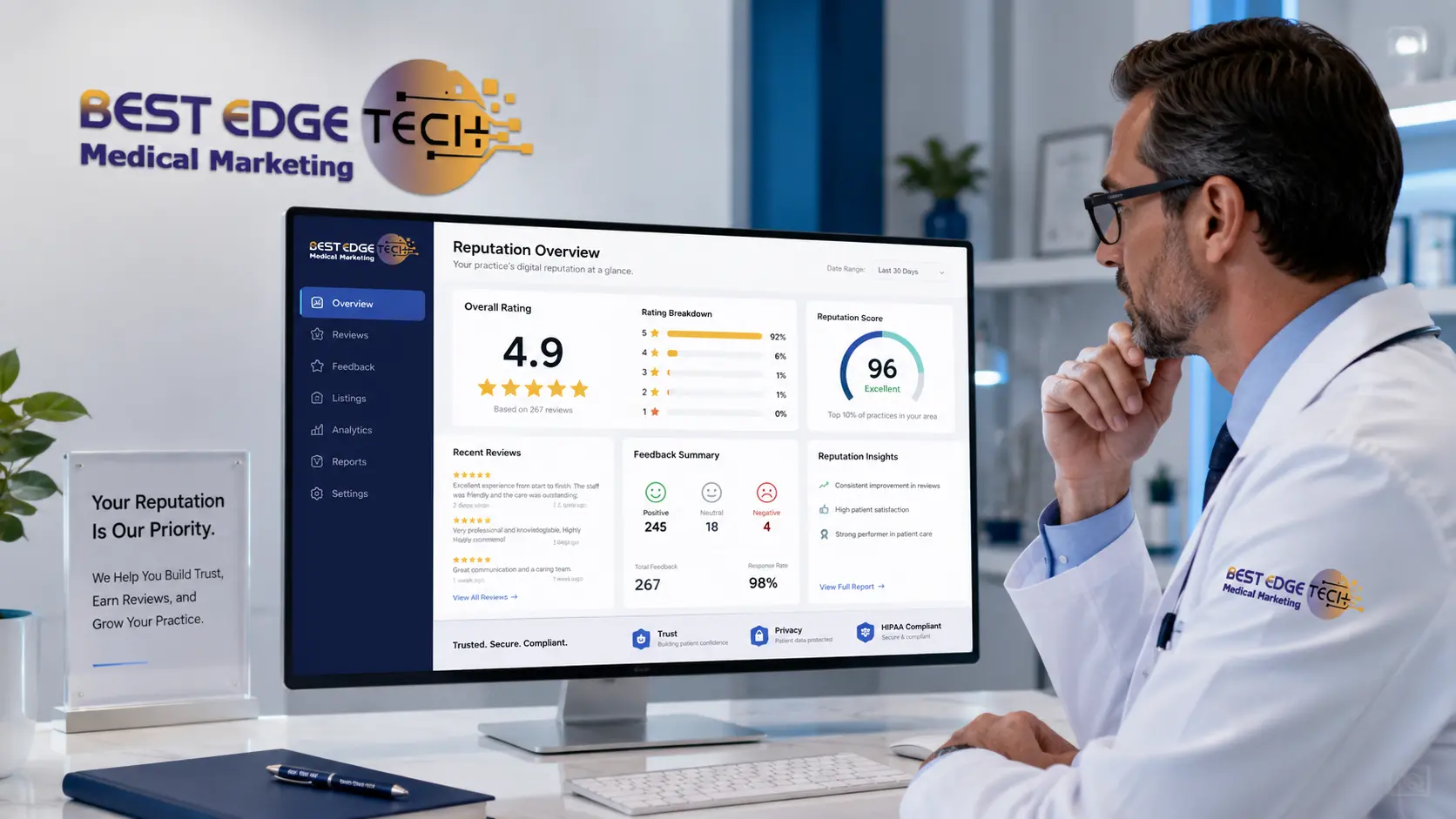
Online reputation management for doctors is the structured process of monitoring patient feedback, requesting authentic reviews, responding without disclosing protected health information, and using reputation signals to strengthen patient trust. For medical practices, the process must account for HIPAA privacy requirements, Federal Trade Commission guidance, platform policies, and applicable state medical board rules.
A strong online reputation can help prospective patients evaluate a medical practice, understand its services, and feel more confident taking the next step. However, a poorly managed response—even when written with good intentions—can expose private information, escalate a complaint, or damage the credibility the practice is trying to build.
This guide explains how physicians, healthcare administrators, practice owners, and marketing teams can develop a compliant, repeatable reputation management program that supports patient acquisition, local visibility, and long-term brand authority.
Does your practice have a documented review-management policy?
Best Edge Medical Marketing helps healthcare organizations evaluate their review requests, public responses, Google Business Profile activity, website trust signals, and patient inquiry paths.
| Reputation Management Step | Primary Purpose | Compliance Priority |
|---|---|---|
| Monitor review platforms | Identify feedback, trends, and potential risks | Limit access to trained team members |
| Request patient reviews | Generate authentic feedback from real experiences | Use general language and avoid review gating |
| Respond publicly | Show that feedback is acknowledged professionally | Never confirm patient status or disclose PHI |
| Escalate concerns privately | Resolve service or operational problems | Use secure, approved communication channels |
| Publish testimonials | Build trust on service and provider pages | Evaluate whether written HIPAA authorization is required |
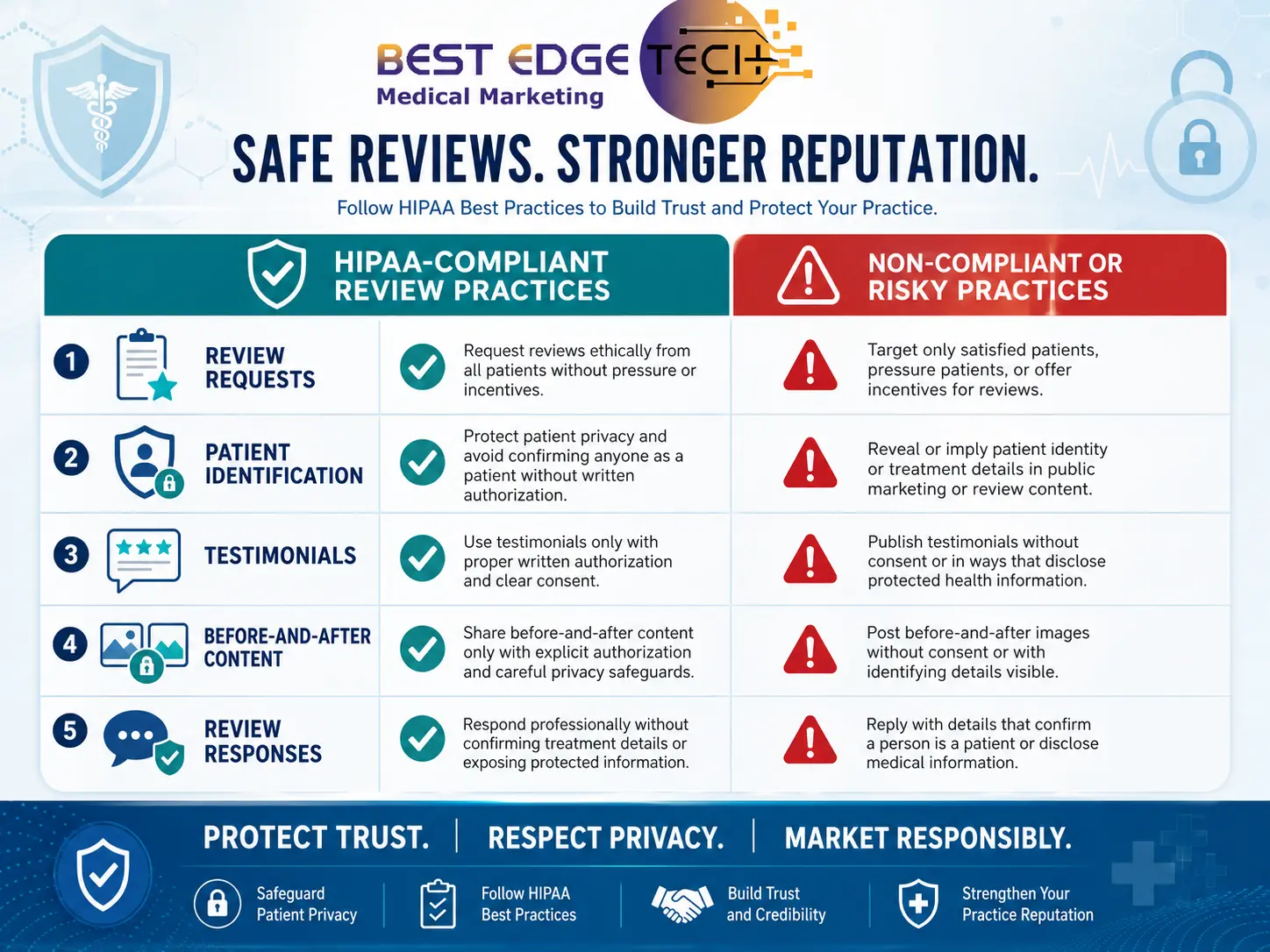
Online reputation management for doctors is an ongoing system for monitoring, requesting, evaluating, responding to, and using patient feedback without compromising patient privacy. It includes public review platforms, Google Business Profiles, healthcare directories, social media, practice websites, provider profiles, and any other digital source that shapes how patients perceive a healthcare organization.
Effective reputation management is not simply an effort to accumulate five-star ratings or remove criticism. It should help a practice:
The process involves marketing, compliance, patient experience, operations, and risk management. A successful program therefore requires more than access to review-monitoring software. It needs documented policies, approved language, staff training, escalation procedures, and clear accountability.
A medical practice’s online reputation can influence patient confidence before the patient ever calls the office. Reviews may help prospective patients evaluate communication, professionalism, accessibility, office operations, and the overall patient experience. They can also affect whether a searcher clicks a listing, visits a provider profile, calls the practice, or continues comparing alternatives.
Reviews should not be treated as clinical proof. A patient’s personal account cannot establish that a provider is clinically superior, guarantee outcomes, or replace objective information about credentials and services. Reviews do, however, provide visible experience signals that can shape how patients perceive a practice.
A reputation program can influence several parts of the patient acquisition process:
Practices should connect reputation management with their broader medical SEO strategy, patient experience program, and conversion tracking rather than operating it as an isolated public relations task.
Reviews can contribute to a medical practice’s local visibility, but they are only one part of Google’s local ranking systems. Google identifies relevance, distance, and prominence as primary considerations for local results. Google also states that review count and positive ratings can help local ranking, while accurate business information and broader web prominence remain important.
A strong review profile does not guarantee a top map position. Local performance can also be affected by:
Review scores, review counts, written feedback, photos, and business responses are visible during local searches. These elements can affect whether a patient clicks the website, requests directions, or calls the practice. Detailed reviews may also reveal recurring themes about staff communication, appointment availability, office organization, and the overall experience.
Medical practices should monitor these themes instead of evaluating performance based only on an average star rating. A high rating can still conceal recurring operational concerns, while a mixed review profile may contain valuable information that helps the practice improve.
Learn more about how medical search engine optimization connects website authority, local visibility, and patient acquisition.
A medical practice should never confirm that a reviewer is a patient or disclose information about the person’s care in a public response. A reviewer may voluntarily disclose personal health information, but that does not give the practice permission to reveal, verify, correct, or expand on protected information publicly.
Potentially risky responses include statements such as:
Each of these responses may confirm or disclose information about an individual’s relationship with the practice, treatment, diagnosis, payment, appointment history, or care.
Negative reviews can feel inaccurate, incomplete, or unfair. The natural impulse may be to correct the record publicly. That is precisely when a compliance-controlled process is most important.
The U.S. Department of Health and Human Services Office for Civil Rights has pursued enforcement matters involving healthcare providers that disclosed patient information while responding to online reviews. These actions demonstrate that public review responses can create genuine HIPAA exposure when a provider reveals or confirms protected information.
The safest public response usually does not debate the facts. It acknowledges the feedback in neutral language, explains that privacy prevents public discussion, and provides an appropriate offline contact path.
Important: A patient’s decision to publish personal information does not waive the medical practice’s HIPAA obligations. Public replies should be reviewed under an approved policy and should never confirm whether the person received care.
Review requests should use general, neutral language and should not mention a diagnosis, procedure, medication, treatment result, appointment type, or other health information. The request should invite honest feedback without pressuring the patient or suggesting what rating or language the practice expects.
Thank you for choosing our practice. We value feedback about your experience. You may share an honest review using the link below.
Please leave a five-star review and mention how successful your procedure was with Dr. Smith.
The second example creates multiple problems. It asks for a specific rating, references treatment, encourages a clinical-outcome statement, and attempts to influence the content of the review.
Practices may use several channels to invite feedback, provided the communication process is properly evaluated:
Healthcare organizations should evaluate whether each vendor that creates, receives, stores, or transmits protected health information requires a business associate agreement. Review-request systems should also be assessed for access controls, data retention, message content, opt-out handling, and integration with practice systems.
Review gating occurs when a business filters patients based on satisfaction and directs only favorable respondents to a public review platform. For example, a practice may send satisfied patients to Google while routing dissatisfied patients to a private form. This distorts the review process and can violate platform policies.
Medical practices should avoid workflows that:
Practices can invite private feedback and public reviews, but the private-feedback process should not be used to determine who receives access to the public review link.
Medical practices should not offer incentives for Google reviews, and any incentive-based testimonial program requires careful review under platform policies, FTC guidance, healthcare regulations, and state law. Incentives can undermine the independence of a review and may require disclosure even when a platform permits them.
Do not offer:
The FTC’s Consumer Reviews and Testimonials Rule addresses deceptive conduct involving reviews and testimonials, including fake reviews and certain forms of review suppression. The rule took effect on October 21, 2024. Practices should also review the current policy of every platform on which feedback will appear.
Public review responses should be brief, neutral, professional, and free of patient-specific information. Their purpose is not to prove that the practice is correct. Their purpose is to acknowledge feedback, demonstrate professionalism, and create an appropriate path for private communication.
The following templates are starting points only. They should be reviewed by the practice’s legal or compliance advisors and adapted to the organization’s policies.
Thank you for taking the time to share your feedback. Our team appreciates hearing about your experience and remains committed to providing respectful, attentive service.
Thank you for your feedback. We continually evaluate how we can improve the experience we provide. Please contact our office directly if you would like to discuss your concerns further.
We take feedback seriously and are committed to addressing concerns appropriately. To protect privacy, we do not discuss individual circumstances publicly. Please contact our office directly so the appropriate team member can assist you.
We take feedback seriously. Because we cannot discuss or verify individual circumstances in a public forum, please contact our office directly so we can better understand your concerns.
We take concerns about safety seriously. To protect privacy, we cannot discuss individual circumstances here. Please contact the office directly through the appropriate number listed on our website. For a medical emergency, call 911 or seek immediate emergency care.
Public replies should not be used to provide individualized medical advice. The practice should also avoid inviting sensitive information through an unsecured channel.
Review responses should protect privacy without sounding automated.
Best Edge Medical Marketing can help your practice create a response library, approval process, escalation matrix, and ongoing reputation monitoring workflow.
Any conversation involving specific care, appointments, billing, insurance, staff conduct, or clinical concerns should move away from the public review platform. The public response should direct the reviewer to an approved contact path without implying that the practice knows or has verified the person.
Taking the conversation offline does not mean moving it to any convenient channel. The practice should define:
Service recovery and public reputation management are related but distinct. The public response protects privacy and demonstrates professionalism. The private process investigates and addresses the underlying issue.
Medical practices should document and report reviews that clearly violate platform policies, but they should not assume that every negative or unrecognized review is fake. A reviewer may use a different name, post on behalf of another person, or omit identifying details.
Practices should not publish private records to disprove a review. They should also avoid organizing employees, friends, or vendors to overwhelm criticism with artificial positive feedback.
A review voluntarily posted by a patient on a third-party platform presents different considerations from a testimonial selected, copied, edited, or republished by the medical practice. Once a practice uses a person’s statement in advertising or on its website, additional HIPAA, authorization, copyright, platform, and advertising considerations may apply.
| Reputation Content | Primary Consideration |
|---|---|
| Patient-posted platform review | The patient chooses what to disclose, but the practice still cannot disclose or confirm PHI in its response. |
| Third-party review widget | Confirm platform terms, display method, data handling, filtering, accessibility, and authenticity. |
| Copied website testimonial | Evaluate written HIPAA authorization, copyright, accuracy, disclosure, and advertising requirements. |
| Edited testimonial | Edits must not distort the reviewer’s message, omit material context, or create a misleading impression. |
| Patient story or case study | Use a legally sufficient authorization that clearly covers the intended content, channels, and disclosures. |
| Before-and-after images | Require heightened authorization, accurate context, secure records, and avoidance of misleading or guaranteed-outcome claims. |
A general marketing consent form may not satisfy the requirements for disclosing protected health information. When a testimonial, image, patient story, or case example identifies an individual or reveals information connected to care, the practice may need a valid written HIPAA authorization that specifically describes the intended use and disclosure.
Before publishing patient-derived content, a healthcare organization should have qualified counsel evaluate:
A dominance-level reputation program is a documented operating system rather than a collection of occasional review requests. It establishes responsibilities, response standards, compliance controls, escalation rules, reporting metrics, and continuous improvement procedures.
Assign a trained owner for reputation management. Depending on the organization, that may be a practice administrator, compliance officer, patient experience leader, marketing director, or qualified agency partner.
Document when requests are sent, who receives them, which systems are used, what language appears, and how the practice prevents review gating.
Create approved starting templates for positive, neutral, negative, unidentified, abusive, billing-related, and safety-related reviews. Templates should guide staff without producing identical or context-insensitive responses.
Many practices benefit from monitoring review channels at least weekly and routing urgent matters immediately. The appropriate response time depends on staffing, review volume, and risk level.
Define which situations require review by leadership, compliance, risk management, legal counsel, a malpractice carrier, human resources, or security.
Categorize feedback by issue, such as:
This transforms reviews from isolated comments into operational intelligence.
Review templates, platform policies, vendor configurations, access permissions, authorization forms, and staff training on a scheduled basis. Regulations and platform rules can change, so the process should not remain static.
Practices should measure reputation performance using a balanced scorecard rather than focusing only on average star ratings. Useful metrics connect feedback quality, response execution, local visibility, website behavior, and patient inquiries.
| Metric | What It Helps Evaluate |
|---|---|
| New reviews by platform | Where patients are actively providing feedback |
| Average rating and rating distribution | Overall sentiment and changes over time |
| Response rate | Whether the practice consistently acknowledges feedback |
| Median response time | Operational responsiveness |
| Recurring review themes | Service strengths and process failures |
| Google Business Profile calls and website clicks | Engagement originating from the local listing |
| Website conversion rate | Whether reputation content supports inquiries |
| Escalation resolution status | Whether serious concerns are investigated and closed |
Practices should not use protected health information in marketing dashboards unless the system, access, vendor relationship, and purpose have been appropriately evaluated.
Authentic, properly authorized reputation content can strengthen a healthcare website when it is presented accurately and placed near relevant decision points. Reviews should support—not replace—clear information about services, provider qualifications, locations, policies, and patient expectations.
Potential placements include:
A testimonial about staff friendliness may belong near general practice information. A properly authorized testimonial related to a service may be more relevant on that service page. Testimonials should not be placed in a way that implies guaranteed results or universal patient experiences.
Reputation management can support search and AI visibility by strengthening the accuracy, consistency, and credibility of a medical practice’s broader digital presence. Reviews alone do not guarantee rankings, AI citations, or inclusion in an AI-generated answer. They work alongside authoritative website content, provider information, local profiles, links, structured data, and other quality signals.
Search engines and AI-assisted search experiences may encounter information about a practice across multiple sources. A coherent presence makes it easier to associate the correct services, providers, locations, and brand information with the same healthcare entity.
Structured data can clarify page meaning and entity relationships, but it should describe visible, accurate content. FAQ, organization, physician, medical business, article, and breadcrumb schema may be appropriate depending on the page. Markup should not contain fabricated reviews, invisible testimonials, or protected health information.
Explore our AI search optimization services and generative engine optimization strategies for healthcare organizations seeking stronger visibility across traditional and AI-assisted discovery.
A complete and actively maintained Google Business Profile gives prospective patients reliable information and creates an important foundation for local reputation management. The profile should accurately represent the practice and comply with current Google policies.
| Activity | More Appropriate Approach | Risky Approach |
|---|---|---|
| Request wording | “We value honest feedback about your experience.” | “Please give us five stars and mention your procedure.” |
| Request distribution | Use a consistent, objective workflow. | Ask only patients expected to leave positive reviews. |
| Public response | Acknowledge feedback without confirming patient status. | Discuss appointments, diagnosis, billing, or treatment. |
| Negative review | Move the conversation to an approved private channel. | Argue publicly or threaten the reviewer. |
| Testimonials | Evaluate written authorization and advertising requirements. | Copy patient comments onto the website without review. |
| Outcome claims | Use accurate context and required disclosures. | Imply guaranteed, typical, or universal results. |
| Incentives | Follow each platform’s policy and obtain compliance guidance. | Offer discounts or gifts for Google reviews or positive ratings. |
Best Edge Medical Marketing develops healthcare-focused digital strategies that connect patient trust, search visibility, compliant communication, and conversion performance. We help medical organizations create structured reputation programs instead of relying on disconnected review tools or generic response templates.
Depending on the practice’s needs, support may include:
Our approach aligns reputation content with the practice’s broader healthcare marketing strategy, website architecture, provider authority, and patient acquisition goals.
Identify gaps in your review requests, response process, Google Business Profile, website trust signals, and patient inquiry tracking.
Online reputation management for doctors is the process of monitoring patient feedback, requesting authentic reviews, responding appropriately, addressing risks, and presenting accurate trust signals across search engines, review platforms, provider directories, and medical websites. The program should include HIPAA-conscious response policies, review solicitation standards, escalation procedures, and ongoing performance measurement.
Doctors and medical practices may respond, but the reply should not confirm that the reviewer is a patient or reveal information about appointments, diagnoses, treatment, billing, insurance, or outcomes. Even when a reviewer discloses personal details, the practice should use neutral language and move case-specific communication to an approved private channel.
A safer response acknowledges the feedback, explains that privacy prevents discussion of individual circumstances, and provides an offline contact option. For example: “We take feedback seriously. To protect privacy, we do not discuss individual circumstances publicly. Please contact our office directly so the appropriate team member can assist you.” Templates should receive compliance review.
Yes. A practice can invite patients to leave honest reviews using neutral language that does not reference diagnoses, procedures, medications, or treatment outcomes. Requests should be distributed through a consistent process and should not ask for five-star ratings, prescribed wording, or only positive feedback. The practice should also comply with Google’s current policies.
Review gating is a process that filters patients by satisfaction and directs only favorable respondents to a public review site. For example, sending happy patients to Google while routing unhappy patients to a private form is review gating. Practices should use objective eligibility criteria and provide the same neutral review opportunity without predicting sentiment.
Medical practices should not offer incentives for Google reviews. Other review or testimonial arrangements may also create FTC, disclosure, platform, healthcare, or state-law concerns. Never condition an incentive on a positive rating or specific sentiment. Before offering anything of value, review the applicable platform policy and obtain qualified legal or compliance guidance.
Republishing a review may involve considerations that do not apply when the patient posts it independently. The practice should evaluate HIPAA authorization, copyright, platform terms, accuracy, editing, advertising disclosures, and whether the content reveals care information. A generic consent form may not be sufficient for using identifiable patient information in marketing.
Before-and-after images may be used only after careful legal and compliance review. Practices generally need a valid authorization covering the intended use and disclosure. Images and captions must not be misleading, omit material context, or imply guaranteed outcomes. Applicable professional board rules, FTC standards, state laws, and platform policies should also be reviewed.
Google states that review count and positive ratings can help local ranking, but reviews are not the only factor. Local results are primarily influenced by relevance, distance, and prominence. Profile completeness, website authority, links, citations, services, location relevance, and competition also affect visibility. No review strategy can guarantee a particular map position.
Many practices should review major platforms at least weekly, while high-volume organizations may need daily monitoring. Urgent allegations, threats, privacy concerns, or safety issues should be escalated immediately. The appropriate schedule depends on review volume, staffing, risk level, and the number of providers and locations being monitored.
Preserve evidence, compare the review with the platform’s policies, and report it using the most accurate violation category. Do not disclose records or patient information to disprove the review publicly. If the review remains visible, use a neutral response that does not confirm or deny a relationship. Escalate threats, extortion, or serious allegations appropriately.
Reputation management may support AI-assisted discovery by strengthening the consistency and credibility of the practice’s overall digital presence. Reviews do not guarantee citations or recommendations. They work alongside provider biographies, authoritative content, accurate business information, structured data, links, service pages, and other signals that help systems understand the practice.
A written HIPAA authorization may be required when a practice uses identifiable patient information or information connected to care for marketing. The exact requirement depends on the content and intended use. Practices should not rely solely on informal permission or a generic release. Qualified legal or compliance counsel should review the authorization and publication process.
A healthcare-focused agency can audit review platforms, improve Google Business Profiles, develop request and response workflows, strengthen website trust signals, monitor reputation trends, and connect review activity with SEO and conversion tracking. Legal and compliance decisions should remain subject to review by the practice’s qualified advisors.
This article provides general marketing and educational information and does not constitute legal, regulatory, medical, or compliance advice. Healthcare organizations should consult qualified legal and compliance professionals regarding their specific obligations.

Strategically Reviewed by Christopher A. Whitfield
Christopher A. Whitfield is a digital marketing, medical SEO, AI search optimization, and content strategy specialist. He reviews Best Edge Medical Marketing content for search strategy, topical authority, user intent, and digital marketing accuracy.
Best Edge Medical Marketing is a medical marketing agency that provides marketing, SEO, design, and development services to businesses in the medical industry.
Call Us Today
(252) 303-0074