
Root-cause medicine • Clear positioning • Patient trust
Functional Medicine Marketing: Building Trust With Complex-Care Patients
Make complex care easier to understand. Build a credible digital presence around careful assessment, transparent expectations, and a clear path to the right consultation.

A prospective patient has searched for explanations of fatigue, widespread pain, or recurrent reactions. They arrive at a clinic website that promises to “find the root cause,” but cannot tell who will evaluate them, what the first appointment includes, or how much the process may cost. The headline sounds reassuring; the decision remains difficult.
For an independent practice, this is a communication problem worth solving. Complex services require more than an impressive therapy list. Visitors need to understand whether the practice addresses their concern, which professional provides care, what evidence supports the explanation, and what happens if another specialist is more appropriate.
Good functional medicine marketing turns those questions into useful information. It can support appropriate inquiries and a sustainable cash-pay service without treating distress as a sales opportunity. This guide gives practice leaders a practical framework for positioning, content, fees, inquiry handling, and measurement. Clinical diagnosis and treatment remain the responsibility of qualified professionals.
How should functional medicine marketing describe root-cause care?
A practice should describe root-cause medicine through the specific assessment and care processes it actually provides. The phrase is a positioning term; it does not establish a diagnosis, a distinct credential, or proof that one underlying problem explains every patient’s symptoms.
Translate the philosophy into verifiable actions. Does the clinician review prior records? How are concerns evaluated? Which services are available? What are the limits of the practice’s scope? Who coordinates referrals? These details allow visitors to evaluate the offer rather than infer a clinical result from an appealing phrase.
A clear assessment starts with understanding your concerns.
Learn how the consultation reviews your history, considers appropriate evaluation, and discusses available options. Recommendations depend on the individual assessment.
Use that wording only if it matches the service. A clinic offering a brief screening appointment should not advertise a comprehensive record review that staff cannot deliver. If care is provided by a professional other than a physician, identify the actual role and relevant qualifications.
Differentiate the process without attacking other clinicians
A practice can explain its appointment structure, areas of focus, and coordination approach without claiming that conventional medicine ignores causes. Patients may need primary care, allergy/immunology, rheumatology, or another specialty alongside an integrative consultation. Positioning should leave room for that collaboration.
For internal planning, define the promise at the level of service delivery: clear information, an appropriate assessment, and an understandable care discussion. Do not turn it into a promise of diagnostic certainty. This makes the brand easier for clinicians, administrators, and marketing teams to explain consistently.
What do complex-care patients need to know before contacting a practice?
Complex-care visitors need to know whether the practice is relevant to their concern, how assessment works, what it costs, and what level of certainty they can reasonably expect. A page should answer those questions without assuming that every visitor has the same diagnosis or prior experience.
Separate the audiences behind similar searches. Someone looking for “chronic fatigue doctor” may be describing a symptom, researching an established condition, or comparing providers after earlier evaluations. Someone searching for MCAS may have a diagnosis, be awaiting evaluation, or be trying to understand information encountered online.
The explanation seeker
Needs plain-language information, evidence boundaries, and a description of how concerns are evaluated.
The provider comparer
Needs accurate clinician credentials, scope of practice, location, appointment details, and financial expectations.
The already-diagnosed visitor
Needs to understand whether the clinic supports the relevant care need and how it coordinates with existing professionals.
The appointment-ready visitor
Needs a clear next step, scheduling information, fees, and an appropriate place for sensitive records.
These are planning categories, not clinical classifications. Ask the practice’s staff which questions actually occur, then prioritize answers. Avoid describing patients as “desperate,” “high-ticket,” or inherently compliant because they can pay. Financial capacity and willingness to book do not establish clinical suitability.
The commercial goal is an informed match between the service and the person seeking care. A page that helps someone recognize a different provider is more appropriate may reduce inquiries while improving their relevance. That outcome should be visible in reporting rather than treated as failed conversion.
Respectful language also improves clarity. Acknowledge uncertainty and the effort involved in navigating care, but do not assume that previous clinicians were dismissive or incompetent. Let the practice explain its own service through specific facts instead of borrowing credibility from criticism of another care model.
How can a clinic write empathetic copy without promising a cure?
Empathetic copy acknowledges a concern, describes an available process, and states its limits. It should help a reader understand the practice without converting uncertainty into a diagnosis or suggesting that a consultation guarantees an answer.
| Weak or unsupported wording | More useful direction | Why it helps |
|---|---|---|
| “We find the cause other doctors missed.” | “Learn how we review your concerns and consider appropriate next steps.” | Explains a process without guaranteeing a discovery. |
| “Reverse chronic fatigue.” | “Understand the scope of our fatigue-related consultations.” | Avoids an unsupported outcome and clarifies the service. |
| “Your symptoms prove you need advanced testing.” | “Testing decisions depend on your clinical assessment.” | Keeps evaluation separate from product promotion. |
| “Premium care for patients who are serious.” | “Review consultation fees, what is included, and how follow-up works.” | Explains fit without judging motivation or affordability. |
These are editorial directions, not an automatic legal clearance. Whether a statement is appropriate depends on its context and supporting evidence. Review the entire page, including photographs, testimonials, before-and-after images, and the appointment offer. The combined impression may communicate more than the headline alone.
The FTC’s Health Products Compliance Guidance addresses substantiation and the messages consumers reasonably receive. A softer verb does not make an unsupported health claim acceptable. “Supports,” “helps,” and “may” still need an appropriate basis when they communicate a benefit.
Build a claim review into the content workflow
For each material clinical statement, record the source, intended meaning, reviewer, and qualification needed. Separate operational claims—appointment structure or fee inclusions—from clinical claims about diagnosis or outcomes. The responsible clinician verifies clinical information; the administrator verifies what the practice actually delivers.
If evidence is uncertain, say so in the explanation where the decision occurs. Do not place a confident promise at the top and rely on a distant disclaimer to undo it. Clear qualification belongs next to the claim it limits.
How should marketing distinguish fatigue, fibromyalgia, MCAS, and MTHFR concerns?
Marketing should distinguish symptoms, diagnosed conditions, and genetic findings rather than treating them as one root-cause category. Each topic requires accurate terminology and an explanation of the practice’s actual assessment or referral role.
| Topic | Important distinction | Content implication |
|---|---|---|
| Persistent fatigue and ME/CFS | Fatigue is a symptom; ME/CFS requires a specific clinical assessment. | Do not use the terms interchangeably or promise one confirmatory test. |
| Fibromyalgia | Assessment is clinical; there is no specific laboratory or imaging test for the condition. | Do not advertise a panel as a definitive fibromyalgia test. |
| MCAS | Evaluation involves clinical criteria and appropriate evidence of mast cell mediator activity. | Do not diagnose it from a general symptom checklist. |
| MTHFR variants | A genetic variant is different from a complete explanation of a person’s symptoms. | Avoid turning a result into a universal diagnosis or supplement recommendation. |
CDC’s ME/CFS diagnostic guidance describes an assessment that includes the clinical history and evaluation for other explanations. There is no currently available confirmatory diagnostic test. Patient-facing fatigue content should reflect that distinction rather than advertise a broad “energy reset.”
NIAMS explains fibromyalgia assessment and the absence of a specific laboratory or imaging test. AAAAI’s MCAS resource describes diagnostic criteria, mediator evidence, and evaluation. These sources support terminology; they do not validate a clinic’s proprietary program.
CDC’s MTHFR information notes that people with variants can process folic acid. Avoid blanket messaging that a variant means someone cannot process it. Any broader genetic or treatment statement needs its own appropriate support and clinical context.
A clinic should publish a condition page only when its relevant care role can be explained truthfully. If the practice provides general assessment and referral rather than specialist management, make that boundary visible. Do not borrow a condition name simply because it attracts searches.
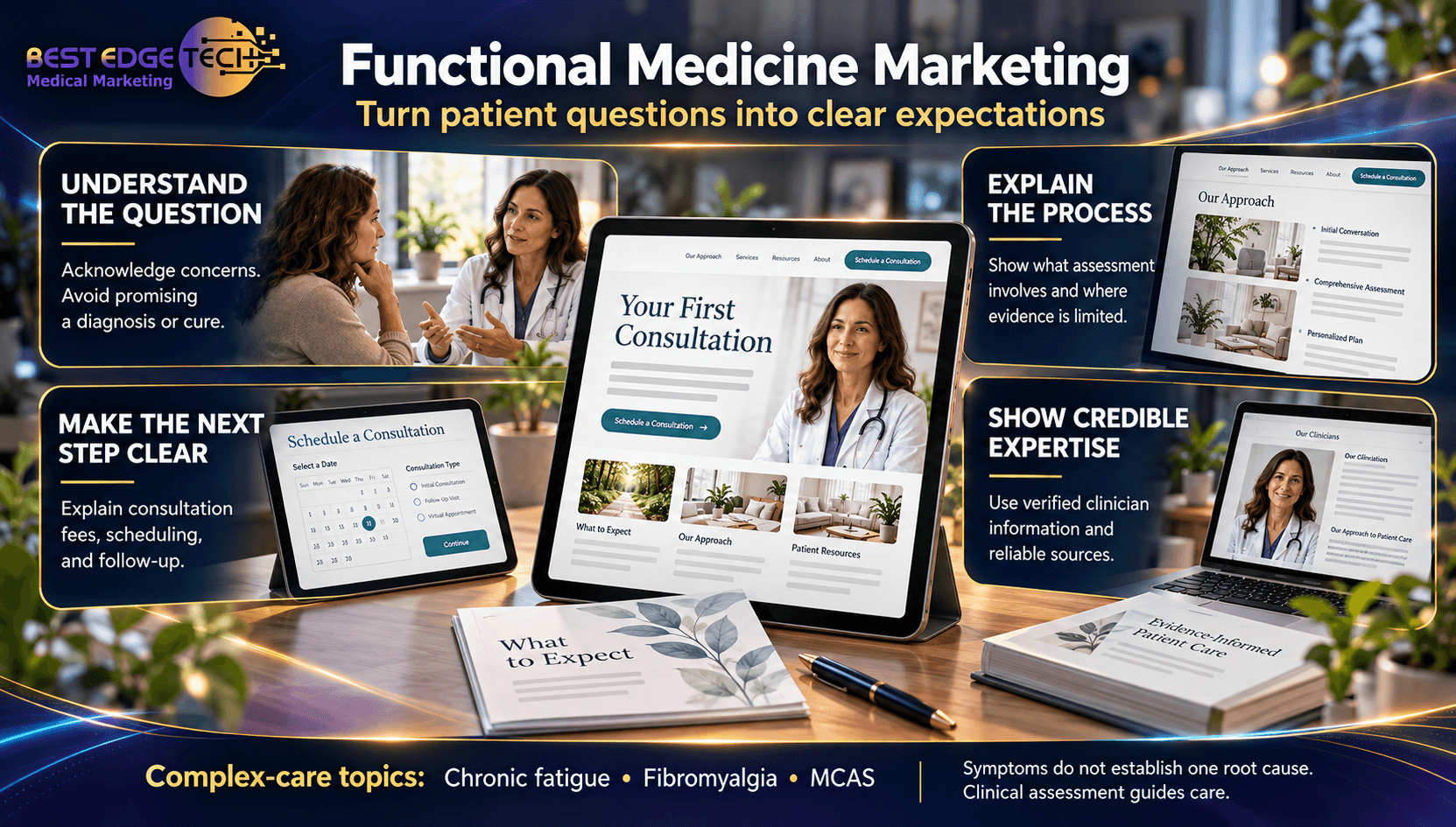
Which website pages support functional medicine marketing?
A useful website separates the overall consultation service, relevant condition education, clinician profiles, financial information, and appointment access. Each page should own a distinct question so visitors and search systems can understand its purpose.
| Page | Primary question | Useful next step |
|---|---|---|
| Consultation service | What does the practice provide, and who is it for? | Review the appointment process. |
| Relevant condition resource | What does this term mean, and what can this practice address? | Explore the appropriate service or referral information. |
| Clinician profile | Who provides care, with which verified qualifications? | See that professional’s services and locations. |
| Fees and preparation | What is included, and what should I expect? | Decide whether to request an appointment. |
| Focused educational article | What is the answer to one specific question? | Read the related service explanation. |
For example, a consultation-preparation article and a fatigue-assessment service page can coexist when they answer different questions. Two near-identical pages targeting the same local consultation, with the same claims and booking path, create a different problem. Inventory existing URLs before expanding the content calendar.
Keep a practical intent register
For every proposed page, record its audience, main question, primary keyword, clinician reviewer, and relationship to existing pages. Name the page that should receive a commercial inquiry. This small planning step helps prevent condition articles from competing with service pages for the same purpose.
Internal links should explain what readers will find. “Consultation fees and preparation” is more useful than “click here.” A clinician profile should link to services that professional actually delivers. A condition resource should not funnel every reader toward the same test or supplement regardless of the question.
Best Edge Medical Marketing’s medical website conversion guide covers the broader design and access problem. This article focuses on the extra communication demands of complex-care positioning rather than repeating a general website redesign checklist.
Which trust signals matter beyond a polished website?
Useful trust signals explain who is responsible for care, what they are qualified to do, how the practice works, and where material claims come from. Attractive design can support those facts, but cannot replace them.
Clinician biographies should distinguish licensure, board certification, training, and membership accurately. State the credential and relevant field rather than grouping different achievements under a vague “certified expert” badge. Verify locations and care roles so visitors know whether the pictured professional will actually see them.
Show the people
Use accurate profiles, real roles, and verified qualifications. Label stock or illustrative imagery appropriately where identity could otherwise be misunderstood.
Show the process
Explain consultation structure, assessment boundaries, communication, and what happens when a referral is appropriate.
Show the evidence
Link material clinical statements to suitable sources and make relevant limitations understandable near the claim.
Show responsibility
Identify authorship and real review activity. Do not invent a medical reviewer or imply a review that did not occur.
Testimonials can communicate an individual experience, but do not establish typical clinical outcomes. Review permission, confidentiality, and the overall advertising message before use. Public replies should not confirm that a reviewer is a patient or disclose treatment details.
Use a documented review cadence for changing information. Clinical pages may need review when evidence or service scope changes; appointment and fee information may change for operational reasons. A visible date should reflect actual review or revision, not a cosmetic attempt to make old content appear new.
Trust also includes answering uncomfortable questions. State what a consultation cannot guarantee, how additional charges are discussed, and how a patient can ask for clarification. A page that acknowledges uncertainty can be more useful than one that sounds certain while withholding basic practical information.
How can a cash-pay practice explain value without pressuring patients?
A cash-pay practice can explain value by describing the actual service and financial terms. Patients should understand consultation fees, separate costs, follow-up arrangements, and relevant policies before deciding whether the practice fits their circumstances.
Describe the appointment as a defined service. If record review, a particular visit length, or follow-up communication is included, explain it accurately. If laboratory services, supplements, additional visits, or procedures cost extra, make that distinction visible. Do not suggest that a higher price proves better care.
What your consultation includes—and what is separate
Explain the clinician’s role, appointment scope, published fee, potential additional charges, and how recommendations are discussed. Avoid implying that booking commits the patient to a treatment package.
A prospect may need time to review the cost or discuss it with someone they trust. Offer clear information instead of urgency designed to overcome that hesitation. Avoid labels that equate affordability with seriousness or adherence. A patient’s financial choice does not reveal how committed they are to their health.
Make program terms understandable
If the practice offers a multi-visit program, explain its structure, costs, cancellation terms, and what happens when the assessment suggests a different care path. Clinical recommendations should not be predetermined by the package advertised before the visit.
Train staff to describe published information without improvising financial promises. The person responding to an inquiry should know which questions can be answered administratively and which require the clinician. Keep the website and staff explanation synchronized whenever a fee or policy changes.
Transparent pricing can reduce unsuitable inquiries, but evaluate the quality of understanding rather than raw lead volume alone. Fewer contacts from people surprised by costs may improve the appointment experience even when a marketing dashboard initially reports fewer conversions.
How should a practice handle inquiries about complex symptoms?
A practice should use inquiries to clarify access and route questions appropriately. Marketing and administrative staff can explain the service, but should not diagnose, recommend tests, or promise treatment from a public contact form.
Keep the public inquiry process proportionate. Collect what is necessary to respond and offer a suitable channel for detailed health information. A marketing contact field should not invite a full medical history unless the system and process have been assessed for that purpose.
- Acknowledge: confirm receipt and explain the practice’s actual response process.
- Clarify: share relevant published information about the appointment, clinician, location, and fees.
- Route: move clinical questions and records into the approved care process.
- Set expectations: explain that diagnosis and recommendations require assessment.
- Offer a choice: let the person decide whether to schedule without repeated pressure.
Thank you for contacting the practice.
We can explain appointment availability, consultation fees, and what the first visit includes. The clinician determines appropriate evaluation after reviewing your concerns. Please use the practice’s approved intake channel for detailed medical information.
This sample needs adaptation to the practice’s real systems and policies. Staff should not promise an immediate response unless it can be delivered. A general inquiry form should also distinguish administrative contact from urgent clinical assistance.
For follow-up, separate necessary care messages from promotional communications and follow applicable permissions. Someone researching fatigue has not consented to every service campaign. Review trackers and integrations using the actual data flow, including what is collected and shared.
HHS guidance addresses online tracking in covered healthcare contexts. Avoid assuming that every public-page visit is protected health information or that every public page is unrestricted. Appropriate review depends on the system, data, use, and legal context.
How can functional medicine content support local SEO, AEO, and GEO?
Functional medicine content supports discovery when it answers distinct questions accurately, identifies the actual practice and clinicians, and provides useful local access information. Direct answers and clear structure help readers interpret content; they do not guarantee rankings or AI citations.
Use one primary intent per page. A local consultation service page explains the clinic’s offer and location. A condition resource defines a term and explains the practice’s role. A preparation article answers a practical question. This separation allows each page to be useful without repeating the same keywords and appointment pitch.
Write self-contained explanations under question-based headings. Start with the answer, define important terms, and include relevant limits. Do not describe a clinic’s speculative mechanism as an established explanation just because it creates an appealing answer passage.
Google’s AI-feature guidance emphasizes existing SEO foundations rather than a special markup requirement. Keep important content accessible as text, use accurate structured data, and ensure the page can be indexed. An FAQ should answer a useful question, not serve as a container for repeated promotional claims.
Explain local access truthfully
Give the actual office location, services available there, scheduling process, and any verified remote-care boundaries. Do not invent offices in surrounding suburbs or assume every visitor can legally receive remote clinical care. A location page needs substantive local information, not a copied template with the city changed.
Best Edge Medical Marketing offers AI search optimization for healthcare alongside broader digital marketing services. Its contact page identifies its Raleigh and Triangle connection; this article addresses strategy for healthcare clients rather than claiming the agency provides clinical care.
What does a focused functional medicine marketing campaign look like?
A focused campaign connects one patient question to a relevant service explanation and an appropriate appointment path. Start with a defined offer the practice can deliver instead of a broad promise to solve every chronic condition.
Consider a hypothetical clinic offering initial consultations for adults with persistent fatigue-related concerns. The clinician defines the actual assessment scope and referral boundaries. The landing page explains the appointment, responsible professional, fees, and limitations. A supporting preparation guide describes what records may be useful and how the first visit works.
The page does not diagnose ME/CFS, advertise a universal fatigue panel, or promise symptom reversal. It gives prospective patients enough information to understand whether the service is relevant. The practice can then examine whether inquiries arrive with realistic expectations.
| Task | Responsible role | Review question |
|---|---|---|
| Service scope and clinical claims | Responsible clinician | Does this accurately describe what we assess and provide? |
| Fees and scheduling | Practice administrator | Can staff deliver the information and access promised? |
| Content and page intent | Marketing team | Does each page answer a distinct question? |
| Privacy and tracking | Qualified privacy or security reviewer | What information is collected and where does it go? |
If paid advertising is considered, verify the specific service and applicable platform rules. Google’s healthcare policy and sensitive-interest targeting restrictions may affect campaign design. Do not assume that remarketing to a condition-page audience is permitted because the software offers the option.
Expand after reviewing the first campaign’s relevance, scheduling, staff feedback, and access capacity. A second condition campaign needs its own service scope and content review. It should not reuse a diagnosis-specific headline while sending every visitor into the same undefined treatment package.
How should you measure functional medicine marketing?
Useful metrics show whether the right people understand the offer and can access the consultation. Review relevant inquiries, booking, attendance, recurring misunderstandings, and actual costs rather than celebrating total leads alone.
A clearer page can reduce noise
A campaign might produce 50 inquiries, but 20 could be requests for a service the clinic does not provide. In that scenario, improving the service explanation may reduce total inquiries while increasing their relevance. Compare consistent periods and actual appointment results before concluding that fewer contacts mean worse marketing.
Define “relevant inquiry” operationally: a genuine contact about an available service, within the practice’s access boundaries, with an understanding of the next step. It is not a diagnosis or proof of treatment eligibility. Administrative staff should not make that clinical determination for the sake of a marketing report.
Track questions patients repeatedly ask. Confusion about included fees points toward a financial explanation problem. Requests for unsupported treatment outcomes may indicate overpromising in the copy. A high cancellation rate may involve appointment availability or expectations rather than keyword selection.
Use actual collected revenue and delivery costs for financial reporting through an approved process. Do not assume a fixed treatment package or lifetime value for every inquiry. Keep clinical records and identifiable health information out of advertising tools, and state the limitations of campaign attribution.
A practical report should identify an action: clarify a page, revise a claim, improve scheduling, pause a campaign, or leave a useful resource unchanged. That is more valuable than a large visibility number with no connection to the practice’s service experience.
What should the practice improve first?
Improve the foundations that affect patient understanding before expanding content or advertising. Prioritize inaccurate claims, unclear service scope, missing fees, and unreliable appointment paths. A stronger message needs an operational process that can support it.
First: audit the offer and existing content
Inventory consultation services, condition pages, clinician profiles, fees, and booking channels. Record who owns each page and which claims require clinical review. Check whether multiple URLs serve the same intent. Keep useful existing pages and identify the specific changes needed.
Next: build the core decision pages
Clarify the main consultation page, provider information, and financial expectations. Add the most useful preparation resource and relevant condition explanations within the practice’s real scope. Verify links, mobile readability, image descriptions, and inquiry forms before directing more visitors to them.
Then: align staff and test access
Give the team a shared explanation of appointment types, included costs, clinical boundaries, and routing. Ask someone unfamiliar with the clinic to read the page and explain the offer back. Note where understanding breaks down and revise that section.
Finally: measure and refine
Review inquiry relevance, attendance, patient questions, and campaign costs over consistent periods. Expand only when the current process is understandable and manageable. Maintain review ownership so clinical facts, financial details, and access information do not drift apart after launch.
For an agency partnership, bring a concrete problem to the discussion: unclear condition pages, conflicting fees, duplicated intent, or inquiries seeking services the clinic does not offer. This helps the work focus on a useful change rather than a generic promise of more traffic.
Does your website make complex care easier to understand?
Best Edge Medical Marketing provides healthcare content, website, and search services. Discuss your functional medicine marketing strategy, consultation pages, clinician information, and inquiry process with the team to identify practical improvements.
Frequently asked questions
What is functional medicine marketing?
Functional medicine marketing explains a practice’s actual approach and helps prospective patients understand available services, clinician qualifications, fees, and appointment expectations. It can include website content, local search, reputation work, and eligible advertising. For complex-care audiences, the priority is accurate information and an appropriate consultation path rather than broad promises about identifying every cause or achieving a cure.
How should a practice use the phrase root-cause medicine?
A practice should connect the phrase to specific assessment processes it genuinely provides. Explain history review, evaluation boundaries, and how options are discussed. The term should not imply a distinct credential, guaranteed diagnostic discovery, or one cause behind every symptom. Visitors need a practical explanation of the service, including uncertainty and when another professional may be more appropriate.
Can fatigue and ME/CFS share the same content?
A broad resource can discuss both, but it must distinguish persistent fatigue as a symptom from ME/CFS as a condition requiring specific clinical assessment. Use accurate headings and explain the practice’s actual role. Do not suggest that every person with fatigue has ME/CFS or that a marketed panel provides a definitive diagnosis. Refer clinical content to an appropriate reviewer.
How can a clinic market fibromyalgia consultations responsibly?
A clinic can explain its assessment role, relevant clinician qualifications, available services, and referral boundaries. Describe the condition accurately and avoid advertising a specific laboratory panel as a definitive fibromyalgia test. Claims about treatment benefits need appropriate evidence. The appointment page should help visitors understand what is offered without guaranteeing symptom resolution or a particular diagnosis.
What should an MCAS page explain?
An MCAS page should define the term accurately, distinguish education from diagnosis, and describe the practice’s actual care or referral role. General symptom overlap does not establish MCAS. Explain that assessment involves clinical criteria and appropriate evidence rather than a website checklist alone. Material diagnostic statements should be reviewed by a qualified clinician and linked to suitable sources.
How should MTHFR variants be discussed in marketing?
Discuss genetic variants carefully and avoid presenting a result as a universal explanation for fatigue, pain, or other concerns. A variant does not automatically establish a need for a product or program. CDC notes that people with MTHFR variants can process folic acid. Broader genetic, diagnostic, and treatment claims need their own appropriate evidence and individual clinical context.
How can a cash-pay practice justify its consultation fee?
Explain the actual service, professional providing it, included components, and separate charges. If particular appointment features are offered, describe them accurately. Do not imply that paying more guarantees better outcomes or that affordability determines a patient’s commitment. Clear fee information, program terms, and follow-up expectations help people decide whether the offer fits their circumstances before booking.
What makes an inquiry relevant to the practice?
A relevant inquiry concerns an available service, fits the practice’s administrative access boundaries, and shows an understanding of the next step. It does not establish diagnosis or treatment eligibility. Staff can explain logistics and route questions; clinical suitability requires assessment. Reporting should distinguish genuine service inquiries from spam, duplicates, and requests for care the clinic does not provide.
Can SEO and structured data guarantee AI citations?
No. Clear pages, reliable information, and accurate structured data can help search systems interpret content, but do not guarantee rankings or AI citations. Give each page a distinct purpose, make clinical qualifications visible, and support material claims with appropriate sources. Any schema should match the visible page, including FAQs, authorship, images, and actual publication and modification dates.
Should a functional medicine clinic begin with ads or content?
Begin by making the service explanation, fees, and inquiry process reliable. Content can address specific questions; eligible advertising can test defined demand once claims, privacy, platform requirements, and practice capacity have been reviewed. The sequence depends on the clinic’s starting position. More traffic will not resolve an unclear offer or an appointment process staff cannot consistently explain.
Sources and editorial references
Evidence checked October 14, 2026. Sources support the terminology and policy statements above; they do not validate an individual clinic’s service or treatment claims.
- CDC: Diagnosing ME/CFS
- NIAMS: Fibromyalgia diagnosis, treatment, and steps to take
- AAAAI: Mast Cell Activation Syndrome
- CDC: MTHFR gene variants and folic acid facts
- FTC: Health Products Compliance Guidance
- HHS: Online tracking technologies and HIPAA
- Google Search Central: AI features and your website
- Google Ads: Healthcare and medicines policy
- Google Ads: Restricted targeting in personalized advertising
Editorial responsibility and scope
Best Edge Medical Marketing publishes resources for healthcare practice owners and teams. This article addresses marketing and communication; it does not provide individualized diagnosis or treatment advice.
Patient-facing clinical descriptions require review by the responsible clinician. Claims, privacy practices, and advertising decisions should be assessed for the specific service, system, and jurisdiction. No individual medical review is represented unless it has actually occurred.