
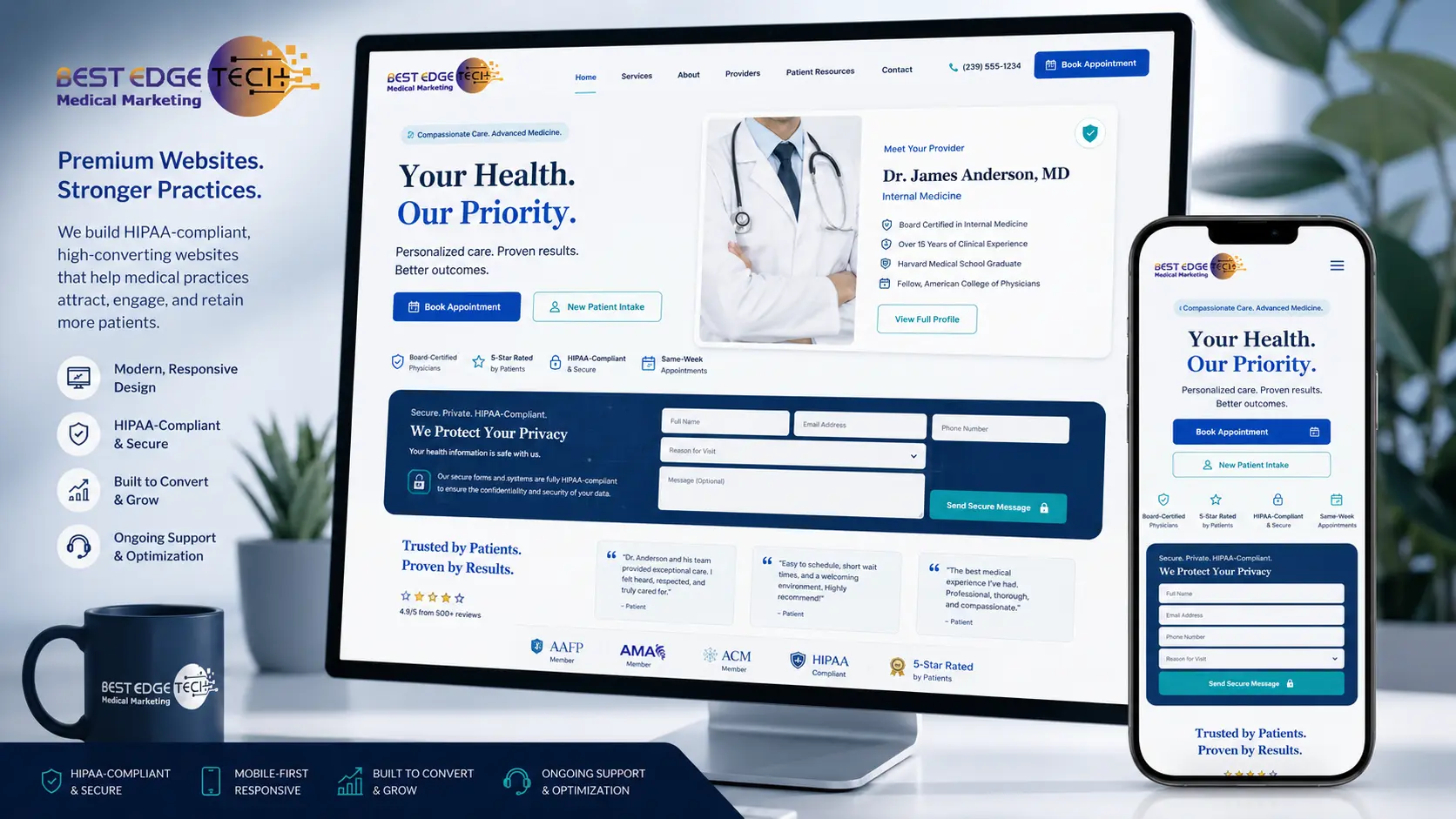
Medical website design should do more than make a healthcare practice look professional. It should help prospective patients understand the practice, trust its providers, find the right service, and take a clear next step. A conversion-focused medical website connects user experience, accessibility, page speed, credible content, secure inquiry paths, and measurable calls to action.
For physicians, dentists, surgeons, medical spas, specialty clinics, and healthcare organizations, the website is often the central point between online discovery and a new patient inquiry. Search visibility may bring people to the site, but design determines whether they stay, find answers, call the office, or request an appointment.
Best Edge Medical Marketing helps healthcare organizations build and optimize medical websites around patient intent, practice credibility, search visibility, and conversion performance. This guide explains the essential elements of a medical website that turns more qualified visitors into patient inquiries.
| Website Element | Conversion Purpose | Recommended Implementation |
|---|---|---|
| Hero section | Confirm relevance immediately | State the specialty, service area, value proposition, and primary action |
| Provider credentials | Build confidence | Display accurate education, certifications, experience, and professional affiliations |
| Mobile calls to action | Reduce friction | Use visible click-to-call and appointment buttons |
| Patient inquiry forms | Capture qualified inquiries | Collect only necessary information through an appropriately secured workflow |
| Trust signals | Reduce uncertainty | Use accurate credentials, reviews, affiliations, locations, and transparent practice information |
| Page speed | Protect engagement | Optimize media, scripts, hosting, layouts, and Core Web Vitals |
Is your website generating traffic but not enough patient inquiries?
Best Edge Medical Marketing can evaluate your site’s mobile experience, calls to action, forms, trust signals, page speed, service architecture, and conversion tracking.
Conversion-focused medical website design is the process of building a healthcare website around the actions prospective patients need to complete. Those actions may include calling the office, requesting an appointment, verifying a service, reviewing provider credentials, finding a location, or accessing patient resources.
The objective is not to pressure visitors. It is to remove unnecessary uncertainty and friction. A high-performing medical website should help visitors answer questions such as:
Design, content, technical performance, and compliance-aware communication must work together. A visually attractive website can still underperform if visitors cannot find the right service, understand the provider’s expertise, or complete an inquiry.
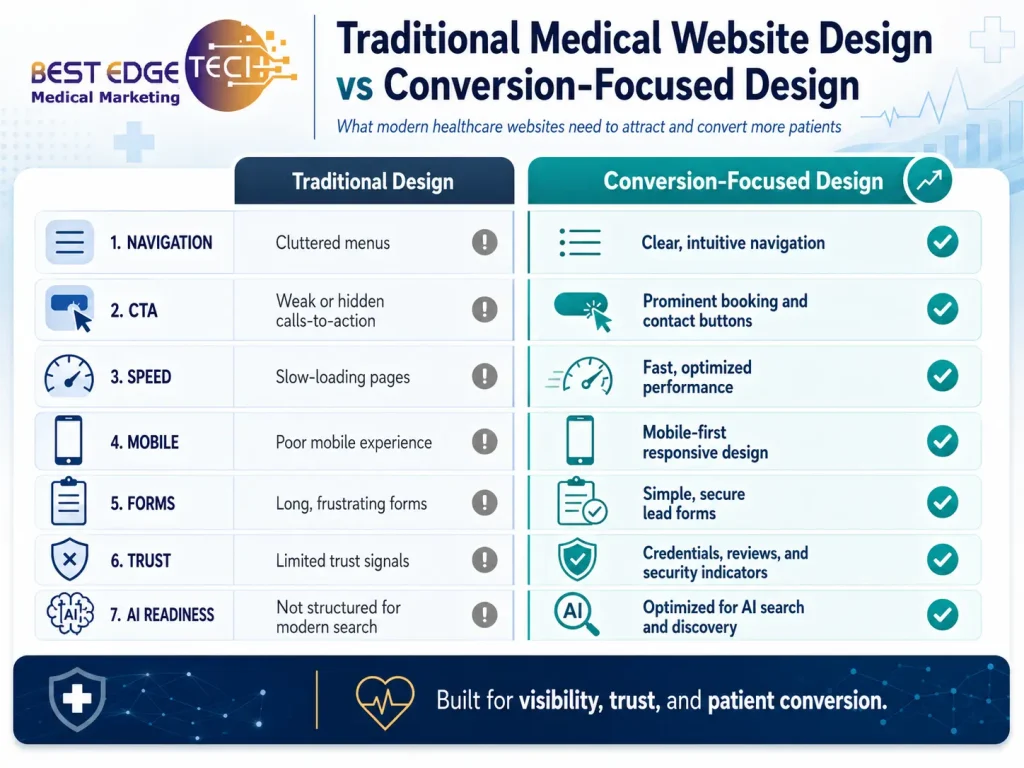
A traditional medical website often functions as a static brochure, while a conversion-focused website actively supports the patient journey. The difference is not simply visual style. It involves navigation, content hierarchy, page speed, mobile usability, forms, calls to action, trust signals, and tracking.
| Feature | Traditional Approach | Conversion-Focused Approach | Patient Acquisition Impact |
|---|---|---|---|
| Navigation | Large or confusing menu | Simplified pathways organized by patient intent | Helps visitors reach relevant pages faster |
| Hero section | Generic welcome message | Clear service, location, trust statement, and CTA | Confirms relevance immediately |
| CTA placement | One contact link in the footer | Contextual booking and calling options throughout the page | Reduces effort required to inquire |
| Mobile experience | Desktop layout adapted to smaller screens | Mobile-first layout with touch-friendly actions | Improves usability for mobile patients |
| Forms | Long, unsecured, or unclear forms | Minimal fields and an appropriately secured inquiry workflow | Reduces abandonment and privacy risk |
| Trust | Generic claims | Accurate provider credentials, reviews, locations, and expectations | Helps patients make informed decisions |
| Measurement | Traffic-only reporting | Call, form, CTA, and landing-page conversion tracking | Connects website activity to patient inquiries |
A high-converting medical website should attract the right audience, reassure visitors, educate them, reduce friction, and make the next step obvious. Best Edge Medical Marketing evaluates medical websites through this five-part conversion framework.
The website must align with the services, conditions, providers, and locations prospective patients are searching for. Search engine optimization, local relevance, internal linking, and focused landing pages help attract users whose needs match the practice.
Visitors often arrive with uncertainty. Accurate provider biographies, clear service descriptions, practice photos, accepted insurance information, location details, and professionally managed reviews can reduce hesitation.
Medical content should answer common questions in plain language while avoiding unsupported claims or individualized medical advice. Headings, summaries, tables, FAQs, and visual explanations make complex information easier to understand.
Every unnecessary click, confusing instruction, excessive form field, slow-loading image, or broken mobile element creates an opportunity for a prospective patient to leave. Effective design shortens the distance between interest and action.
The site should make calls, appointment requests, directions, and other actions easy to complete. Analytics, call tracking, form tracking, and landing-page reporting should then show which pages and pathways generate inquiries.
A medical homepage should immediately explain who the practice serves, what it offers, where it is located, and how a prospective patient can take action. It should not require visitors to search through long paragraphs or multiple menus to understand the practice.
The first visible section should include:
Avoid generic headlines such as “Welcome to Our Website.” A stronger headline confirms that the visitor has reached a relevant provider.
Trust information should be easy to find without overwhelming the design. Depending on the practice, appropriate signals may include:
Every trust signal should be accurate, current, and supportable. Avoid broad claims such as “the best doctor” unless the statement is properly substantiated and permitted under applicable advertising rules.
Each important medical service should have a dedicated page that explains the service, who it may be appropriate for, what patients can expect, and how to contact the practice. Thin pages with only a few sentences rarely provide enough information to satisfy patient intent or support strong organic visibility.
A well-structured service page may include:
Service pages should link naturally to related provider biographies, conditions, locations, patient resources, and appointment options. They should also avoid claims that guarantee results or imply that every patient is an appropriate candidate.
Provider biography pages are among the most important trust assets on a medical website. Patients frequently want to understand who will provide care before requesting an appointment. Search engines and AI-assisted systems may also use provider information to interpret professional roles and areas of expertise.
A strong provider page should include:
Provider information should be updated when credentials, locations, affiliations, or service availability change. Individual provider pages also create stronger internal linking opportunities from service and condition pages.
Medical websites should be designed for mobile use from the beginning rather than treated as reduced desktop layouts. Mobile visitors often need immediate access to a phone number, directions, office hours, appointment options, or urgent instructions.
A sticky mobile action bar can be useful when it remains accessible, does not obscure content, and presents only the most important actions. Common options include “Call,” “Book,” and “Directions.”
Medical website forms that collect protected health information require more than a basic SSL certificate or a claim that the form is encrypted. The entire collection, transmission, storage, access, integration, and follow-up workflow should be evaluated.
Depending on the information collected and the systems involved, considerations may include:
A general contact form may not need to request symptoms, diagnoses, insurance numbers, or detailed medical histories. The less sensitive information collected during an initial inquiry, the lower the privacy and security exposure.
Compliance note: A website platform or form should not be described as HIPAA compliant based only on encryption. Medical practices should evaluate the full workflow with qualified privacy, security, legal, and compliance professionals.
Trust signals help prospective patients determine whether a practice appears legitimate, qualified, transparent, and prepared to address their needs. Strong trust signals are specific and verifiable rather than generic marketing statements.
A testimonial voluntarily posted on a third-party platform is different from content selected, edited, copied, or republished by a medical practice. Before using identifiable patient information for marketing, the practice should evaluate whether a valid written HIPAA authorization is required.
Testimonials should not:
For a deeper review of patient-feedback strategy, read our guide to online reputation management for doctors.
Page speed affects whether visitors can use the website efficiently, particularly on mobile devices and slower connections. Slow-loading images, layout shifts, excessive scripts, unstable page elements, and delayed interactions can disrupt the patient journey.
Performance work should focus on measurable user experience rather than an arbitrary single loading-time promise. Practices should review Core Web Vitals, mobile usability, server performance, image delivery, script execution, and actual conversion behavior.
Accessible medical website design helps patients with visual, hearing, motor, cognitive, and other disabilities use the site and access important information. Accessibility should be built into the design, content, development, and testing process.
Recommended practices include:
Recognized guidance such as the Web Content Accessibility Guidelines can support implementation, but automated scanning alone cannot confirm full accessibility. Practices should consider manual testing and qualified accessibility or legal review where appropriate.
Medical content architecture organizes pages around the questions and tasks patients need to complete. Clear architecture improves navigation, internal linking, search-engine crawling, and machine interpretation.
| Section | Primary Purpose | Conversion Role |
|---|---|---|
| Home | Introduce the practice and main services | Direct users to the correct pathway |
| Provider bios | Present qualifications and areas of focus | Build confidence before an inquiry |
| Service pages | Explain treatments and services | Connect service interest to an appointment |
| Condition pages | Answer condition-related questions | Guide appropriate users to relevant care |
| Location pages | Clarify local availability | Support directions, calls, and local inquiries |
| Patient resources | Provide forms, insurance, policies, and instructions | Reduce administrative friction |
| Contact page | Provide communication and location options | Complete the inquiry journey |
Navigation labels should use terms patients understand. Internal department language, abbreviations, and vague menu labels can make the site harder to use.
Medical website design can support traditional search visibility and AI-assisted discovery when it makes content easier for users and systems to find, understand, and evaluate. No design feature, schema type, or content format can guarantee rankings or AI citations.
Useful supporting elements include:
Google advises website owners to follow established search fundamentals for AI features rather than relying on special AI-only markup. Medical practices should therefore prioritize useful content, technical quality, accuracy, accessibility, and clear entity information.
Learn more about our AI search optimization services for healthcare and Generative Engine Optimization services.
Structured data helps search engines interpret the entities and content represented on a page. It should accurately describe visible information and should not be used to insert unsupported claims, hidden testimonials, or information that is not available to users.
Depending on the page, appropriate schema types may include:
Structured data should be selected page by page. Adding every available schema type does not improve quality and can create conflicting entities or validation problems.
A medical website should support the same accurate practice information patients find on Google Business Profile and major directories. Consistency helps users move between the local listing and the website without encountering conflicting contact or location details.
Review the following elements:
The appointment URL should lead to a relevant, functioning page rather than a generic homepage whenever possible. Tracking should also distinguish inquiries originating from Google Business Profile from other website traffic.
A medical website conversion audit identifies the technical, content, design, trust, and measurement problems that prevent qualified visitors from becoming patient inquiries. The objective is to understand how real users move through the site and where they encounter friction.
Traffic without conversion is an incomplete result.
Our team evaluates how your medical website attracts, educates, reassures, and converts prospective patients across desktop and mobile devices.
A dermatology website should connect different patient needs with distinct service, condition, provider, and appointment pathways. Someone searching for a skin cancer screening has different intent from someone researching acne treatment or cosmetic dermatology.
This structure gives prospective patients a more direct path from search intent to an informed inquiry.
A medical practice should measure how website visitors interact with calls to action, contact methods, service pages, and appointment paths. Traffic alone does not reveal whether the website is generating meaningful business outcomes.
| Metric | What It Measures | Potential Insight |
|---|---|---|
| Appointment form submissions | Completed website inquiries | Which pages generate appointment interest |
| Tracked phone calls | Calls originating from website sessions | Which channels and landing pages drive calls |
| CTA click rate | Interaction with booking and calling buttons | Whether CTAs are visible and persuasive |
| Landing-page conversion rate | Percentage of visitors who complete a target action | Which service pages convert effectively |
| Form abandonment | Users who start but do not complete forms | Whether the form is too long or confusing |
| Device conversion rate | Conversions by desktop, mobile, and tablet | Whether mobile design is limiting inquiries |
Practices should also evaluate lead quality. A website that produces a large number of irrelevant inquiries may need clearer service, location, insurance, eligibility, or scheduling information.
Best Edge Medical Marketing combines healthcare website development, medical SEO, conversion strategy, content architecture, local visibility, and AI search optimization. Our objective is to build websites that are easier for patients to use and easier for search systems to understand.
Our medical website support may include:
Explore our website development services or review our complete range of medical marketing services.
Best Edge Medical Marketing can evaluate your current website and identify opportunities to improve patient pathways, mobile usability, trust, search visibility, and conversion measurement.
The most important element is a clear patient journey. Visitors should quickly understand what the practice provides, whether it serves their location, who the providers are, and how to take the next step. Strong medical website design combines clear navigation, credible content, visible calls to action, mobile usability, and appropriately secured inquiry paths.
Medical website design improves conversion by reducing uncertainty and friction. Clear service descriptions, provider credentials, mobile call buttons, relevant appointment options, fast pages, and concise forms help prospective patients move from research to inquiry. Conversion tracking then shows which pages and actions contribute to phone calls and appointment requests.
The first visible section should identify the practice’s specialty, primary service area, patient-centered value proposition, and main call to action. It may also include a secondary call option, a professional image, and an important trust signal. Visitors should not need to scroll extensively to understand the practice or contact it.
An initial appointment request form should collect only the information necessary to route and respond to the inquiry. Excessive fields can increase abandonment and privacy exposure. Practices should evaluate whether sensitive details are required at the first step and ensure the complete collection, transmission, storage, access, and follow-up process is appropriately secured.
Encryption is important, but it does not by itself establish HIPAA compliance. The full workflow may involve business associate agreements, user access, storage, retention, authentication, audit controls, integrations, and staff procedures. Healthcare organizations should have qualified privacy, security, legal, or compliance professionals evaluate systems that collect protected health information.
Mobile responsiveness affects usability, engagement, and conversion because many prospective patients use phones to research providers, call offices, find directions, and request appointments. A mobile-first site should load efficiently, use readable text, provide touch-friendly navigation, and make calling or booking easy without requiring excessive zooming or scrolling.
Practices should evaluate whether a valid written HIPAA authorization is required before publishing identifiable patient testimonials, photographs, or stories. Testimonials should be accurate, should not imply guaranteed outcomes, and should comply with applicable FTC guidance, platform rules, professional advertising standards, and state requirements. Informal permission may not be sufficient.
Slow pages can interrupt the patient journey, particularly on mobile devices. Large images, unstable layouts, excessive scripts, and slow third-party tools may increase abandonment. Practices should review Core Web Vitals, mobile performance, server response, visual stability, and conversion behavior rather than relying on a single arbitrary loading-time target.
Medical websites should use descriptive alt text, keyboard-accessible navigation, visible focus states, readable fonts, appropriate contrast, labeled forms, captions for video, and logical headings. Automated tools can identify some issues but cannot confirm complete accessibility. Manual testing and qualified accessibility or legal review may also be appropriate.
Schema markup helps search engines interpret providers, organizations, services, articles, FAQs, and page relationships. It should accurately describe content that visitors can see. Structured data may improve machine understanding, but it does not guarantee rankings, rich results, AI citations, or inclusion in generated answers.
Clear structure, accurate provider information, direct answers, authoritative sources, internal links, mobile performance, and structured data may make content easier for search and AI-assisted systems to interpret. However, medical practices cannot guarantee AI citations. Strong SEO fundamentals and useful, trustworthy content remain the appropriate foundation.
There is no universal redesign schedule. A practice should consider redesign or major improvement when the site is difficult to use, slow, inaccessible, insecure, visually outdated, technically unsupported, or unable to convert visitors effectively. Regular audits can identify targeted improvements without requiring a complete rebuild every few years.
Yes. Confusing navigation, slow performance, mobile usability problems, broken links, thin service pages, inaccessible content, and poor site architecture can weaken user experience and search performance. Strong content may still underperform when technical and design problems make it difficult for patients and search engines to use the website.
Practices should track appointment requests, calls, CTA clicks, landing-page conversion rates, form abandonment, device performance, source attribution, and inquiry quality. Traffic and rankings are useful, but they do not show whether visitors are becoming qualified patient leads. Measurement should connect website behavior with meaningful practice outcomes.
This article provides general marketing and educational information and does not constitute legal, medical, accessibility, cybersecurity, privacy, or regulatory advice. Healthcare organizations should consult qualified professionals regarding their specific obligations.

Strategically Reviewed by Christopher A. Whitfield
Christopher A. Whitfield is a medical marketing, SEO, AI search optimization, website performance, and content strategy specialist. He reviews Best Edge Medical Marketing content for search intent, clarity, source quality, technical SEO, patient-centered communication, and digital marketing accuracy.
Best Edge Medical Marketing is a medical marketing agency that provides marketing, SEO, design, and development services to businesses in the medical industry.
Call Us Today
(252) 303-0074