
Menu
Close
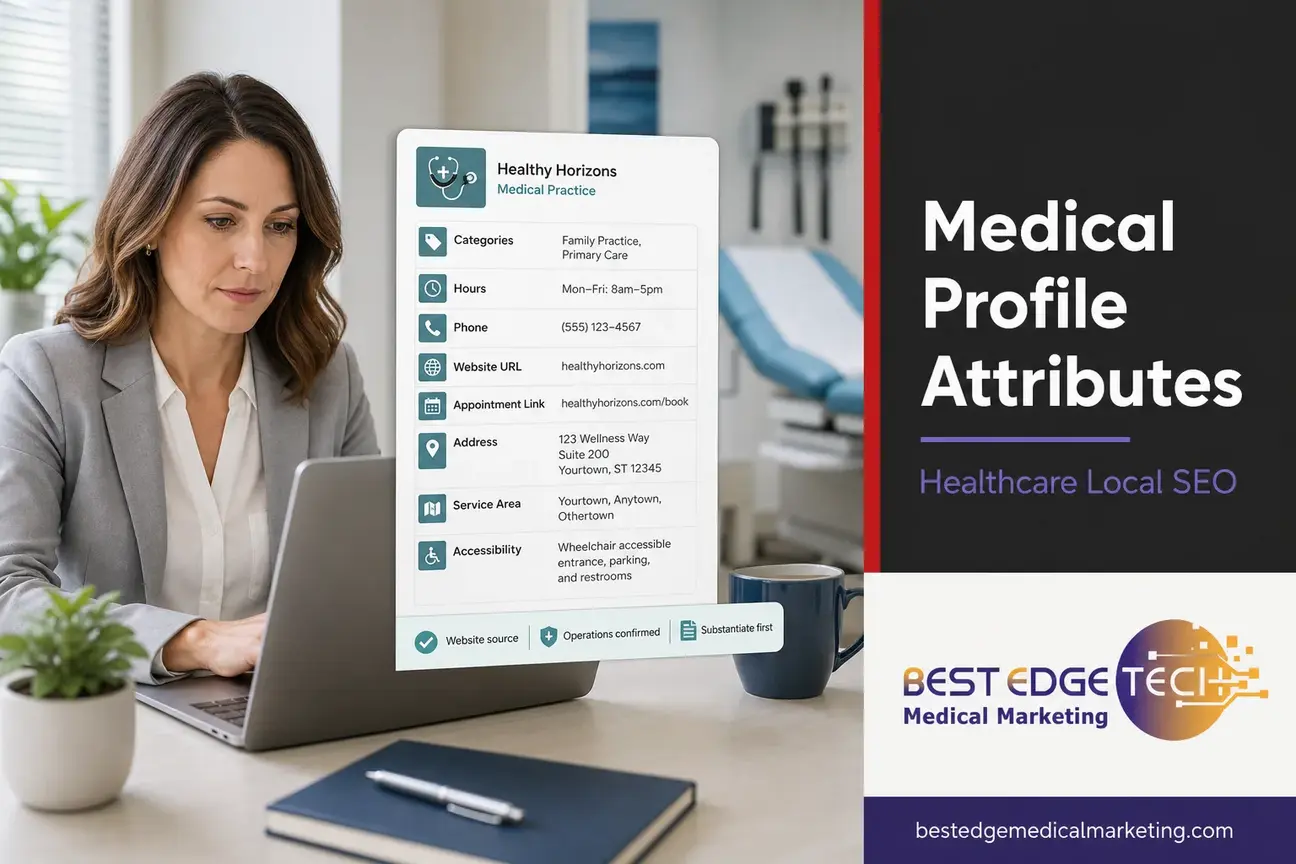
Medical profile attributes should be treated as public business facts, not as marketing wish lists. For a healthcare organization, the safest working rule is simple: put concise, confirmed information in Google Business Profile, then use the practice website to explain the details that require context. A profile should not imply a location, provider, service, accessibility feature, schedule, or appointment process that the practice cannot substantiate internally.
Quick Answer: Publish confirmed business identity, eligible location or service-area information, real customer-facing hours, authoritative contact details, a functioning appointment or inquiry destination, and confirmed accessibility or operational details in the profile. Put fuller explanations, provider details, specialty pages, location instructions, and scheduling expectations on the website. Do not use profile fields to suggest services, offices, credentials, or access features that do not exist.
A Google Business Profile is often one of the first structured summaries a prospective patient, caregiver, referring office, or local searcher sees. That does not make it a complete practice website. It is a compact listing of facts, and each fact needs a source of truth inside the organization.
For healthcare teams, the issue is not just whether a field can be filled out. The issue is whether the practice can prove that field is accurate today. The front desk may know hours. Operations may know parking and entrance details. Credentialing or leadership may know which providers belong on the website. Marketing may manage the profile, but marketing should not guess.
Google’s own guidance says businesses should use an accurate address or service area and provide contact details that represent the individual business location, according to the Google Business Profile guidelines for representing your business. That standard matters for medical groups because a profile can easily blur distinctions between a real office, a service area, a virtual operation, a scheduling workflow, and a specialty page.
The practical goal is disciplined publication: the Google profile gives searchers clear facts, while the website documents the larger story. That separation supports healthcare local SEO without turning the profile into a keyword container or a substitute for operational confirmation.
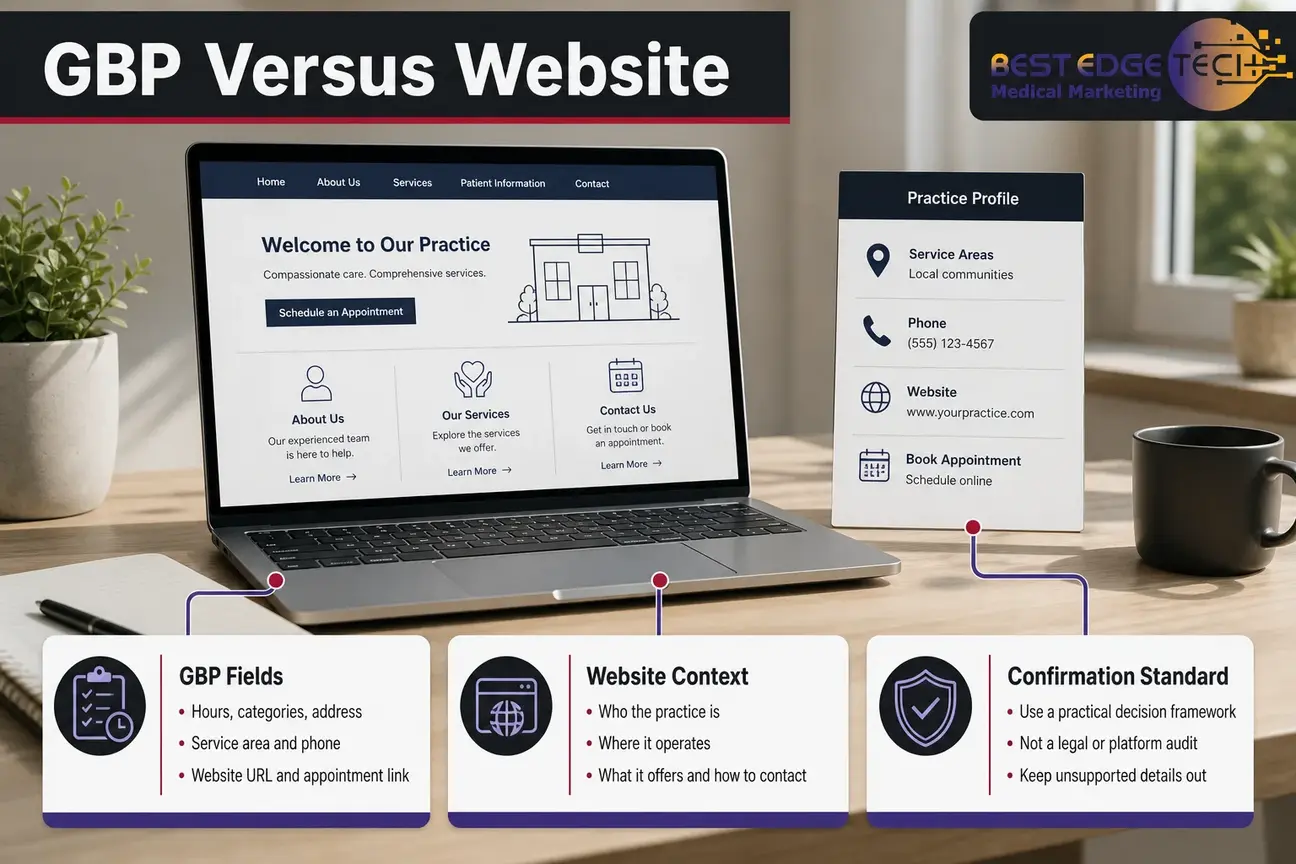
The phrase medical profile attributes covers the factual details that help define how a healthcare business appears in Google Business Profile. Some are formal profile fields, such as hours, categories, address, service area, phone number, website URL, appointment link, and attributes. Others are related business facts that influence how patients understand the listing.
The table below is a practical decision framework for practice owners, administrators, and healthcare marketing directors. It is not a legal standard or a Google-mandated audit format. It is a way to prevent unsupported medical listing details from moving into a public profile.
| Detail | GBP treatment | Website treatment | Confirmation question |
|---|---|---|---|
| Business identity | Use the confirmed public-facing practice name without stuffing keywords. | Explain the practice, providers, specialties, and ownership context where appropriate. | Is this the name patients and referring organizations recognize? |
| Address or service area | Use the eligible, accurate location or service-area model. | Provide location pages, directions, parking, arrival instructions, and service coverage context. | Does the practice actually serve people at this address or in this model? |
| Categories | Select representative categories from Google’s available list. | Use website pages to explain specialties, services, and provider focus areas. | Does the category describe what the business is, not just a keyword target? |
| Hours | Publish real customer-facing hours when appropriate. | Explain appointment-only rules, holiday changes, virtual visit expectations, and provider schedules. | Have operations confirmed the hours currently shown? |
| Phone number | Use the authoritative number for the represented practice or location. | Repeat consistently on contact, location, and appointment pages. | Does the number connect users to the correct office or workflow? |
| Appointment link | Link to a functioning scheduling or inquiry destination. | Explain what happens after a request, without promising availability or outcomes. | Does the link do what the label suggests? |
| Accessibility and operations | Select only confirmed attributes. | Add practical details about entrances, parking, elevators, communication access, and arrival steps. | Has a responsible person confirmed the feature on site? |
This distinction helps prevent profile bloat. GBP attributes should be concise. The website should provide the supporting explanation. If a fact cannot be confirmed by a responsible internal owner, do not publish it as a profile detail.
GBP attributes should describe what is currently true. A practice should not use them to imply that it has a branch, provider, specialty, accessibility feature, or scheduling option that is only planned, outsourced, unavailable, or limited in a way the profile does not disclose.
For example, a med spa, dental group, plastic surgery practice, or primary care office may have many website pages describing services. That does not mean every service belongs in every profile field. A service page can explain who provides the service, where it is available, and how a patient should inquire. A doctor business profile has less room for nuance, so the facts need to be especially clean.
Unsupported details create three problems. First, they may frustrate users who arrive expecting a service, access feature, or office that does not exist. Second, they create inconsistency between the profile, website, and other practice listings. Third, they can lead internal teams to build campaigns around claims that operations has not approved.
For healthcare local SEO, consistency is not a shortcut to rankings; it is the foundation for accurate representation. Google describes local ranking factors in terms of relevance, distance, and prominence in its guidance on improving local ranking on Google. Results still depend on competition, site quality, profile accuracy, reviews, relevance, proximity, and execution. The priority is to publish reliable medical listing details that match how the practice actually operates.
Categories, services, and attributes are often confused, especially when a marketing team is trying to improve a doctor business profile. They are not interchangeable.
Google tells businesses to use as few categories as possible, choose categories that are specific and representative, and not use categories solely as keywords or to describe attributes in the Google Business Profile representation guidelines. That matters because a category decision should not become a catch-all local SEO tactic.
For example, a dental practice should not treat every related keyword as a category. A plastic surgery practice should not choose a category just because a service page mentions a procedure. An anti-aging or longevity clinic should not use category fields to imply clinical capabilities that the practice does not currently provide. The category should identify the business model; website content can explain the rest.
The same logic applies to GBP attributes. If the profile offers an attribute for online appointments, wheelchair-accessible seating, hearing assistance, or another operational fact, the practice should confirm that fact before selecting it. If the attribute needs explanation, add that context on the website rather than stretching the profile field beyond what it can accurately communicate.
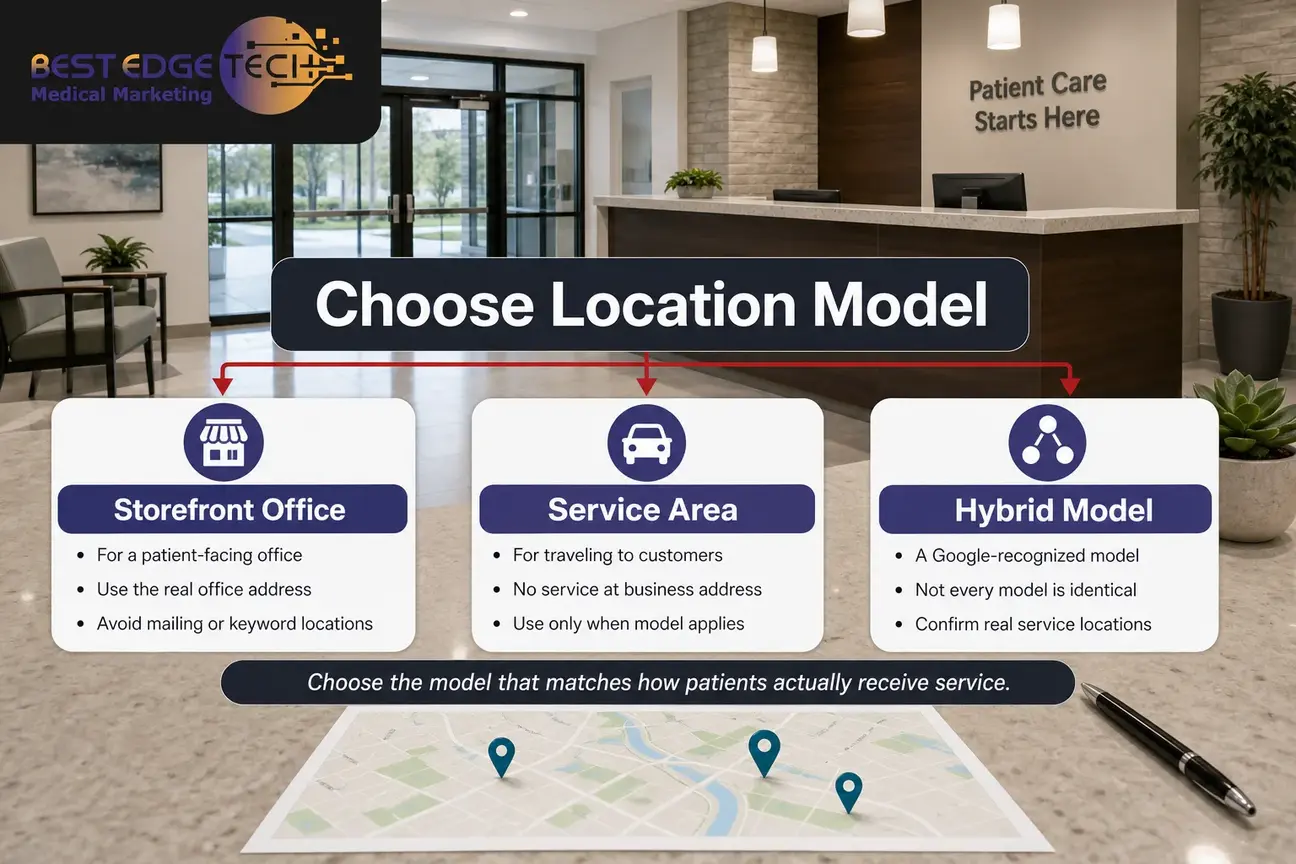
A doctor business profile needs a clear location model. For many healthcare organizations, the profile represents a patient-facing office where patients come for scheduled care, consultation, administrative support, or other services. But not every business model is identical, and Google distinguishes storefront, service-area, and hybrid businesses.
A storefront model usually fits a practice that serves people at a physical location. In that case, the profile address should represent the real office where people can receive service, not a mailing address, keyword location, or aspirational expansion market.
A service-area model may apply when the business travels to customers and does not serve them at the business address. Google says service-area businesses should have one profile for the central office or location with a designated service area, and that service-area businesses cannot list a virtual office unless it is staffed during business hours, according to the same Google Business Profile business-representation guidance.
A hybrid model can apply when a business serves customers at a storefront and also travels to customers. The profile should not use a service area to imply that the practice has offices in every city or neighborhood it wants to reach. A service area is not the same thing as a physical branch.
For healthcare local SEO, this is especially important in competitive markets. Adding nearby cities to a profile does not create real locations. If the practice wants to reach those markets, the website can explain service coverage, referral relationships, telehealth availability where applicable, or location-specific patient information, but only when those facts are true and approved internally.
Hours look simple until a healthcare team compares office hours, phone hours, clinician schedules, appointment availability, holiday schedules, and virtual-visit workflows. A doctor business profile should not collapse all of those into one guessed schedule.
Google’s guidance says businesses should provide regular customer-facing hours and may specify special hours for holidays or events. The same guidance also notes that certain businesses, including those that operate only by appointment, should not provide hours. For a medical practice, that means the team must decide what the profile’s hours actually represent before publishing them.
Use an internal hours checklist:
The website can carry nuance that the profile cannot. A location page can clarify arrival windows, appointment-only policies, department hours, referral instructions, and how a scheduling request is handled. The profile should stay aligned with the confirmed customer-facing reality.
This is also where medical listing details can drift. A practice may change phone coverage, consolidate appointments, renovate an entrance, adjust provider schedules, or add online requests, while the profile still shows old information. Assigning an internal owner for hours reduces that risk.
Contact fields should be treated as high-risk business facts because they directly shape patient inquiries. The profile phone number should connect to the represented practice or location. The website URL should represent the practice or location. The appointment link should lead to a working destination that supports the action a user expects.
A profile link to the homepage may be acceptable in some situations, but it is not always the most helpful choice. If the profile has an appointment field, a specific scheduling page or appointment-request page is usually clearer than a generic homepage, provided that the page is current and controlled by the practice.
Google’s getting-started materials say businesses can direct customers to websites, booking links, and more through Business Profile, as described in Google Business Profile getting-started guidance. For healthcare teams, that should be read conservatively: the link should be real, accurate, functional, and clearly labeled.
Do not call a form a booking tool if it only starts a conversation. A contact form can be useful, but the website should explain what the form does and avoid promising appointment availability, response time, treatment outcomes, or clinical results. If a third-party scheduling platform is used, confirm that the location, providers, specialties, and instructions shown there match the practice’s current operations.
The same consistency check should cover structured data if the website uses it, contact pages, location pages, appointment pages, and major practice listings. If the profile says one thing and the website says another, the marketing team should pause updates until the source of truth is confirmed.
Accessibility and operational details can be helpful for searchers, but they should never be inferred. Do not select an attribute because the building looks accessible in photos, because a neighboring tenant has a ramp, or because the practice plans to make a change later.
Google’s Business Profile materials describe accessibility attributes such as wheelchair-accessible entrances, restrooms, seating, parking, elevators, and hearing assistance devices in its Google Business Profile attributes guidance. Some of these attributes include specific criteria, so a practice should confirm details with facilities, operations, property management, or another responsible internal owner before publishing.
Operational attributes deserve the same discipline. If a practice offers online appointments, virtual consultations, language assistance, parking, or other features, the marketing team should confirm the exact fact, where it applies, and whether it varies by location. A multi-location group may have one office with accessible parking and another with different arrival instructions. A single profile cannot responsibly imply that all locations share the same feature.
When the detail is too nuanced for GBP attributes, move the explanation to the website. A location page can describe which entrance to use, whether elevator access is available, where accessible parking is located, how to request communication assistance, and whom to contact with arrival questions. Those details should be confirmed and maintained, not invented for content depth.
Healthcare local SEO works better when the practice website supports the facts in the profile. That does not mean stuffing the same phrase into every field. It means building a coherent set of pages that explain who the practice is, where it operates, what it offers, and how people should contact it.
Use the website for details that do not fit cleanly in the profile:
This is also where broader search work connects to profile accuracy. A technically sound website, clear location pages, and consistent structured business information can support medical SEO. If your team is evaluating the larger search strategy behind profile and website consistency, Best Edge Medical Marketing publishes information on medical SEO services and related Google Business Profile optimization for medical practices.
Website documentation is not a substitute for profile compliance. It is a support layer. If the profile lists an office, the website should help users understand that office. If the profile links to appointments, the website should explain the appointment workflow. If the profile selects an attribute, the website can provide practical details that make the attribute useful.
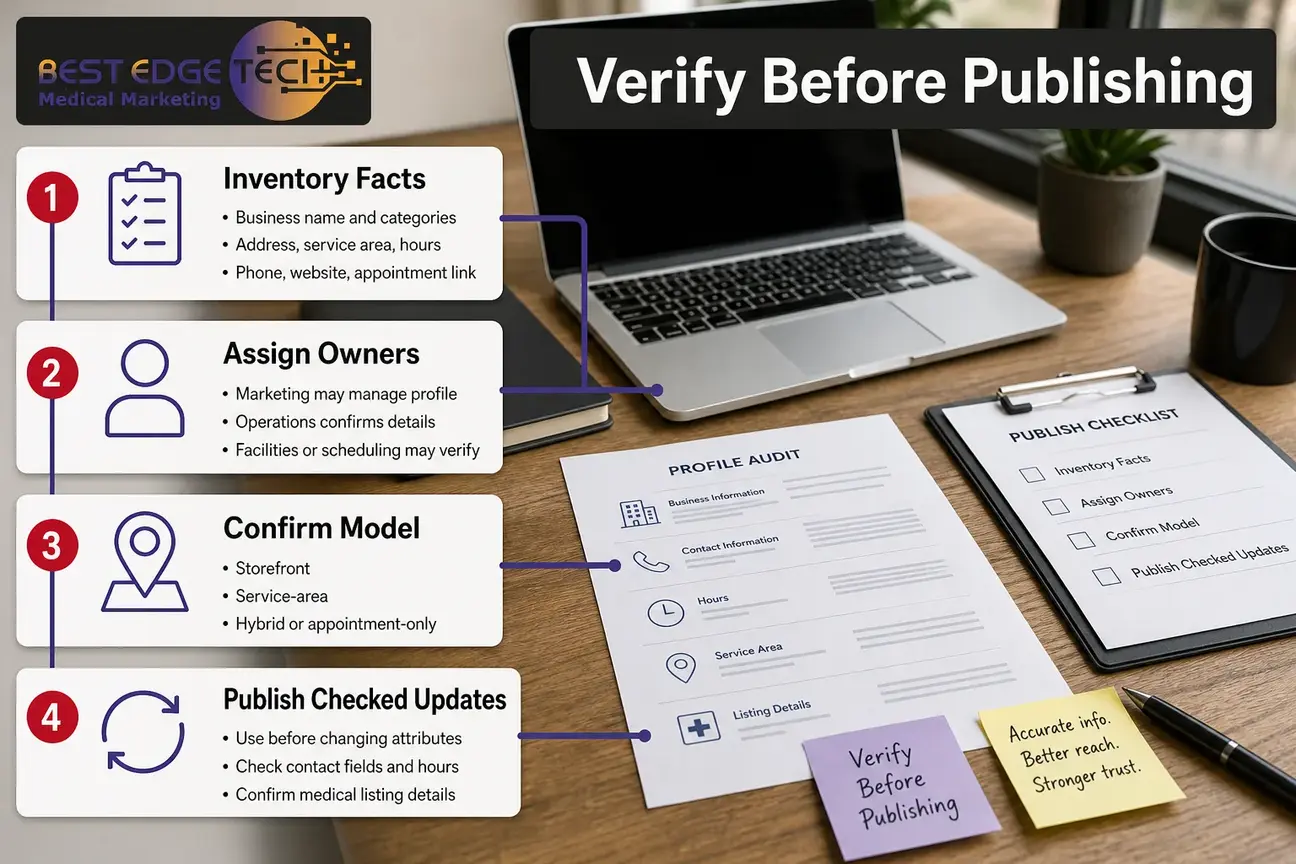
Use this workflow before changing GBP attributes, contact fields, hours, or medical listing details. It is an editorial and operational audit process, not a legal or platform requirement.
This process is especially helpful for multi-location groups and specialty practices. It creates a repeatable way to decide what belongs in the profile and what belongs on the site. It also keeps a doctor business profile from becoming a collection of outdated assumptions.
Most profile problems are not dramatic. They are small mismatches that accumulate over time. A new location page launches, but the profile still points to the homepage. A provider schedule changes, but the hours remain unchanged. A parking situation changes, but accessibility instructions are not updated. These issues can affect user trust even when no one intended to mislead.
Watch for these common problems:
Reputation also intersects with profile accuracy. If users are confused by outdated hours, inaccessible entrances, wrong appointment links, or unsupported service claims, that confusion can affect inquiries and feedback. Best Edge Medical Marketing’s guide to online reputation management for doctors explains review-related considerations separately; profile facts should be handled before review problems arise.
Best Edge Medical Marketing is a Raleigh-headquartered healthcare marketing agency serving practices across the United States. In medical SEO, healthcare marketing services, and website planning conversations, the practical emphasis is alignment: GBP attributes, website content, location pages, appointment paths, and reputation processes should reflect the same confirmed business reality.
That alignment may involve medical SEO, content architecture, website design, technical cleanup, or an educational review of how profile facts are documented on the website. Scope depends on factors such as practice size, specialties, number of locations, competition, content volume, existing website condition, and how many business facts need to be checked. No responsible agency should promise rankings, patient volume, revenue, ROI, or timing from profile edits.
If your team wants to discuss how profile facts, website content, and search visibility should work together, you can contact Best Edge Medical Marketing or call (252) 303-0074. Share your website URL, specialties, locations, goals, recent site changes, and whether you are evaluating medical SEO services, medical website design, or broader healthcare marketing services.
The best working rule for medical profile attributes is to substantiate first and publish second. If a fact is confirmed, concise, and useful in the Google profile, put it there. If it needs explanation, nuance, provider context, location details, or workflow expectations, document it on the website. If it cannot be confirmed, leave it out until the responsible internal team verifies it.
This approach protects the integrity of the doctor business profile, improves the usefulness of medical listing details, and gives healthcare local SEO a stronger factual base. It also keeps the practice from using profile fields to imply services, locations, hours, or access features that are not currently true.
This article is marketing education, not legal, medical or compliance advice. Confirm advertising and privacy requirements with your own counsel or compliance team.
Medical profile attributes are the factual details that help define a healthcare organization in Google Business Profile. They can include contact details, location model, hours, appointment links, accessibility features, operational options, and other confirmed business information. They should reflect what the practice can substantiate today.
No. A practice should select only the attributes that are accurate and confirmed. If a feature is planned, assumed, nearby, available only at another location, or not confirmed by operations, it should not be published as a current profile attribute.
No. A service area describes where a business serves customers; it does not create a physical office. If a practice does not serve people at a listed address, the team should check Google’s service-area and eligibility rules before showing or hiding address information.
Detailed provider, specialty, and service information usually belongs on the practice website. The Google profile can summarize confirmed business facts, but the website is better for explaining providers, locations, appointment workflows, service availability, and patient-facing details.
A practice should check profile details whenever operations change, including relocations, renovations, provider changes, scheduling changes, new appointment workflows, phone changes, holiday hours, or accessibility updates. Many teams also benefit from assigning a recurring internal maintenance owner.
Attributes can make a profile more complete and useful when they are accurate, but no profile field should be treated as a ranking guarantee. Search visibility depends on many factors, including relevance, distance, prominence, website quality, competition, and ongoing execution.
Pause new updates until the source of truth is confirmed. Then correct the Google profile, website, appointment pages, location pages, structured data if used, and major practice listings so they reflect the same confirmed business information.
Best Edge Medical Marketing is a medical marketing agency that provides marketing, SEO, design, and development services to businesses in the medical industry.
Call Us Today
(252) 303-0074