
Medical marketing strategy · Local search
Regenerative SEO: A Local Search Playbook for PRP Clinics
By Best Edge Medical Marketing · Published October 4, 2026 · Updated October 14, 2026
Quick answer: what makes a PRP clinic’s local SEO useful?
Regenerative SEO for PRP clinics connects accurately described services with reachable local markets. Start with distinct treatment pages, truthful office information, and clear consultation access. Support patient questions with credible sources and realistic evidence limits, then measure qualified inquiries. More keywords, town pages, or schema do not guarantee map rankings, AI citations, or treatment outcomes.
A person researching PRP may need to understand the treatment application, find a qualified clinician, compare practical access, and decide whether to request an evaluation. A clinic can lose that opportunity even when it appears in search: the page may blur different procedures, suggest an office that does not exist, or leave the consultation process unclear.
This regenerative SEO playbook focuses on those decisions. It connects market selection, page responsibilities, business information, credible explanations, and consultation measurement into a practical plan for PRP clinics. The goal is stronger relevant visibility and a clearer patient experience, with results assessed against the practice’s actual starting point.
What is regenerative SEO for PRP clinics?
Regenerative SEO is search engine optimization for practices offering accurately described regenerative-medicine services, including platelet-rich plasma procedures. In this guide, the term means a PRP-specific local search strategy: match an actual service to a reachable community, explain the consultation process, and help prospective patients evaluate the practice without overstating treatment benefits.
A clinic owner may search for “regenerative SEO,” while a prospective patient may search for “PRP consultation near me,” a treatment application, or a provider’s name. Those are different audiences. The clinic’s website should answer patient questions; the marketing plan should translate those questions into useful pages, accurate business information, and measurable consultation access. Repeating an agency keyword on every clinic page would miss that distinction.
Platelet-rich plasma, or PRP, is a preparation containing a higher concentration of platelets than ordinary blood plasma. It is commonly prepared from the patient’s own blood. AAOS explains PRP preparation and the limits of current evidence. A practice’s content must identify the specific application rather than assume that evidence for one condition establishes effectiveness for every use.
This playbook is for clinic owners, practice managers, and marketing teams. It addresses discovery, information quality, and appointment access. A treating clinician determines whether a patient is a candidate, which alternatives are appropriate, and what risks apply. Best Edge Medical Marketing provides marketing services; it is not presented here as a PRP treatment provider.
How does local search visibility work for a PRP clinic?
Local search visibility depends on the match between the query, the clinic’s real location, and its online presence. A nearby patient searching for a consultation may see map listings, practice websites, directories, educational results, or AI-generated explanations. The mix changes with the query, device, location, and search platform. A single ranking screenshot cannot describe the entire market.
Google’s local ranking guidance identifies relevance, distance, and prominence as principal considerations. Complete business information helps explain what the practice does. The clinic cannot remove the effect of distance by adding more town names to a page, and Google does not offer a way to pay for a better organic local ranking.
For planning, separate four surfaces. Map visibility concerns the clinic’s eligible business listing. Organic visibility concerns useful, accessible website pages. Answer visibility concerns clear explanations that can be understood and referenced. Conversion performance concerns whether the person can request an appropriate consultation. These surfaces interact, but none guarantees the others.
Record what appears for representative treatment, location, and question queries before deciding what to change. Look for missing information, unclear clinic identities, weak appointment routes, and pages serving the wrong intent. Competitor visibility can reveal a useful question; it does not establish that a competitor’s medical claims are accurate or that an advertised procedure is appropriate.
Keep broad commercial SEO information on the appropriate agency service page. This PRP playbook supports Best Edge Medical Marketing’s SEO services by showing how the planning process applies to a particular clinical market, rather than duplicating a general agency sales page.
Which local markets should a PRP clinic prioritize?
Prioritize communities the clinic can realistically serve, where relevant search interest and consultation capacity justify additional work. A high-population suburb is not automatically the best opportunity. Travel practicality, competing providers, the application being considered, and the clinic’s ability to answer inquiries all affect whether visibility can become a useful consultation.
Start with the real office location and the communities from which patients can reasonably travel. Use aggregated operational information where permitted, public route information, and privacy-reviewed reporting. Do not export identifiable patient addresses into advertising tools to create a marketing map. The aim is a practical catchment assessment, not a patient surveillance exercise.
In a Triangle-area planning exercise, Raleigh, Cary, Apex, Durham, and Wake Forest would be examples of separate communities to evaluate—not automatic claims of clinic locations or recommended targets for every practice. A clinic’s actual address, provider availability, parking, and follow-up expectations must determine which communities it can credibly discuss.
| Decision factor | What to examine | Useful planning output |
|---|---|---|
| Travel practicality | Real routes, accessibility, appointment times, and follow-up needs. | Communities patients can reasonably reach the clinic from. |
| Relevant demand | Treatment and consultation queries, existing impressions, and inquiry topics. | A short list of search needs tied to offered services. |
| Competition and information gaps | Visible providers, page quality, and unanswered patient questions. | Specific content gaps instead of a generic “beat everyone” brief. |
| Clinical and operational fit | Services actually available and the staff’s consultation capacity. | A realistic order for improving pages and handling inquiries. |
Assign a priority and a reason to each market instead of inventing a numerical ranking forecast. If a practice receives qualified inquiries from a nearby community but its website gives no directions or office context, improving access information may be more useful than creating a new page. If the clinic does not offer the searched service, demand alone is not a reason to target it.
Treat keyword tools as estimates rather than audited patient counts. Low-volume queries can still matter when they describe a specific service and a realistic consultation need. Conversely, broad traffic around “regeneration” may include academic, biological, or unrelated interests that a local PRP clinic cannot satisfy.
How should keywords map to distinct pages?
Give each important search intent one clear primary destination. A treatment page should explain a service the clinic actually offers. A location page should help someone understand a real office. A blog should answer a narrower educational question. A provider page should establish the clinician’s relevant identity and credentials. Creating multiple pages for interchangeable phrases can divide attention without improving the patient experience.
| Query pattern | Primary destination | What the page should resolve |
|---|---|---|
| PRP consultation near me | Actual clinic location or relevant service page. | Where the clinic is, which service is available, and how consultation works. |
| PRP for a specific application | Distinct treatment page, only when offered. | Scope, candidacy assessment, evidence limits, risks, and alternatives. |
| What happens at a PRP consultation? | Educational guide supporting the service page. | Preparation, evaluation, questions to ask, and expectations. |
| Provider name and PRP | Verified clinician profile. | Credentials, role, relevant services, and office access. |
| How should a PRP clinic improve local SEO? | This marketing playbook. | Market selection, page structure, local accuracy, and measurement. |
These are illustrative query patterns, not verified search volumes. Before writing, compare the proposed page with existing titles, H1s, URLs, and actual content. Mark the intended primary page in a simple inventory. If two pages already answer the same question, improve their boundaries or consider consolidation after checking performance and redirects. Do not automatically delete a page merely because it shares a keyword.
Secondary phrases should explain the topic naturally: PRP clinic SEO, local SEO for PRP clinics, regenerative medicine marketing, treatment-page strategy, and consultation conversion. Conversational questions might ask how a clinic can target nearby towns without pretending to have offices there, or which information a PRP page should include. Those questions deserve direct answers, not a hidden block of repeated keywords.
Existing broad guides should remain useful entry points. Link to Google Business Profile optimization for medical practices for detailed listing guidance, and keep this article focused on the decisions unique to a PRP-focused local plan.
What should a PRP treatment page include?
A PRP treatment page should describe a specific offered service, establish who evaluates patients, explain uncertainty, and provide an appropriate consultation route. Its purpose is to help someone understand the available care, not to promise an injection is suitable before assessment. A broad list of body parts is not a substitute for a clear service explanation.
- Identify the procedure and its intended application in plain language. Define platelet-rich plasma at first use.
- Describe the clinician’s evaluation process and explain that eligibility depends on individual circumstances.
- Summarize relevant evidence with sources, distinguishing a particular indication from PRP as a broad category.
- Explain meaningful limitations, potential risks, and alternatives the clinician may discuss.
- Describe preparation and follow-up only after the treating team verifies the instructions.
- Clarify consultation access, actual office details, and the process for obtaining current cost information.
Clinical alternatives might include rehabilitation, medication, other procedures, or referral, depending on the condition. A marketing writer should not invent a comparison that says PRP is safer, more effective, or a replacement for surgery. The clinician should verify the comparison and the evidence supporting it. Describing alternatives can help patients understand why evaluation matters.
Separate different applications when their content and service purpose genuinely differ. For example, a clinic offering more than one PRP service may need different explanations of patient selection and expectations. Merely changing the city name or swapping a body-part keyword does not create a substantive new page. Each destination should earn its place through useful, distinct information.
Keep the consultation action close to the relevant explanation. “Request a consultation” is often more accurate than “Book your cure” or “Start regeneration today.” Explain what happens after contact and whether a visit involves evaluation before a treatment decision. Clear process information can improve usability without manufacturing urgency or implying guaranteed results.
For the broader page-experience framework, see medical website design that converts visitors into patients. The PRP-specific additions are careful clinical scope, transparent uncertainty, and a consultation pathway that reflects the practice’s actual process.
How can a clinic target nearby towns without inventing offices?
A clinic can discuss travel from nearby communities while clearly identifying where appointments actually take place. An office page represents a real location. A community-access guide explains how people from another area reach that office. The difference should remain obvious in the title, introduction, contact information, and any structured data.
For example, a hypothetical Raleigh office could explain consultation access for people traveling from Cary if that reflects its real operation. It should not label itself a Cary office, publish a fabricated Cary address, or create a listing for a place where the clinic does not operate. Community names should answer an access question rather than decorate an otherwise identical page.
Google’s business representation rules require accurate identities and locations. A rented mailing address without an operating business is not eligible as a location. Co-working arrangements have additional conditions. Practitioner and department listings have their own rules, so creating another profile is not a universal shortcut.
Useful local details include the real office entrance, parking, accessibility, appointment arrangements, and directions from a relevant route. Add original information that patients need to plan a visit. Avoid publishing dozens of interchangeable town pages whose only function is forwarding everyone to the same generic treatment description; Google’s spam policies address doorway abuse.
Choose actual available Business Profile categories that describe the business accurately. Do not assume a category suggested by a competitor exists in the current interface or is appropriate for the practice. Keep the listing’s name aligned with real branding, use current contact details, and link to the page that best explains the actual location.
Multi-location practices should maintain meaningful differences between office pages: providers, offered services, appointment access, and practical visit details. If two offices offer different PRP applications, say so. Local relevance grows from operational truth and useful information, not from duplicating every service under every municipality.
The regenerative SEO playbook at a glance
The five priorities below connect local discovery with trustworthy information and a practical consultation route. They are planning actions, not a claim that a practice can control every ranking or that any treatment produces a guaranteed outcome.
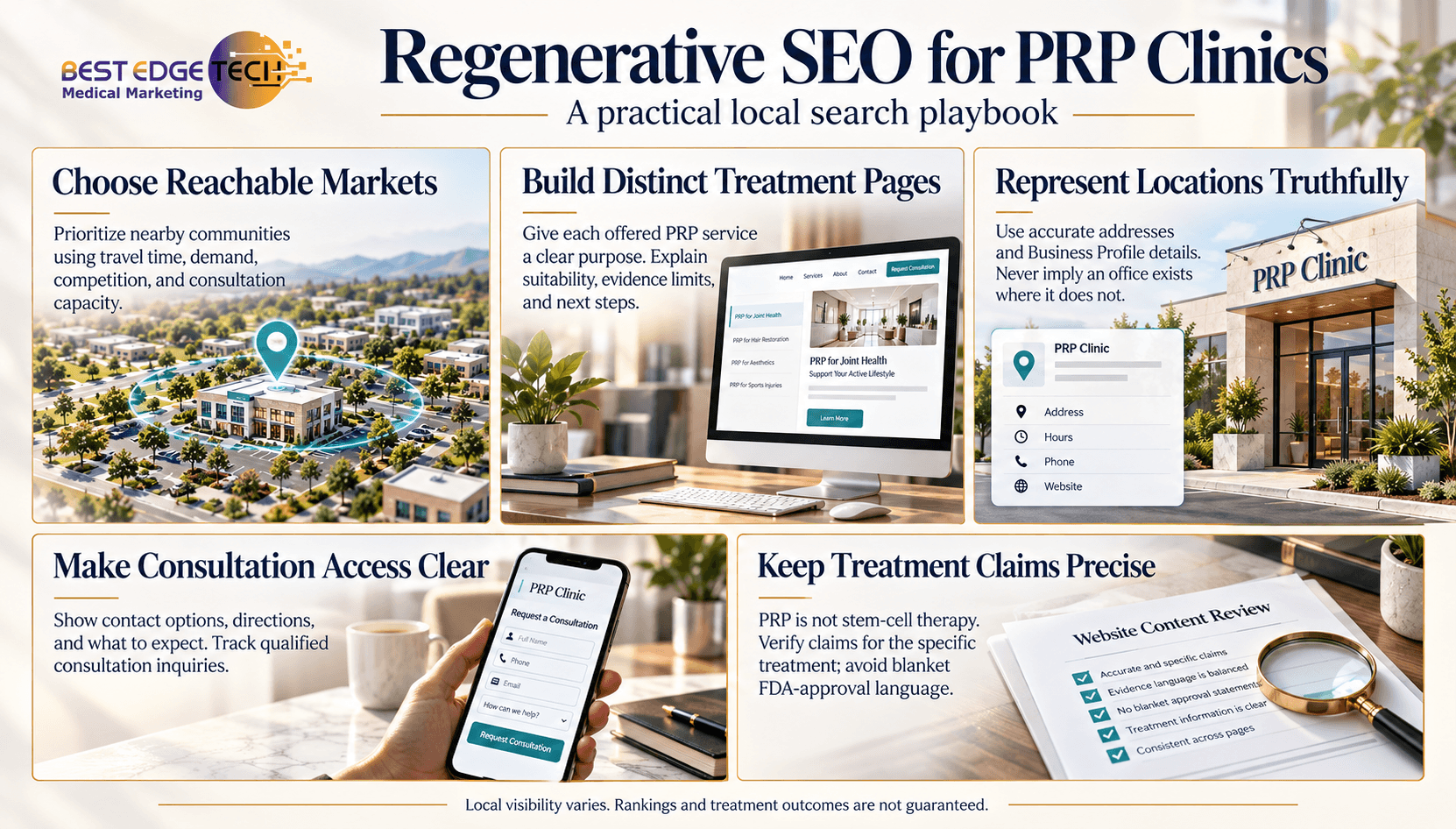
Use the infographic as a shared discussion tool for the clinician, practice manager, and marketing team. The clinician verifies treatment information; operations confirms access and capacity; marketing organizes discoverable pages and reporting. A gap in one area cannot always be repaired by producing more content in another.
Why must PRP and stem-cell marketing remain distinct?
PRP and stem-cell therapies are different, and a website should not use their names interchangeably. A PRP page must describe the preparation and application actually offered. Broad phrases such as “regenerative treatment” do not establish a product’s regulatory status, the strength of evidence, or a patient’s eligibility.
Device clearance and treatment approval are also different concepts. A statement about a particular preparation device does not justify a blanket claim that all PRP procedures, or every advertised use, are FDA-approved. Verify the exact product, device, intended use, and regulatory language before publishing. The FDA’s device approval and clearance resources are starting points for checking that distinction.
The FDA consumer alert on regenerative medicine products warns about misleading marketing and unapproved uses of products promoted as stem cells, exosomes, and related materials. Do not use a general page about PRP to legitimize an unrelated product or imply that a clinical-trial listing establishes approval.
The FTC’s health-products guidance emphasizes truthful, nonmisleading claims supported by appropriate scientific evidence. A prominent promise can remain misleading even when a small disclaimer says results vary. Review the impression created by headlines, before-and-after imagery, testimonials, and descriptions—not just isolated sentences.
| Marketing issue | Why it needs review | Editorial action |
|---|---|---|
| “Regrows cartilage” or “avoids surgery” | An outcome claim may overstate the evidence or imply guaranteed suitability. | Use only a clinically verified, appropriately qualified statement supported for the specific use. |
| “FDA-approved regenerative therapy” | The wording may confuse device status with treatment approval. | Verify the exact product and indication; remove blanket language. |
| PRP described as stem-cell therapy | Different interventions become indistinguishable to readers. | Identify the actual preparation and separate different services. |
| Universal candidacy or painless treatment | Patient selection and risks cannot be assumed from a search query. | Explain evaluation, meaningful limitations, and clinician-directed care. |
Evidence and policy status checked October 14, 2026. Regulatory treatment of a product depends on its specifics; this article is not a product approval determination or individualized legal advice. When uncertainty remains, the practice’s clinical and compliance advisers should resolve the claim before publication.
How can PRP clinics earn trust in search and AI answers?
Make the practice’s identity, clinical scope, sources, and access information easy to verify. A useful page should answer a complete question even when a visitor lands midway through it. Name the treatment, explain who provides it, and state the limitation alongside the benefit being discussed. Do not make readers infer that a marketing organization is a clinical authority.
Publish accurate clinician profiles with verifiable credentials and relevant roles. Attribute clinical review only when the named professional actually reviewed the material. Maintain evidence references and update meaningful changes. Staff photographs and office images should represent the real practice; a generic stock image does not prove who provides care or where a service is available.
For extractable answers, place a direct explanation immediately below a question heading, then add details. An example is: “A PRP consultation is an evaluation of whether a specific application may be appropriate; requesting an appointment does not establish eligibility.” Each passage should preserve its qualifiers when read separately. Useful specificity is more valuable than repeatedly claiming authority.
Google’s guidance for AI search features says foundational SEO remains relevant and there is no special AI-specific schema required. Keep important information in visible text, support discovery through internal links, and make structured data agree with the page. Inclusion and citations are not guaranteed. Bing’s webmaster guidance also connects discovery, indexing, and clarity with eligibility for its search and AI experiences.
Handle reviews as genuine feedback rather than outcome proof. Avoid fake reviews and misleading testimonials. Do not disclose patient details in public responses. The FTC review-rule guidance and platform policies should inform the practice’s review process. For broader implementation, read online reputation management for doctors.
Authority also depends on technical access. Confirm that the intended page can be crawled, renders its essential text, and has an appropriate canonical URL. Improve mobile navigation and image delivery. A polished page hidden behind an accidental noindex setting or an incorrect canonical cannot reliably serve its intended search role.
How should consultation performance be measured?
Measure qualified inquiries and consultation access alongside visibility. A page can attract traffic while failing to explain where care occurs, how to contact the clinic, or what happens next. A request can also be irrelevant to the offered service. Reporting should distinguish a click, an inquiry, a suitable consultation request, and an attended appointment.
| Stage | Example measure | Interpretation limit |
|---|---|---|
| Search discovery | Relevant page impressions and query patterns. | Impressions are not individual patients or guaranteed local demand. |
| Website engagement | Visits to the right treatment and location pages. | Reading a page does not establish suitability or intent to book. |
| Contact access | Successful form submissions and appropriate call actions. | A click alone is not a completed inquiry. |
| Consultation operations | Qualified requests, response process, and attended consultations. | Use approved systems and distinguish scheduling from treatment. |
| AI visibility | Documented citations or identifiable referral visits. | A citation, referral, and completed consultation are different events. |
Build a baseline before changing several things at once. Record page changes and campaign activity so the team can interpret later movement. Review whether the inquiries concern an offered service, whether staff can respond through the actual process, and whether the intended office is clear. Report a smaller number of meaningful measures consistently rather than a large dashboard of disconnected totals.
Google’s AI-feature guidance describes AI search performance within the overall Web reporting in Search Console; that is not a stand-alone count of AI-driven consultations. Bing’s AI Performance documentation describes citation-related reporting in its tools. Treat each report according to what it actually measures and avoid combining unlike metrics into a fictional single patient-acquisition number.
Use a privacy-reviewed tracking plan. Do not send symptoms, appointment details, form-message contents, or patient identifiers into ordinary advertising or analytics events. Collect only appropriate scheduling information through approved systems. HHS tracking guidance addresses disclosures involving protected health information and also notes a court limitation affecting part of its public-webpage guidance. Applicability requires a fact-specific review rather than assuming every anonymous pageview is PHI or that every tracker is acceptable.
Improve the experience before increasing promotion: visible contact options, clear office context, usable forms, confirmation that a request was received, and an accurate explanation of the next step. Describe the practice’s actual response process; do not publish a same-day response promise unless operations can support it.
What should a first 90-day implementation plan include?
Use the first 90 days to establish accuracy, improve priority pages, and build a reliable reporting process. This is a proposed work sequence, not a forecast of ranking gains. A new site, a mature clinic, and a multi-office practice may need different schedules, and clinical review can change the order of publication.
| Planning period | Core work | Reviewable deliverable |
|---|---|---|
| Days 1–30 | Inventory pages and queries; verify services, offices, listing details, and claims. | A page-intent map, market shortlist, baseline report, and corrected factual gaps. |
| Days 31–60 | Improve the highest-priority treatment and location pages; repair consultation paths and internal links. | Clinically checked pages with useful access information and functioning contact routes. |
| Days 61–90 | Assess inquiry quality, test mobile usability, review technical access, and refine content priorities. | A documented comparison with the baseline and a reasoned next-quarter plan. |
Assign ownership: a clinician checks clinical statements; an operations lead confirms locations and appointment arrangements; a marketing lead manages intent mapping and implementation; a privacy or compliance adviser reviews relevant tracking and claims. A clear handoff prevents a well-designed page from publishing a service that the office does not provide.
Paid search, referral relationships, and patient education can complement SEO when appropriate. They do not replace truthful pages or qualified intake. If paid promotion is considered, review the current platform rules for the exact procedure and audience; an organic page’s existence is not permission to advertise an unapproved product. Referral activity should also reflect applicable professional and legal requirements.
At the end of the cycle, ask what improved: Did patients reach the right pages? Did the website answer recurring consultation questions? Were inaccurate listings corrected? Can the practice distinguish useful requests from unrelated inquiries? These observations provide a more actionable next step than treating an arbitrary keyword score as proof of business or clinical success.
Build a PRP search strategy around the practice you actually operate
A useful regenerative SEO plan aligns the clinic’s real services, reachable communities, treatment information, and consultation process. It gives each important page a distinct job and checks whether visitors can move from understanding to an appropriate inquiry. More pages and more impressions are only useful when they support that purpose.
Best Edge Medical Marketing is based in Raleigh and serves healthcare organizations across the United States. Its medical SEO services, website design services, and anti-aging medical practice marketing provide relevant starting points for discussing search visibility and patient-facing information. The services a particular practice needs depend on its actual website and operations.
Discuss your clinic’s local search priorities
Bring your website, actual office locations, offered PRP services, and current consultation process. The next step is a practical discussion of page structure, visibility gaps, and the information patients need before contacting the practice.
Frequently asked questions about regenerative SEO
What does regenerative SEO mean for a PRP clinic?
Regenerative SEO means optimizing a practice’s online presence around accurately described regenerative-medicine services and relevant patient searches. For a PRP clinic, that includes distinct treatment pages, truthful office information, useful consultation explanations, and a reachable local audience. It is a marketing strategy, not a medical treatment category or a guarantee of rankings. The page structure should reflect services the clinic actually provides.
Should a PRP clinic target regenerative SEO as its patient-facing keyword?
Usually, a clinic should prioritize the service, location, and consultation questions its prospective patients actually ask. Regenerative SEO is commonly a marketing-planning phrase used by clinic owners or agencies. A patient-facing page may instead need to explain a specific PRP application or office access. Confirm the intent in current search results and existing query data before assigning a primary phrase to a page.
Does each nearby town need its own PRP landing page?
No. A separate town page should provide genuinely useful information and remain clear about the clinic’s real office location. Changing only the town name across similar pages can create overlap and a poor experience. When travel from a community matters, explain directions and consultation access truthfully. Do not imply a branch office, publish a fabricated address, or create an ineligible business listing to support the page.
Can one PRP service page cover every treatment application?
A single overview can introduce the clinic’s offered services, but genuinely different applications may need distinct explanations. Separate pages are useful when patient selection, evidence, alternatives, or the consultation process differ substantially. They should not be created merely for keyword variations. A clinician should verify each application, its limitations, and the actual service availability before the marketing team publishes the corresponding content.
Can a clinic describe PRP as FDA-approved?
A clinic should not use a blanket FDA-approved claim without verifying the exact product, device, intended use, and regulatory status. Device clearance and approval of a therapeutic use are different concepts. A statement about preparation equipment does not establish approval for every PRP procedure or advertised application. Have the specific wording reviewed against current authoritative information and the actual service before publishing it.
Is PRP the same as stem-cell therapy?
No. Platelet-rich plasma and stem-cell therapies are different interventions and should not be presented interchangeably. A PRP page should explain the preparation and application actually offered. A broad regenerative-medicine label does not establish that a product is approved, effective for a particular condition, or appropriate for an individual patient. Keep different services clearly separated and have clinical and regulatory statements checked by qualified advisers.
Can regenerative SEO guarantee Google Maps rankings or AI citations?
No. Local visibility depends on the query, searcher location, competition, business information, and search systems. AI inclusion and citations also vary and are not guaranteed by structured data or a particular writing format. Use accurate information, useful pages, crawlable content, and appropriate internal links. Measure relevant visibility and qualified consultation inquiries rather than treating a single ranking or citation as a guaranteed acquisition channel.
How long does a PRP clinic’s SEO strategy take to work?
There is no dependable universal timeline. Results depend on the starting website, market, existing visibility, implementation quality, and the type of improvement being measured. A 90-day plan can organize audits, page improvements, and baseline reporting without promising ranking gains in that period. Review whether information is more accurate, consultation routes function, and inquiry quality changes before interpreting traffic movement as business growth.
Which measurements matter beyond website traffic?
Useful measures include relevant query impressions, visits to the appropriate treatment pages, completed contact requests, qualified consultation inquiries, and attended consultations recorded through approved systems. These describe different stages and should not be treated as interchangeable. Review the clinic’s privacy requirements before implementing tracking, and avoid sending patient identifiers or appointment details into ordinary analytics. A clear baseline helps explain what changed and what remains uncertain.
How can Best Edge Medical Marketing help with PRP clinic visibility?
Best Edge Medical Marketing offers medical SEO, website design, and healthcare marketing services. A practice can discuss how its actual treatment pages, office information, internal links, and consultation routes support local discovery. The agency is based in Raleigh and serves healthcare organizations across the United States. Any recommended scope should follow a review of the clinic’s real services, existing content, and operational needs rather than assume identical requirements for every practice.
Sources and editorial standards
Source and policy check: October 14, 2026. Search guidance, platform interfaces, and product-specific regulatory status can change. The implementation plan and market worksheet are editorial planning recommendations, not measured ranking factors or clinical outcome predictions.
- Google: Tips to improve your local ranking
- Google: Guidelines for representing your business
- Google Search Central: AI features and your website
- Google Search Central: Spam policies
- Bing: Webmaster guidelines
- Bing: AI Performance documentation
- AAOS OrthoInfo: Platelet-rich plasma
- FDA: Device approvals and clearances
- FDA: Consumer alert on regenerative medicine products
- FTC: Health Products Compliance Guidance
- FTC: Consumer reviews and testimonials rule guidance
- HHS: Online tracking technologies guidance
Best Edge Medical Marketing staff: editorial responsibility
Publisher: Best Edge Medical Marketing. This business guide uses public search-platform and health-agency sources to explain responsible PRP marketing. It does not provide individual treatment recommendations or claim a medical reviewer who has not reviewed the article. Clinical claims on a treating practice’s website require verification by its qualified clinical team.