
Menu
Close

Quick Answer: Choose a medical SEO agency by evaluating its process, access model, healthcare content safeguards, reporting, contract language, and willingness to document limitations. Do not rely on ranking guarantees, patient-volume promises, revenue promises, AI-citation promises, or fixed time-to-result claims. A credible agency should explain what it can control, what depends on your practice, and how it will report evidence without overstating outcomes.
For practice owners, administrators, and healthcare marketing directors, agency selection is less about hearing a bold promise and more about confirming whether the work can be governed. Medical search visibility depends on competition, site history, technical condition, local market factors, content quality, reviews, implementation speed, and how well the practice handles inquiries after they arrive. Those variables make ranking guarantees a poor basis for a contract.
A better evaluation asks: What will be delivered? Who owns the accounts? Who approves clinical language? How are errors corrected? Which reports will show work, evidence, limitations, and next actions? Google Search Central’s guidance on creating helpful, reliable, people-first content explains that people-first content is created primarily for people, not to manipulate search engine rankings. That matters in healthcare because many medical topics fall into YMYL, or “Your Money or Your Life,” where accuracy, trust, and clear responsibility are essential.
A medical SEO agency should be able to describe its approach before asking you to accept a broad promise. The conversation should begin with your practice model: specialties, services, locations, referral mix, patient inquiry goals, website condition, decision-makers, and approval constraints. If the agency cannot connect the proposed work to those details, the proposal may be generic rather than practice-specific.
Ask the agency to separate three categories of work: controllable deliverables, practice responsibilities, and outside dependencies. Controllable deliverables may include technical audits, implementation tickets, content briefs, edited drafts, internal linking recommendations, Google Business Profile maintenance tasks, Search Console configuration, analytics review, and reporting. Practice responsibilities may include approving service language, verifying provider credentials, granting access, reviewing claims, and responding to open questions. Outside dependencies include competition, platform changes, site history, search demand, and patient decision behavior.
The agency should also explain what it will implement directly and what it will only recommend. For example, a healthcare marketing team may identify crawl issues, broken links, duplicate content, thin service pages, weak internal linking, or missing tracking. But if your website developer, hosting provider, or internal compliance team controls implementation, the timeline and outcome depend on coordination.
This is where due diligence protects the practice. A strong proposal does not pretend every factor is under agency control. It defines work clearly enough that you can tell whether progress is happening even before ranking movement appears.
The right SEO agency questions make the sales process more concrete. Use the same questions with every finalist so you can compare answers consistently instead of reacting to presentation style.
Good SEO agency questions are not adversarial. They clarify governance. If a proposal depends on content approvals, provider input, developer availability, tracking access, or call-handling data, you want that dependency visible before the agreement begins.
Listen for specificity. “We will optimize your site” is not enough. “We will audit indexation, internal linking, service-page structure, metadata, local landing pages, tracking configuration, and content gaps, then prioritize implementation by impact, difficulty, and access requirements” is easier to govern. The second answer gives you a basis for accountability.
Also ask what the agency will not do. Exclusions are not necessarily negative. A clear exclusion may be healthier than an implied service that never appears in the work plan. If paid advertising, website development, review management, AI search optimization, or conversion tracking is outside the engagement, the proposal should say so plainly.
Use SEO agency questions to test whether the agency can translate strategy into monthly work. A good answer should connect discovery, access, approvals, implementation, and SEO reporting instead of treating each as a separate conversation.
Medical SEO services should be broad enough to address the way patients and caregivers discover providers online, but specific enough to avoid vague “optimization” language. A healthcare SEO scope often touches technical SEO, content, local visibility, site structure, conversion paths, reputation signals, and measurement. Not every practice needs every component at the same depth, but the agency should explain its reasoning.
For technical SEO, ask whether the review includes crawlability, indexation, URL structure, redirects, broken pages, canonical signals, duplicate or outdated content, XML sitemaps, robots directives, internal linking, mobile experience, page performance, accessibility coordination, and structured data accuracy. You do not need to become the technician, but you do need a clear issue-to-action path.
A practical technical recommendation should identify the problem, proposed fix, owner, approval requirement, implementation path, and validation method. For example, if service pages are buried three clicks deep and lack internal links, the recommendation should show which pages need links, where the links should appear, who updates them, and how the agency will confirm the change.
The same standard applies to content. If the agency recommends new service pages, specialty pages, provider biographies, or location pages, the proposal should specify the editorial workflow. Medical SEO services should not rely on unverified claims, copied language, or bulk AI output without practice review. For healthcare, the content process is not a side detail; it is part of risk management.
Medical SEO services should also define the relationship between visibility and conversion. A page can earn impressions but still fail to produce useful inquiries if the offer is unclear, the appointment path is confusing, or the page does not answer the decision-maker’s practical questions.
If your practice is evaluating a specialized partner, review whether its medical SEO services page matches the type of work being discussed in the proposal. A service page should not replace due diligence, but it can help you confirm whether the engagement fits the agency’s stated focus.
YMYL content is content that can affect a person’s health, safety, financial stability, or well-being. Healthcare websites often contain YMYL-adjacent or YMYL content, even when the page is written for marketing. A service page, provider biography, treatment overview, or patient education resource can influence how people understand care options. That raises the standard for accuracy and accountability.
Google describes E-E-A-T as experience, expertise, authoritativeness, and trustworthiness in its Search quality concepts, and its helpful content guidance asks site owners to consider whether content is helpful, reliable, and made for people. For a healthcare practice, that does not mean the agency should present itself as a clinician. It means the agency should help the practice show real expertise through accurate provider bios, practice-verified credentials, sourced statements when claims require support, clear editorial responsibility, and a process for correcting outdated or inaccurate material.
Ask whether the agency’s content process includes practice-provided subject-matter input, clinician or practice-side review when appropriate, verification of provider names and credentials, separation between marketing education and medical advice, and a documented approval workflow. The agency should also avoid unsupported treatment, safety, efficacy, cost, or outcome claims unless the practice has reviewed the claim and approved the sourcing.
AI-assisted drafting deserves direct discussion. Google’s helpful content guidance tells publishers to focus on content that is useful to people, and it warns against automation used primarily to manipulate ranking systems. In healthcare selection, the practical question is not “Do you use AI?” The better question is: “How do you control accuracy, edit the draft, verify facts, document sources, and obtain practice approval before publication?”
If an agency offers large content volume without a medical content workflow, that should pause the evaluation. High output without review can create accuracy, brand, compliance, and trust problems. Your practice should know who is responsible for drafts, revisions, approvals, update cycles, and corrections.
AI search optimization is often described with terms such as AEO, or Answer Engine Optimization, and GEO, or Generative Engine Optimization. The definitions vary across the industry, so ask the agency to define exactly what it means. A credible answer should distinguish documented platform guidance from the agency’s interpretation or observed behavior.
As of 2026, Google says SEO best practices remain relevant for AI features in Google Search. Google also explains that site owners do not need special AI-specific files or tags for eligibility beyond following its documented guidance. That does not mean AI visibility is simple. It means no agency should claim a special lever that assures AI Overviews, AI citations, or a fixed number of generated-answer mentions.
In practice, AI search work for healthcare should still begin with fundamentals: crawlable pages, clear site architecture, accurate service information, strong internal linking, useful content, transparent authorship or editorial responsibility, and consistent entity information across the web. If a practice has thin pages, unclear service definitions, weak provider bios, or unverified claims, the first priority is usually to improve the source material rather than chase screenshots.
Measurement should also be specific. Google says that to measure content performance in generative AI features on Google Search and Discover, site owners can use the Generative AI performance report in Search Console where available. Ask whether the agency will report URLs, impressions, queries, countries, limitations, and interpretation. Screenshots alone are not a reporting framework.
If AI search is part of the scope, compare it with the agency’s broader AI search optimization for healthcare work or service description. Then ask how the proposal translates that concept into tasks, review points, and reporting. No one should present AI citations as a promised deliverable.
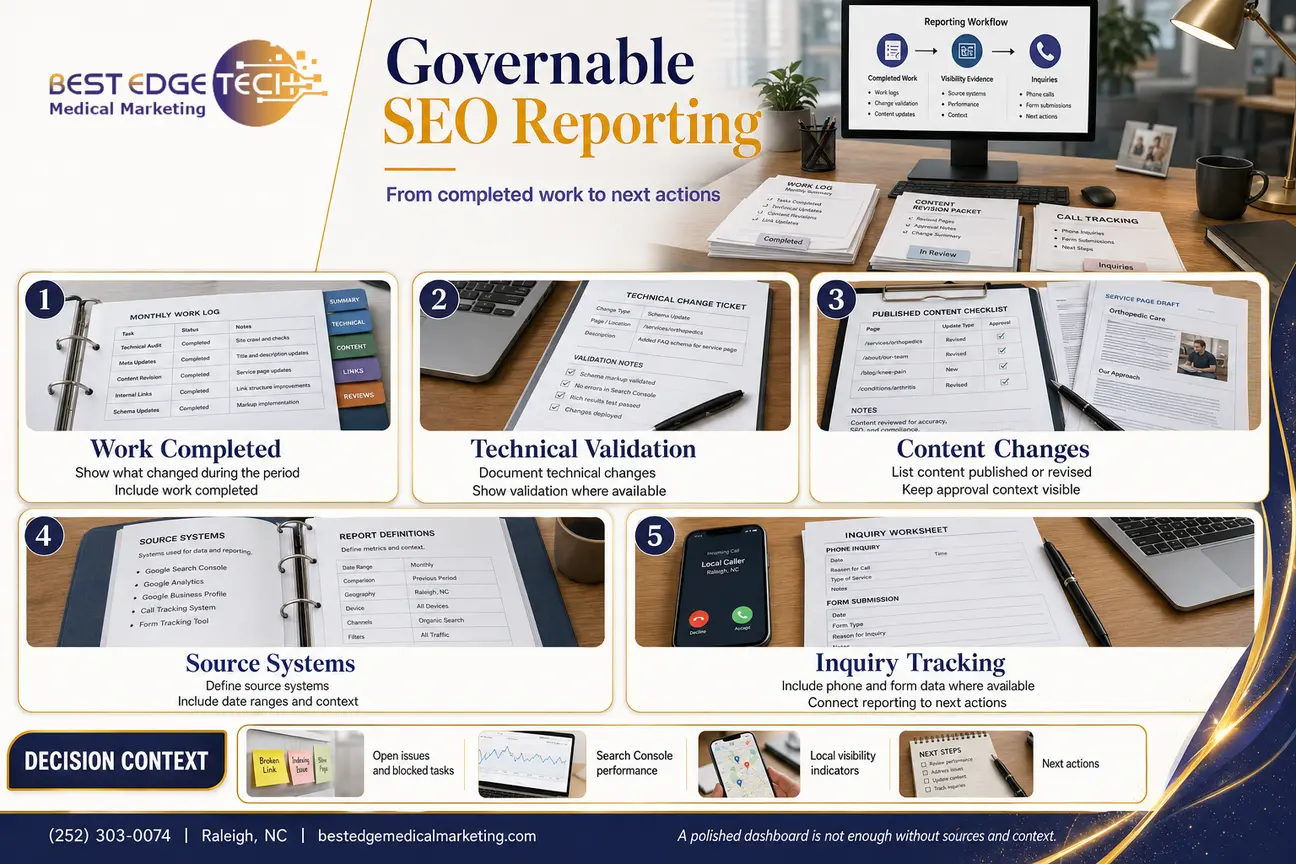
SEO reporting should help decision-makers understand what changed, what evidence exists, what remains blocked, and what comes next. A polished dashboard is not enough if it lacks source systems, definitions, date ranges, and context.
Useful SEO reporting should include work completed during the period, technical changes and validation, content published or revised, open issues, blocked tasks, Search Console performance, organic traffic definitions, inquiry tracking where configured, phone and form data where available, Google Business Profile activity where relevant, local visibility indicators, and next actions. Rankings can be included, but they should be treated as directional evidence rather than the sole measure of success.
Ask each agency to show a sample reporting outline or an anonymized format. You are not looking for another practice’s results. You are looking for methodology. The report should tell you which systems were used, how traffic was categorized, what counts as an inquiry, whether call tracking is configured, and which limitations apply.
SEO reporting should also show the difference between activity and outcome. Publishing a page is an activity. Improving indexation is a technical milestone. Growth in relevant impressions may be an early visibility indicator. Patient inquiries may be influenced by search visibility, website conversion, reputation, call handling, form usability, schedule availability, and market demand. A credible report avoids flattening those variables into one unsupported claim.
Make account access part of the reporting conversation. If reports are generated from analytics, Search Console, call tracking, form systems, or dashboards, the practice should understand who controls those accounts and whether data can be exported if the relationship ends.
Strong SEO reporting also helps leadership decide what to fund next. If the report shows technical debt, slow approvals, weak service-page depth, or incomplete tracking, the next decision may be operational rather than promotional.
SEO contract terms should make the relationship governable. The agreement should describe scope, deliverables, reporting cadence, approval timelines, implementation responsibility, content ownership, account access, data handling, term, renewal, cancellation, transition assistance, change-order rules, and exclusions. It should also explain what happens to unfinished work if the engagement ends.
For healthcare practices, SEO contract terms should also address privacy, advertising review, testimonial review, subcontractors, AI tools, and compliance boundaries. That does not mean the agency is giving legal advice. It means the contract should identify when questions must be escalated to the practice’s counsel or compliance team.
The practice should generally retain administrator ownership wherever practical. That includes the domain registrar, website hosting, content management system, Google Analytics, Google Search Console, Google Business Profile, call-tracking account, CRM or form data, creative files, written content, photography, video, local listings, review-management tools, dashboards, and historical reports. The agency can be granted appropriate access without owning the assets.
Credential control matters. If the agency creates accounts under its own ownership, the practice may struggle to revoke access, export historical data, or continue operating after termination. SEO contract terms should state how access is granted, who has administrator rights, how passwords are managed, how data is exported, and what transition assistance is included.
Review provisions should also be clear. The agreement should not encourage buying, gating, fabricating, or incentivizing reviews. The FTC provides guidance for marketers on soliciting and paying for online reviews, and healthcare practices should be careful that review requests, testimonials, and endorsements are handled transparently. Public review replies should avoid confirming whether someone is a patient.
Privacy language deserves similar care. The HHS Office for Civil Rights publishes information on the HIPAA Privacy Rule, but a marketing agency should not declare your program legally compliant. Look for HIPAA-aware process language, clear escalation, and practice-side review of privacy questions.
When comparing SEO contract terms, ask for the practical version of every clause. If a clause says the agency owns “campaign assets,” clarify whether that includes content, tracking numbers, dashboards, creative files, or historical data.
Use this checklist when comparing medical SEO services and agency access terms. The point is not to deny the agency the access it needs. The point is to preserve the practice’s control over its own digital infrastructure.
If an agency says ownership is “standard,” ask for the exact clause. If the practice cannot revoke access, export data, or keep operating after the engagement ends, the arrangement deserves closer review before signing.
Search visibility is not created by an agency in isolation. A practice’s responsiveness, internal accuracy review, provider information, location changes, website platform, developer access, and call-handling process all affect the work. Those dependencies should be documented in the proposal or onboarding plan.
Common dependencies include practice approvals, verified provider biographies, service-line changes, location updates, tracking configuration, developer availability, review-policy decisions, content accuracy review, website redesigns, migrations, appointment availability, competition, seasonality, demand, and platform changes. If a practice is expanding, changing its brand, adding a specialty, or replacing its website, the SEO plan should reflect that reality.
Medical SEO services are often slowed by content approval bottlenecks. That is not a failure if it is expected and managed. It becomes a problem when the agency promises outcomes without acknowledging that provider review, compliance review, or website implementation may take time.
Ask how the agency will document blocked tasks. A useful status note might say: “Provider biography revisions are waiting on credential verification from the practice,” or “Tracking cannot be validated until form confirmation pages are updated.” Those notes help administrators solve operational issues rather than guessing why progress is delayed.

Some warning signs are serious enough to stop the selection process or require clarification before moving forward. The biggest is any unsupported promise of rankings, page-one placement, patient volume, booked appointments, revenue, ROI, AI citations, or a fixed time-to-result. Those outcomes depend on variables no agency fully controls.
Other warning signs include vague proprietary methods without deliverables, bulk content without editorial review, AI-generated content without human editing and practice approval, no technical scope, no named reporting data sources, rankings presented without business context, agency-controlled ownership of critical accounts, refusal to provide an exit process, and pressure to sign before discovery or access review.
Review tactics require special caution. A proposal should not involve buying reviews, gating reviews, fabricating reviews, suppressing negative feedback, or offering undisclosed incentives. For healthcare practices, public responses should also avoid confirming that a reviewer is or was a patient.
Be careful with broad compliance promises. An agency may describe HIPAA-aware safeguards, privacy-conscious workflows, or escalation to counsel, but it should not ask you to rely on a marketing vendor’s legal conclusion. Your practice’s counsel or compliance team should review privacy, advertising, testimonial, and contract questions.
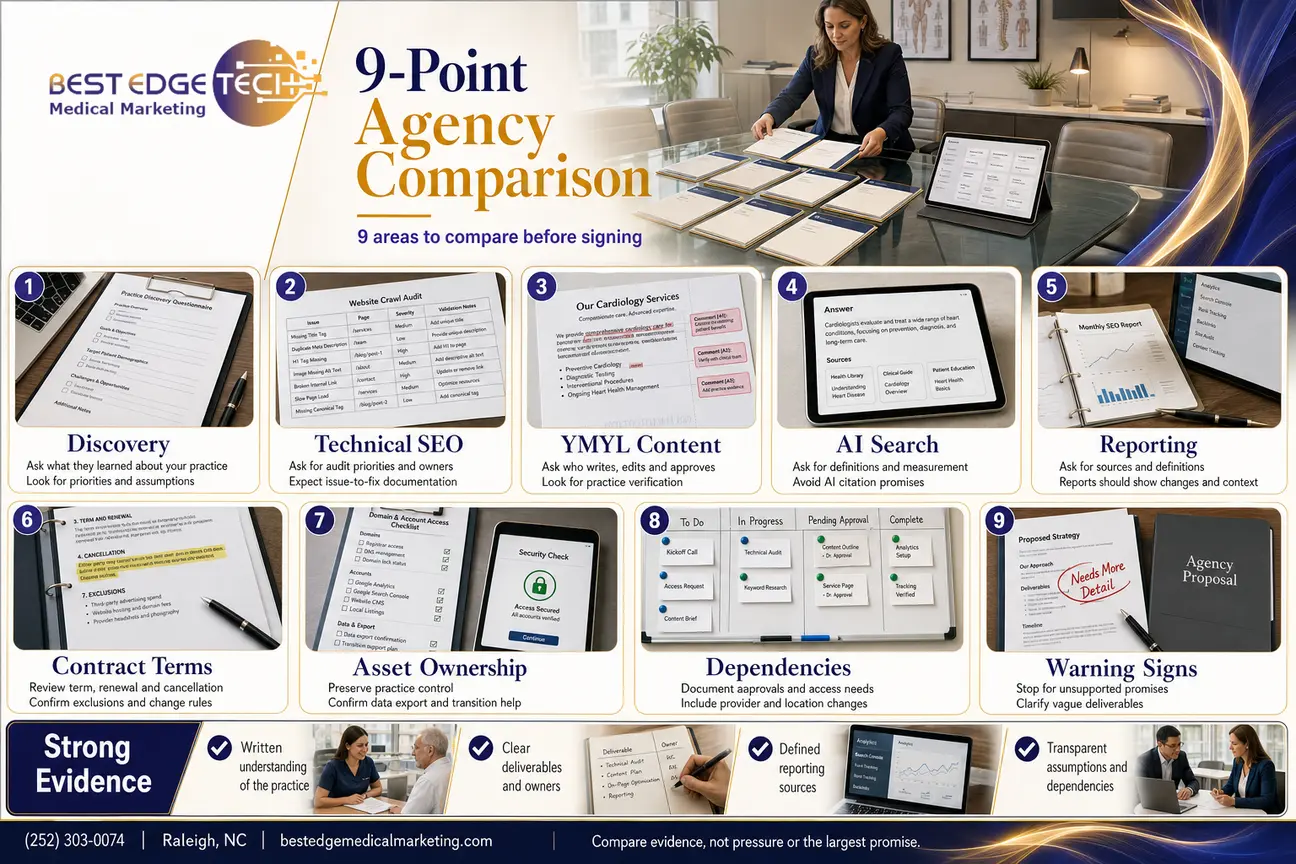
Use this comparison table after discovery calls. It keeps the decision focused on evidence rather than pressure, personality, or the largest promise.
| Evaluation area | Ask for | Strong evidence | Warning sign |
|---|---|---|---|
| Discovery | Written understanding of the practice | Specific priorities, assumptions, and dependencies | Generic proposal |
| Technical SEO | Audit, priorities, owners, and validation | Issue-to-fix documentation | Vague “optimization” language |
| YMYL content | Editorial and approval workflow | Practice verification and clear accountability | Unreviewed bulk content |
| AI search | Definitions and measurement plan | Foundational SEO plus transparent reporting | AI citation promises |
| Reporting | Sources, definitions, changes, and actions | Search Console and analytics context | Vanity metrics only |
| Ownership | Administrator access and export rights | Practice retains control | Agency-owned accounts |
| Contract | Scope, exclusions, exit terms | Plain-language responsibilities | Ambiguous deliverables |
| Compliance boundary | Counsel or compliance escalation path | HIPAA-aware process language | Legal conclusions from the vendor |
| Outcomes | Dependencies and scenarios | No unsupported promises | Ranking guarantees, lead, revenue, or timing promises |
Start by shortlisting agencies that describe healthcare-specific workflows without unsupported credentials, exaggerated claims, or ranking guarantees. Review whether they understand how medical practices are structured: providers, services, specialties, locations, referrals, patient inquiries, and compliance review.
If your evaluation includes website conversion, content, reputation, or local visibility work beyond core SEO, compare those needs with the agency’s broader healthcare marketing services. A multi-service scope can be useful when it is clearly defined; it becomes risky when everything is bundled under vague language.
You may also need supporting guidance in adjacent areas. For example, review processes often connect to online reputation management for doctors, and website inquiry performance may connect to medical website design that converts. Keep those workstreams connected, but make sure each has its own scope and measurement.
Best Edge Medical Marketing is a Raleigh-headquartered healthcare marketing agency serving the United States. If your practice is comparing medical SEO services and wants a clearer selection conversation, you can contact Best Edge Medical Marketing or call (252) 303-0074. Share your website URL, specialties, locations, goals, recent site changes, and the service you are considering.
The goal of a first conversation should be fit and clarity, not a promised outcome. A responsible discussion should cover your current website, service lines, decision-makers, access requirements, reporting expectations, and the practical constraints that may shape the scope.
The right medical SEO agency evaluation should leave your team with more clarity, not more pressure. You should understand what will be done, who owns the accounts, how content is approved, what SEO reporting will show, which SEO contract terms matter, and which outcomes cannot be responsibly promised.
Ranking movement, patient inquiries, and AI visibility are influenced by many factors outside a vendor’s full control. A practical, healthcare-aware agency selection process focuses on documented work, accurate content, sound technical recommendations, clear access, useful reports, and honest dependencies instead of ranking guarantees.
This article is marketing education, not legal, medical or compliance advice. Confirm advertising and privacy requirements with your own counsel or compliance team.
No. A practice should be cautious of any agency that presents rankings, page-one placement, patient volume, revenue, ROI, AI citations, or a fixed time-to-result as assured outcomes. Search visibility depends on competition, site history, technical condition, content quality, implementation, local factors, and platform changes.
Ask what the agency learned about your practice, which services and locations are in scope, who performs and approves content, what access is required, what your team must provide, how success will be measured, what is excluded, and which outcomes depend on factors outside the agency’s control.
The practice should generally retain administrator ownership wherever practical and grant the agency appropriate access. The agreement should explain credential control, access levels, data export, revocation, and transition steps if the relationship ends.
The agency should use a documented editorial workflow with practice-side input, verification of provider names and credentials, clear approval responsibilities, source handling, update procedures, and correction steps. The agency should not impersonate clinicians or present itself as a healthcare provider.
No. Patient inquiries and revenue depend on many variables, including search demand, competition, website conversion, reputation, appointment availability, call handling, form usability, insurance and payment considerations, and practice operations. An agency can document work and measurement, but should not promise those outcomes.
Monthly SEO reporting should include work completed, technical changes, validation, content updates, open issues, blocked tasks, Search Console context, organic traffic definitions, inquiry tracking where configured, local visibility signals where relevant, next actions, owners, and limitations.
No. AI visibility should be discussed as a measurement and content-quality opportunity, not as an assured placement. Ask how the agency defines AI search optimization, which documented platform guidance it follows, and how it will report visibility without relying on screenshots alone.
Best Edge Medical Marketing is a medical marketing agency that provides marketing, SEO, design, and development services to businesses in the medical industry.
Call Us Today
(252) 303-0074